Song · Kid A / Amnesiac era (2000–01)
Kid A
Its name came from a file on one of Thom Yorke's sequencers.
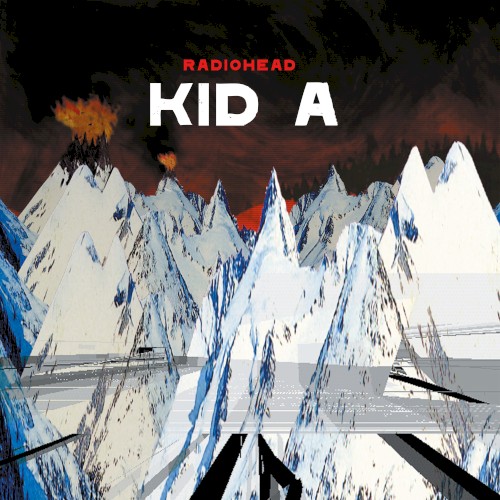 Kid Aalbum
- 2000released
- 4:44length
1999
a file in the sequencer
Thom Yorke does not remember writing it, and the title is just what a file on one of his sequencers was called. He told Select he simply came across the file one day, in a year when he had something like fifty things on the go at once and another hundred sitting in the sequencer, which drove the others mad and made him happy. Jake Kennedy of Record Collector was told it began around a computer program and was jammed over after that.
It was finished early. On 23 November 1999, with Nigel Godrich mixing, Ed O'Brien's diary said that of the six songs mixed only one was right, “kid a”, though Godrich knew what he wanted to do with the others. The entry went up on radiohead.com on 1 December, the first time the name appeared in the diary.
2000
the voice taken apart
It is the second track on Kid A, and the one that told anyone who had got past “Everything in Its Right Place” that the old Radiohead were not coming back. The disguise on Yorke's voice is an ondes Martenot, the early electronic instrument Jonny Greenwood brought to these sessions, and Marc Hogan at Vulture enjoyed the irony of the band's great leap into the future leaning on an instrument from the 1920s.
Brent DiCrescenzo's Pitchfork review opened on its skittering toy boxes and called it a vocoder lullaby. Simon Reynolds in Spin heard the wordless vocal melted down like something out of Dalí, and Kennedy picked out a skiffle beat under the artificial singing. At 2:53 the voice and the bass drop out, and the drums and synthesisers carry the rest of it upward on their own.
17 jun 2000
fréjus
It was first played at the Arènes de Fréjus, a Roman arena on the Riviera, on 17 June 2000, the same night as “You and Whose Army?”. NME described it as a piano-led piece about five minutes long, mostly without singing, and fans told the paper that Colin Greenwood played an old double bass on it.
That year it turned up only six times; the tours of 2003 and 2012 were where it settled, and in 2010 the band played it at the Oxfam benefit for Haiti at the Music Box in Hollywood. After the Wells Fargo Center in Philadelphia on 1 August 2018 the band left it alone for 2,665 days. Yorke got there first, playing it on his own at Spark Arena in Auckland on 25 October 2024, which Rolling Stone counted as his first solo performance of it, and the band brought it back at the Unipol Arena outside Bologna on 17 November 2025.
the words
the most vicious
The lyrics were not printed on the sleeve, and Yorke had not even explained them to the band. Andrew Smith of The Observer, on the road with them in Paris, got one line out of him about the title track, that its words were “the most vicious I've ever sung”. What can be made out takes in a lie, heads on poles and ventriloquists, a figure in the shadows by the bed and, near the end, the Pied Piper's exit from Hamelin.
the title
non-meaning
Smith asked whether the title was a nod to Carl Steadman's Kid A in Alphabet Land, a set of thirty trading cards that takes the ideas of the psychoanalyst Jacques Lacan letter by letter, also put on the web.
No. It just seemed to work. I think the best ones are usually like that.
thom yorke · the observer, 1 october 2000
He liked the non-meaning, because a specific title drives a record one way, and his favourite of the theories people had brought him was that some rogue scientist had already made the first cloned baby, and it was Kid A.
The 2003 version of this site was still wondering about the Steadman project on its lyric page, three years after Yorke had said no.
on stage
Live at Hultsfred, Sweden, June 2003, from a Swedish television broadcast.· phatashnikwatch on youtube →
the record(1)
on stage(9)
Live history
| Times played | 132 shows · 7 of them Thom Yorke solo shows |
|---|---|
| Live debut | Saturday 17 June 2000 · Frejus |
| Last played | Monday 15 December 2025 · Copenhagen |
| Longest absence | 7 years · back on Monday 17 November 2025 · Casalecchio di Reno |
Thom Yorke, solo 25 October 2024 Auckland, 30 October 2024 Melbourne, 15 November 2024 Tachikawa, 18 November 2024 Fukuoka, 21 November 2024 Nagoya, 23 November 2024 Tokyo, 26 November 2024 Kyoto
Nights played include broadcasts; opened and closed count gigs only. A cancelled night has no setlist. Thom Yorke’s solo nights are counted and marked as his; the openers, closers, longest absence and chart are Radiohead’s own. All setlist stats →
sources14
- Yoichiro Yamasaki and Erica Yamashita, “I don't want to be in a rock band any more”, Select, December 2000, for the sequencer and the fifty ideas.
- Wikipedia, “Kid A”, for the sequencer filename and Yorke's “non-meaning”.
- Jake Kennedy, “Kid A Rock”, Record Collector, November 2000, for the computer program and the skiffle beat.
- Ed O'Brien's studio diary on radiohead.com, 23 November 1999, posted on 1 December 1999 and kept on the 2003 treefingers.com lyric page (
_legacy/lyrics/songs/kid_a.txt), which also carries the Steadman guess. - Brent DiCrescenzo, “Kid A”, Pitchfork, 2 October 2000.
- Simon Reynolds, “Radio Chaos”, Spin, October 2000.
- Marc Hogan, “I Might Be Wrong: every Radiohead song, ranked”, Vulture, 28 March 2019, for the ondes Martenot.
- Evan Sawdey, in “Between the grooves of Radiohead's ‘Kid A’”, PopMatters, 2 October 2020, for the drop at 2:53.
- Andrew Smith, “Sound and fury”, The Observer, 1 October 2000, for the lyrics, the title and the clone.
- NME, “Radiohead's tangled web”, 19 June 2000, and Ed O'Brien's diary on radiohead.com, 18 June 2000, for the first night in Fréjus.
- Carl Steadman and Andra Brubaker, Kid A In Alphabet Land, electronic edition, as kept by No Subject: Encyclopedia of Lacanian Psychoanalysis (nosubject.com, read in the Internet Archive's copy of 14 July 2011), for what the cards were.
- Wikipedia, “Radiohead for Haiti”, for the benefit.
- Daniel Kreps, Rolling Stone, 26 October 2024, for Yorke's first solo performance in Auckland.
- Performance dates from this site's own setlist archive.