Song · OK Computer era (1996–98)
Fitter Happier
Fred, a stock voice on an Apple Macintosh, reads out Yorke's list, and Parlophone pasted the words up in tube stations.
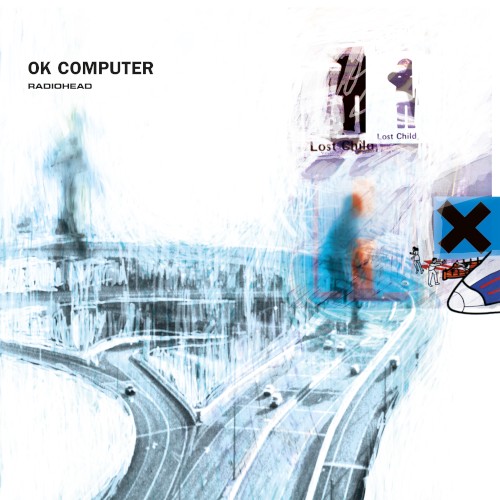 OK Computeralbum
- 1997released
- 1:57length
1996
ten minutes upstairs
Yorke had been stuck. He told Humo he had three months of writer's block in which the only thing he could produce was lists of words, and it took him a while to see that the lists were the way out. At St Catherine's Court he went upstairs while the others were playing and wrote this one, he told Select, in ten minutes.
Nigel Godrich was working in the library downstairs. Up in the house Stanley Donwood had been typing short stories into the Macintosh, having Fred read them aloud and sending the recordings to his dad, which everyone found hilarious. Then Yorke vanished for a few hours, came down, and played them what he had done.
Fuck. That's perfect.
nigel godrich · rolling stone, 16 june 2017
1996
fred
Fred is one of the synthesised voices that came with the Macintosh's SimpleText, running here on a Macintosh LC II, and he gets the stresses in the wrong places. Ed O'Brien, quoted on the 2003 site, thought that was the point: a computer stumbling over the words keeps them neutral, where Yorke reading them himself would have been pretentious. Yorke called handing the words over liberating. Plenty of listeners took the voice for Stephen Hawking's.
Around it is a small collage. The piano is Yorke's, off a Dictaphone recording made at home; O'Brien remembered it as a late-night rehearsal-room take, played drunk, which you can hear in the playing. Jonny Greenwood scored strings to fit it. Godrich supplied electronic noises from his own experiments, and Yorke added a loop of dialogue from Three Days of the Condor that he had taped off the television.
the words
a checklist
It is a list of 1990s aspiration, the gym and the diet and the better working relationships, which frays as it goes on. Yorke described the words as a checklist of slogans for the decade.
The most upsetting thing I've ever written.
thom yorke · melody maker, 31 may 1997
The last image, a caged pig on antibiotics, came from a book. Q named it as Jonathan Coe's What a Carve Up!, and Yorke told Rolling Stone it was the first time he had read about what farmers feed the animals we eat. Later he said he no longer stood behind the lyric, and listened to the piano part instead.
1997
the campaign
They thought about opening the album with it and decided it was too off-putting, so it sits seventh, between “Karma Police” and “Electioneering”. Parlophone then made it the face of the record: full-page advertisements in British newspapers and posters in tube stations, the words in big black type on white, and the same slogans on T-shirts. Yorke said the choice tied the artwork and the promotion to one set of concerns.
On the 1997 tour it was the tape the band walked on to. The archive has no night on which anybody performed it.
after
at ease
The first big Radiohead fan site, At Ease, took its name from the lyric shortly after the album came out. Menny More recorded it for the Easy Star All-Stars' Radiodread in 2006, with the words lightly reworked, by Radiohead's leave, to suit the style.
the video
The OK Computer recording.· naokiwanderingcatwatch on youtube →
Tabs (1)
sources10
- Andy Greene, “Radiohead's ‘OK Computer’: An Oral History”, Rolling Stone, 16 June 2017, for Godrich on Donwood, Fred and the collage, the Three Days of the Condor tape, and Yorke on the book.
- Andy Greene, “Inside ‘OK Computer’”, Rolling Stone, 31 May 2017, for the Macintosh LC II and the mispronunciations.
- Annie Zaleski, “Radiohead Deliver ‘OK Computer’'s Manifesto With ‘Fitter Happier’”, Ultimate Classic Rock, 15 May 2022, for Yorke in Humo on writer's block, his later view of the lyric, Q on Jonathan Coe, and the walk-on tape.
- Caitlin Moran, “I was feeling incredible hysteria and panic…”, Select, July 1997, via Wikipedia, “OK Computer”, for the ten minutes and “liberating”.
- Mark Sutherland, “Return of the Mac!”, Melody Maker, 31 May 1997, via Wikipedia, “OK Computer”, for “the most upsetting thing”.
- John Harris, “Renaissance Men”, Select, January 1998, via Wikipedia, “OK Computer”, for the opening-track decision, the shirts and Yorke on the campaign.
- Paul Cantin, “Radiohead's OK Computer confounds expectations”, Ottawa Sun, 19 October 1997, via Wikipedia, “OK Computer”, for the newspaper and tube advertisements.
- Wikipedia, “OK Computer”, for SimpleText (citing Randall) and At Ease (citing Jeremy Gordon, Pitchfork, 12 May 2016).
- Wikipedia, “Radiodread”, for the Menny More version and the altered lyrics.
- treefingers.com, the 2003 lyric page for “Fitter Happier”, for O'Brien on the neutral voice and the piano, the Hawking confusion and the tour.