Song · OK Computer era (1996–98)
Karma Police
A tour in-joke about cosmic punishment turned into a song against bosses.
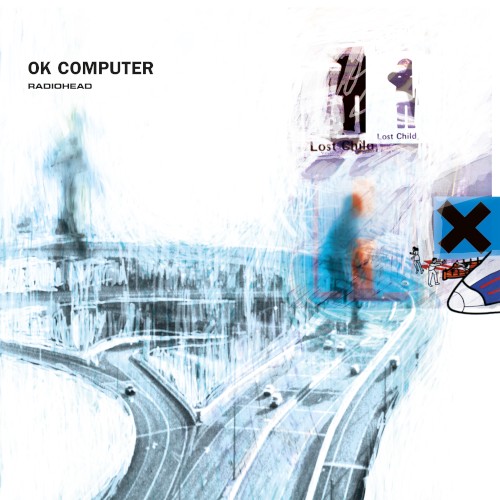 OK Computeralbum
- 1997released
- 4:21length
1995–96
the joke that came first
The title came off the road. On the tour behind The Bends, whenever one of them behaved badly, someone would say the karma police would catch up with him sooner or later. Jonny Greenwood put it plainly: “whenever someone was behaving in a particularly shitty way, we'd say ‘The karma police will catch up with him sooner or later.’”
Yorke kept the phrase and wrote a threat around it. He said the song was about stress, about “having people looking at you in that certain [malicious] way”, and both he and Greenwood were careful to say it was funny and not entirely serious.
It's for someone who has to work for a large company. This is a song against bosses. Fuck the middle management!
thom yorke · the independent, 15 september 2006
1996–97
acoustic guitar, piano, and a key that will not settle
Acoustic guitar and piano carry it. The key is ambiguous and keeps moving: the verse reads as either A natural minor or A dorian, or as E natural minor sliding into E phrygian; the chorus is in G major; the coda can be heard in B minor or in D major. The piano figure is close enough to “Sexy Sadie” that the comparison has followed the song since 1997.
Two verses alternate with a subdued break, the pattern runs twice, and then the song abandons it for the section built on “For a minute there, I lost myself”. Yorke's voice goes through reverb with a sliding figure moving against it.
The last minute is Ed O'Brien driving a delay into self-oscillation and then lowering the delay rate, which melts the sound down. Yorke told Nigel Godrich he hated the ending as it stood, and the two of them rebuilt it out of loops and samples.
It was the first time we did anything like that. Just us in the studio, and a forerunner of a lot of things to come, good and bad.
nigel godrich · rolling stone, 31 may 2017
the words
fridge buzz
“He buzzes like a fridge / He's like a detuned radio” is background noise made into a person: the “fridge buzz” Yorke kept returning to across OK Computer. The closing line was picked up rather than written.
It's so ironic that for years people would write about the way I wrote lyrics as if it's like some deep heartfelt thing. It's fucking not at all. It's like collage. It's just walking down the street and experiencing something and thinking, ‘What would that be like if I stuck that in your face?’
thom yorke · financial times, 30 august 2023
Yorke said he probably heard “Phew, for a minute there I lost myself” on television.
25 aug 1997
released
It came out in Britain on 25 August 1997 as the second single from OK Computer, on two CD singles and a 12-inch, and reached number eight. American modern rock radio got it on 13 October; five months later it peaked at 14 on the Billboard Modern Rock Tracks chart. It went to number one in Iceland. In March 2010, nearly thirteen years late, it turned up at 15 on the Danish singles chart.
Early versions surfaced in 2019 on the hacked minidisc archive released as MiniDiscs [Hacked].
1997
a man, a road, a trail of petrol
Jonathan Glazer directed the video, having already made “Street Spirit (Fade Out)”. It is shot from the driver's seat of a car chasing a man down a dark road, Yorke in the back. The man falls, the car reverses, the trail of leaking fuel becomes visible, he lights it with a book of matches, Yorke vanishes and the car burns.
Glazer had pitched the idea to Marilyn Manson first, who wanted something closer to Lost Highway and turned it down; the commissioner Dilly Gent passed it to Radiohead. The running man was the Hungarian actor Lajos Kovács, who cramped so badly during the running shots that he needed injections in his leg to keep going, and burnt his thumb raw lighting matches behind his back take after take.
It won Best Direction at the 1997 MTV Video Music Awards. Glazer's own verdict, four years on, was that it had failed.
Because I decided to do a very minimalist, subjective use of camera, and tried to do something hypnotic and dramatic from one perspective, and it was very hard to achieve and I feel that I didn't achieve it.
jonathan glazer · indiewire, 12 june 2001
1996–2025
the closer
It arrived on stage before the record did, in Mansfield on 14 August 1996, and has stayed. Sixty-eight performances in 1997 alone. The archive counts 354 nights, and it has closed a show sixty-nine times, which is most of what you need to know about what it does to a room.
after
other people's hands
AllMusic called it “haunting, mystifying, and exquisite” and “one of the cornerstones of one of the greatest albums of the '90s”. Rolling Stone placed it at 279 in its 500 greatest songs of all time in 2021 and again in 2024. The Guardian ranked it the fifth-best Radiohead song in 2020, calling it “an enduringly odd superhit: at once relatable, inscrutable and chilling”. Pierce the Veil covered it for Triple J in 2023 while touring Australia.
the video
The promo, directed by Jonathan Glazer.· Radioheadwatch on youtube →
takes(3)
explained
Why listeners disagree about whether it is in E minor or A minor.· David Bennett Music Theorywatch on youtube →
videos(2)
Live history
| Times played | 354 shows |
|---|---|
| Live debut | Wednesday 14 August 1996 · Mansfield |
| Last played | Tuesday 16 December 2025 · Copenhagen |
| Closed the night | 69 times |
| Longest absence | 7 years · back on Tuesday 4 November 2025 · Madrid |
Nights played include broadcasts; opened and closed count gigs only. A cancelled night has no setlist. All setlist stats →
Tabs (4)
Heard in (1)
- InvincibleOpens the episode as Mark flies through the city on rescues.
sources12
- Mark Sutherland, “Return of the Mac!”, Melody Maker, 31 May 1997.
- Mac Randall, Exit Music: The Radiohead Story, pp. 223–224, 248.
- Tim Footman, Radiohead: Welcome to the Machine, pp. 79, 140, 144–147.
- Robert Webb, “Story of the Song: ‘Karma Police’”, The Independent, 15 September 2006.
- Andy Greene, “Inside OK Computer”, Rolling Stone, 31 May 2017.
- Ryan Dombal, “This is what you get: an oral history of Radiohead's ‘Karma Police’ video”, Pitchfork, 21 March 2017.
- “Interview: Shooting the ‘Beast’”, IndieWire, 12 June 2001.
- Ludovic Hunter-Tilney, “A Thom Yorke painting: yours for a song”, Financial Times, 30 August 2023.
- Steve Huey, “Karma Police”, AllMusic.
- Guy Capuzzo, “Sectional Tonality and Sectional Centricity in Rock Music”, Music Theory Spectrum.
- “New Releases: Singles”, Music Week, 23 August 1997.
- Jazz Monroe, “Radiohead's 40 greatest songs, ranked!”, The Guardian, 23 January 2020.