Song · Kid A / Amnesiac era (2000–01)
Packt Like Sardines in a Crushd Tin Box
Clanking percussion, a laptop noise Colin Greenwood spells as a word, and Yorke's voice pushed through Auto-Tune until it goes nasal.
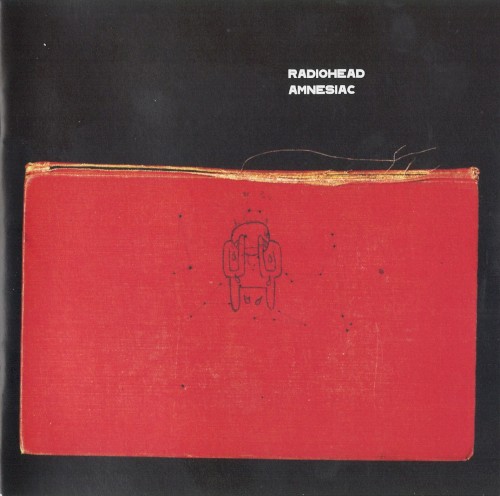 Amnesiacalbum
- 2001released
- 4:00length
2000
thom's laptop
Three weeks before Amnesiac came out, Colin Greenwood sat down at EMI's Brook Green offices in London with Kodwo Eshun for an A to Z interview, and under D for distortion he explained where the track's harshest sound came from.
The kkkurrghh from Packt Like Sardines, that's from Thom's laptop.
colin greenwood · culture lab, may 2001
The band had compressed loops that had gone wrong and kept them. Further down the alphabet Colin said the fuzz bass he plays on it, and on “Exit Music (For a Film)”, comes from his love of the bass player in Curtis Mayfield's band.
The voice was treated too. Simon Reynolds, interviewing Yorke and Jonny Greenwood for The Wire in July 2001, reported that they ran the vocal through Auto-Tune, the pitch-correction software, to get a nasal, depersonalised sound (Wikipedia's Amnesiac article carries his account; the piece itself is behind a subscription).
2001
the dial tone
It opens Amnesiac, and Fricke's Rolling Stone preview of 24 May 2001 joked that American fans putting the record on might wonder whether they had got a dial tone, what with the clanging percussion and a pulse that builds into a smear of synth noise. He also caught what separated it from Kid A. Once Yorke comes in, the words are clear and irritated, and O'Brien told him the new album put the vocals up front so the songs engaged you.
Jon Pareles, in the same magazine five days later, heard a man going over a wasted life, set to a would-be dance record crushed down to small metallic noises and then spoiled on purpose with dissonance.
Alexis Petridis in The Guardian on 1 June set the two openers side by side and chose this one by a distance. “Everything in Its Right Place” he dismissed as a doodle. This, he wrote, was “sharp, articulate and riven with paranoia”, and he noted that Yorke had recently implied he was being watched by MI5.
2001
funk at bray
Before the American tour the band ran through nearly thirty songs on a soundstage at Bray Studios, and Fricke was there. On that stage the quiet record grew into something close to funk, a krautrock groove with Stones-style guitar crashing over it.
It was first played on 28 April 2001 in a Canal+ studio in Paris, 26 nights that year in all, the last of them at the Parkbühne Wuhlheide in Berlin on 11 September 2001. Then nothing for 3,838 days, until one night in Glendale on 15 March 2012. That makes 27, and it never opened or closed a show.
on stage
Live at Glendale Arizona 3/15/12.· CWhippwatch on youtube →
takes(2)
Live history
| Times played | 27 shows |
|---|---|
| Live debut | Saturday 28 April 2001 · Paris |
| Last played | Thursday 15 March 2012 · Glendale |
| Longest absence | 10 years · back on Thursday 15 March 2012 · Glendale |
Nights played include broadcasts; opened and closed count gigs only. A cancelled night has no setlist. All setlist stats →
Tabs (1)
sources6
- Kodwo Eshun, “The A–Z of Radiohead” (interview with Colin Greenwood), Culture Lab, British Council, May 2001, for the laptop noise and the fuzz bass.
- Wikipedia, “Amnesiac (album)”, for Simon Reynolds, “Walking on thin ice”, The Wire, July 2001, on the Auto-Tune vocal.
- David Fricke, “Radiohead warm up with Amnesiac”, Rolling Stone, 24 May 2001, for the dial tone and O'Brien on the vocals.
- David Fricke, “Radiohead: making music that matters”, Rolling Stone, 2 August 2001, for the Bray rehearsal.
- Jon Pareles, review of Amnesiac, Rolling Stone, 29 May 2001.
- Alexis Petridis, “Relax: it's nothing like Kid A”, The Guardian, 1 June 2001.