Radiohead studio album · Kid A / Amnesiac era (2000–01)
Amnesiac
The other half of the Kid A sessions, dressed as a lost library book and sold, this time, with singles.
the sessions
- Mar 1999Medley, Copenhagen“Knives Out” begun; “Dollars and Cents” grows from a jam
- Dec 1999Radiohead's studio, OxfordshireYorke and Selway tape “Egyptian Song”, later “Pyramid Song”
- 4 Feb 2000Dorchester Abbey, OxfordshireOrchestra of St John's records Jonny Greenwood's string parts
- 20 Mar 2000Radiohead's studio, Oxfordshire“Knives Out” finished after 373 days
- Feb 2001Gateway Mastering, Portland, MaineThe album is mastered
- Mar 2001Plush, AustinSix tracks played to journalists at South by Southwest
- 21 May 2001UK“Pyramid Song” released as the first single
- 4 Jun 2001UKParlophone release; Capitol follows in America next day
- 18 Jun 2001The Woodlands, TexasFirst North American tour in three years opens
- 7 Jul 2001South Park, OxfordHomecoming show for over 42,000, Lyttelton on the bill
1999
two days in a room
By the end of 1999 Radiohead had nearly 50 pieces of music from a year of recording with Nigel Godrich, much of it unfinished, and a meeting to decide what to do with it. Phil Selway told Rolling Stone the band were split for two days. Thom Yorke wanted a double album that would clear the decks of three years' work. Selway thought a double would be unpalatable, and Ed O'Brien sided with him.
I think OK Computer was a song too long.
ed o'brien · rolling stone, 24 may 2001
He put the right length for their music at about 45 minutes. Amnesiac runs a little under 44. Jonny Greenwood, on KCRW in October 2000, said there was an arrogance in double albums.
Yorke later gave his own reason in an email to Greg Kot of the Chicago Tribune. Put back to back, he said, the two records cancelled each other out, and releasing the songs as a run of EPs had been considered and dropped as a dodge. Twenty years on, Chris DeVille of Stereogum thought the split the right call: Kid A is a closed system, and this is a collection.
They are separate because they cannot run in a straight line with each other.
thom yorke · chicago tribune, 31 july 2001
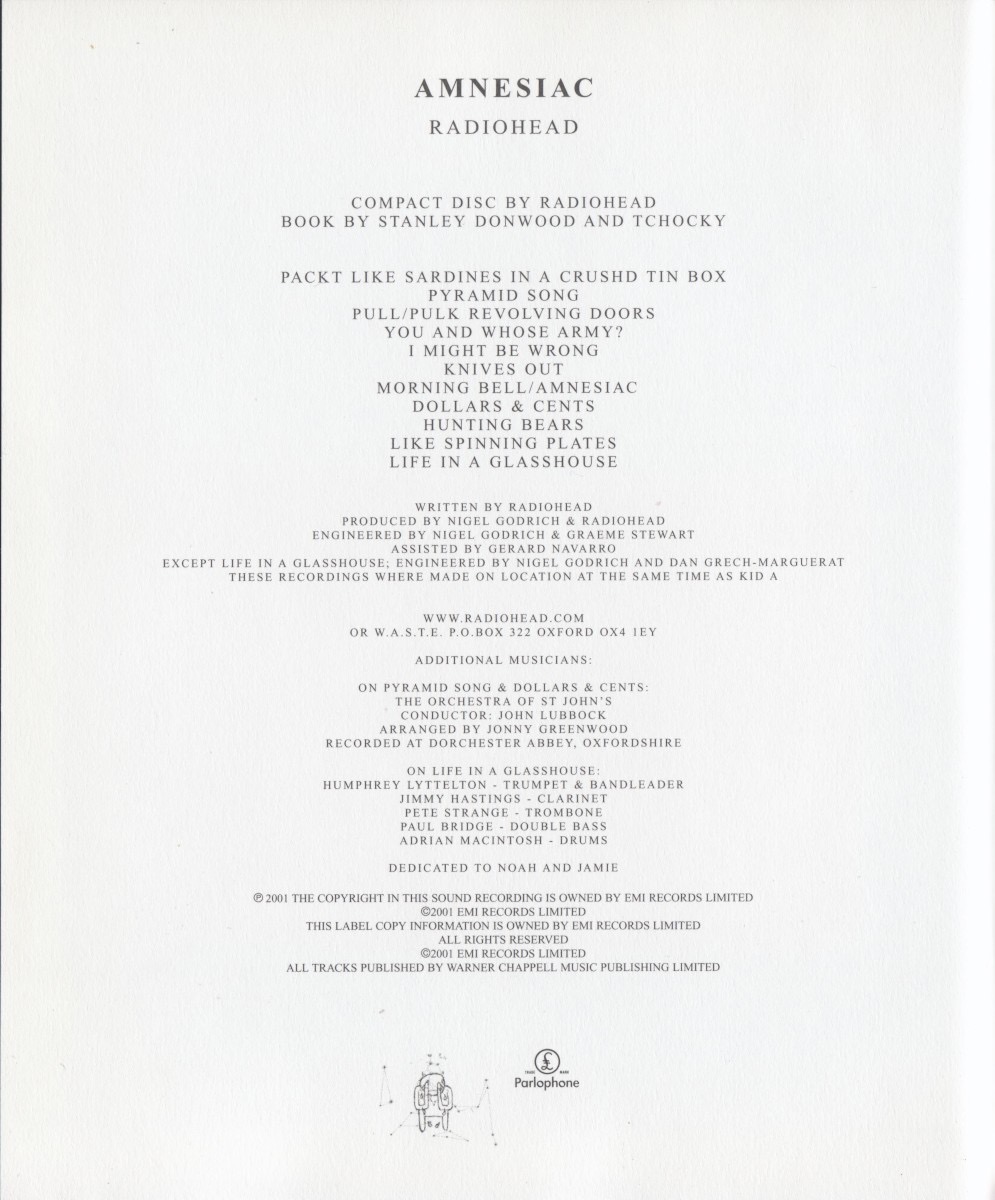
The sleeve of the special edition settles where the songs came from in one line, typo and all: these recordings “where made on location at the same time as Kid A”.
1999–2000
paris, copenhagen, an abbey
The rooms are Kid A's rooms: Guillaume Tell in Paris, Medley in Copenhagen in March 1999, Batsford Park, then the converted barn in Oxfordshire that the band's managers had set up for them with no deadline. David Fricke's reporting for Rolling Stone put the second day in Copenhagen as the day “Knives Out”, “Dollars and Cents” and the first “Morning Bell” went down. Two of those three are on Amnesiac.
Ed O'Brien's diary, posted on the band's site and mirrored here, catches the record being made a song at a time. In December 1999 Yorke and Selway nailed a version of the song then called “Egyptian Song”, and Yorke called it the best thing the band had ever committed to tape. On 20 March 2000 O'Brien described a line drawn on the studio board, finished tracks above it and nearly finished below, level for the first time. In April he wrote that recording would be done in a couple of days, and joked that if the band ran true to form nobody would hear any of it until the autumn of 2001. It was out by June.
The strings came on Friday 4 February 2000. John Lubbock conducted the Orchestra of St John's, of Smith Square, in Jonny Greenwood's parts at Dorchester Abbey, a 12th-century church about five miles from the studio. The sleeve credits them on “Pyramid Song” and “Dollars and Cents”. O'Brien set the day against the strings for OK Computer, recorded at Abbey Road, where Greenwood's unusual ideas had been waved away. At Dorchester the players tried them, and at the end Lubbock handed Greenwood the baton.
the whole session was the complete antithesis to the ok computer experience
ed o'brien · ed's diary, 4 february 2000
Godrich engineered with Graeme Stewart, assisted by Gerard Navarro; “Life in a Glasshouse”, made with Humphrey Lyttelton's band, was engineered by Godrich and Dan Grech-Marguerat. Selway heard two frames of mind in the sessions, the old way of five people playing in a room against music manufactured in the studio, and thought Amnesiac came out stronger as band arrangements. By February 2001 the record had been mastered at Gateway Mastering in Portland, Maine, with Bob Ludwig credited.
2000–01
the finished record nobody had heard
Amnesiac was done long before anyone could buy it. On the Kid A tour Yorke kept playing it on his laptop, officially to work out a running order. He admitted on the band's message board in January 2001 that the real reason was the pleasure of owning something nobody else had heard. He told The Big Issue that month the record had been finished for six months. Kid A's cover, he said, was a fire seen from far off, and Amnesiac was what it felt like to be standing in it.
The name surfaced on 11 December 2000, the night Radiohead recorded a Radio 1 session and three of them played records on Breezeblock. Yorke explained it online on 30 January 2001: he had read that the Gnostics believed birth makes us forget where we came from, so that we can survive arriving. A song list on the band's site that January had something called “Po Pad” opening the record, by Rolling Stone's reading. No song of that name is on it. On 28 February a fan on the message board asked when the running order would be made public, and Yorke typed it out in reply.
He had already said June at the earliest. The artwork was unfinished, there was film to make, and a record needed at least four months of working through the industry to get a fair hearing. By his own sums the band had made about two minutes of finished music a month since OK Computer, which he called a pretty shit turnout.
2001
a red book on a black ground
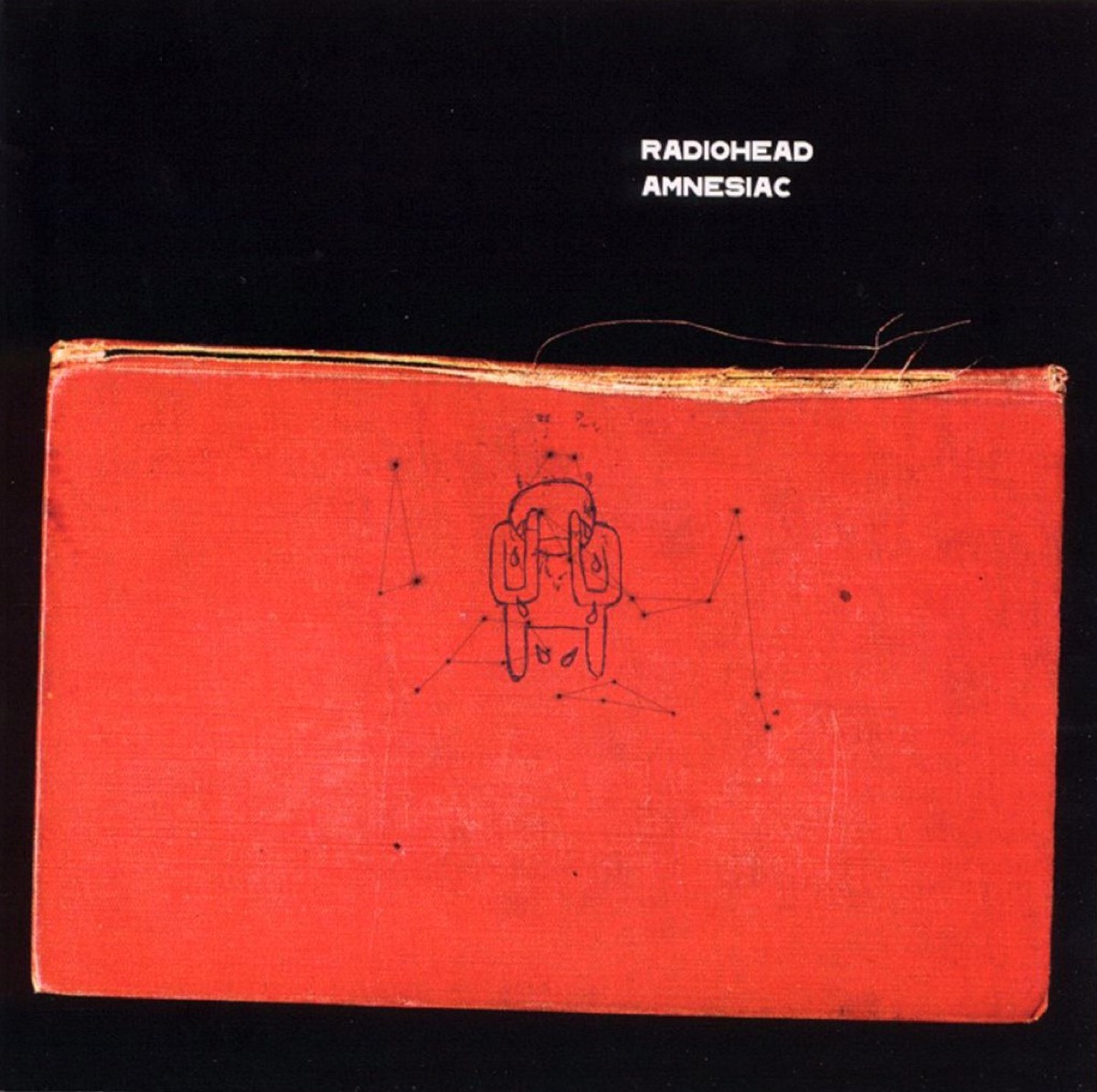
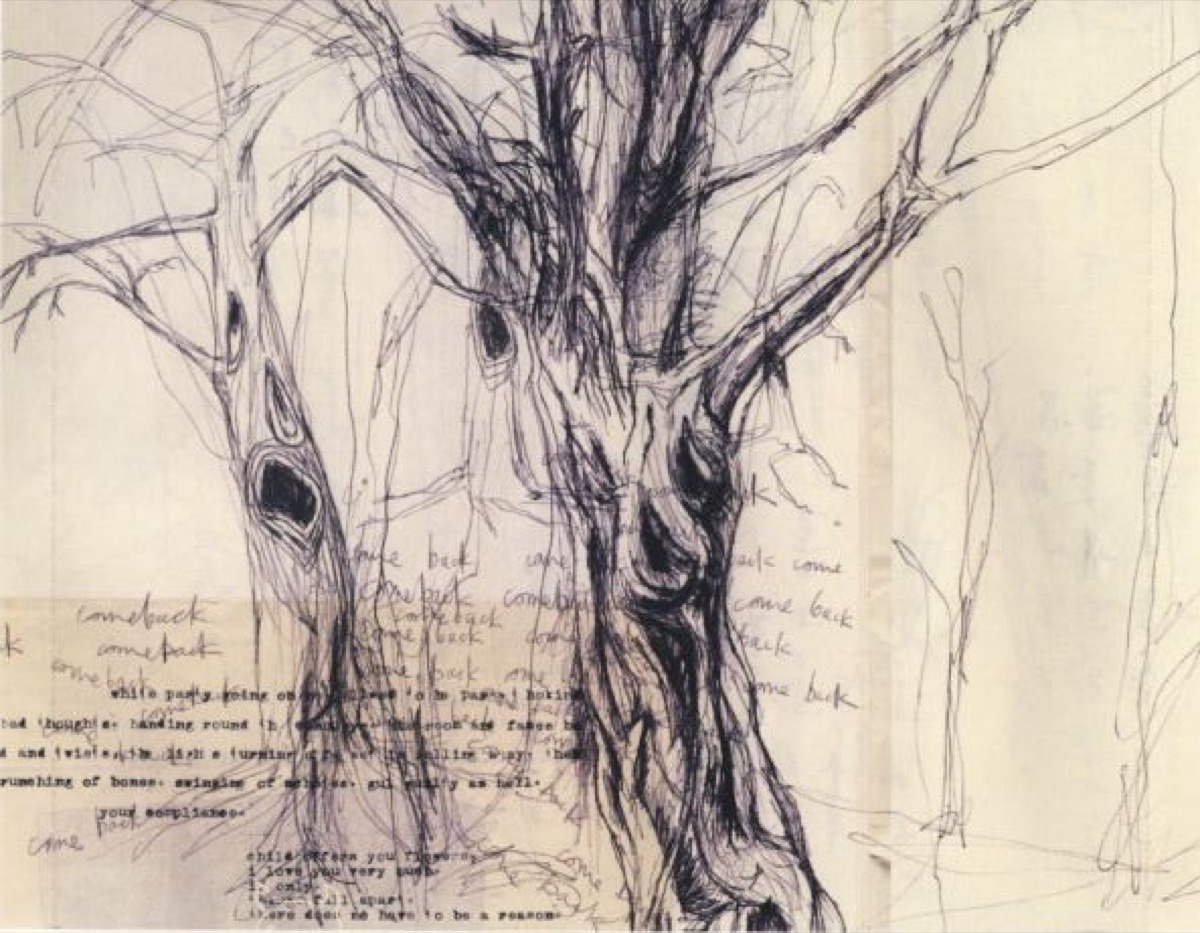
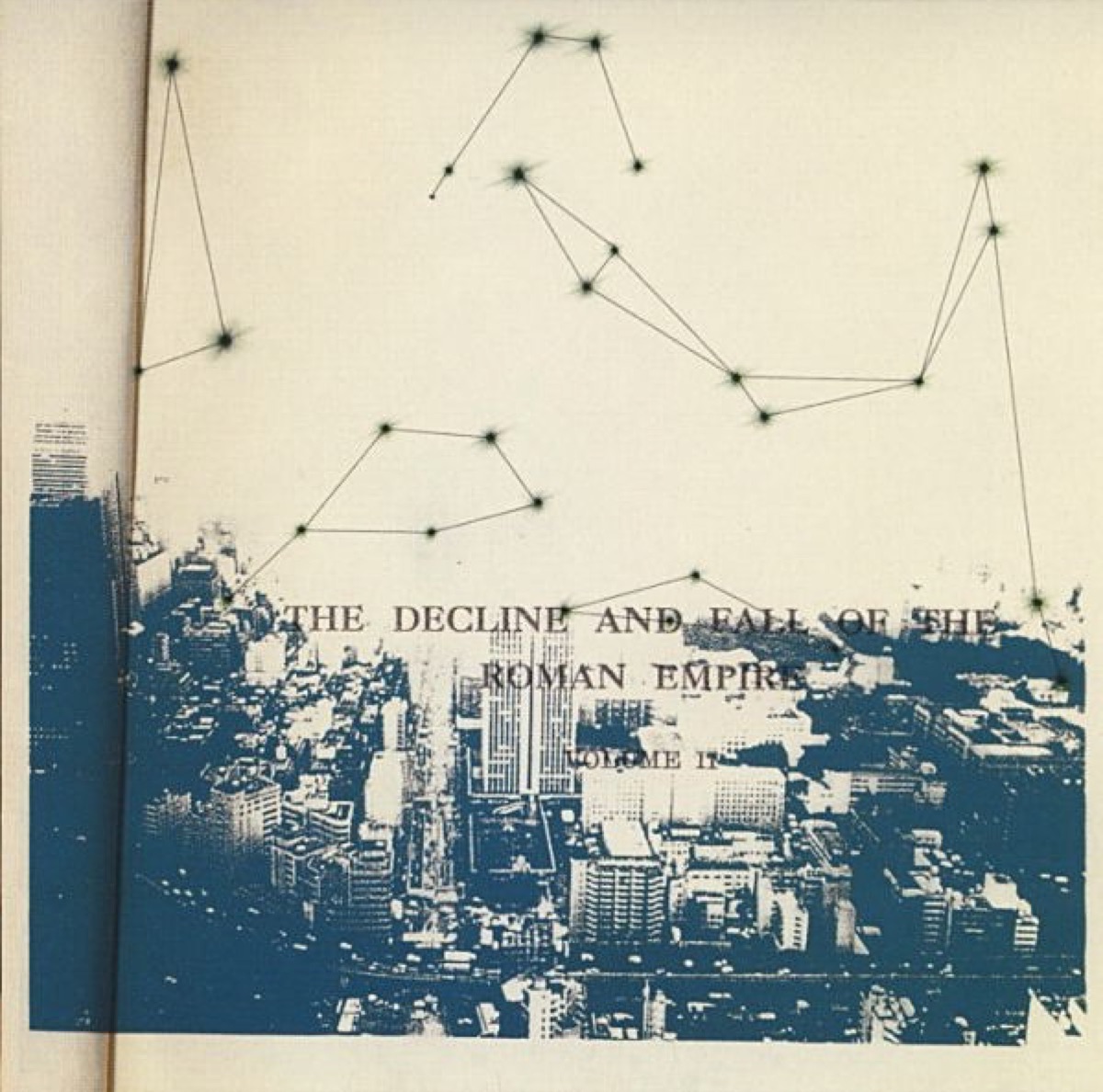
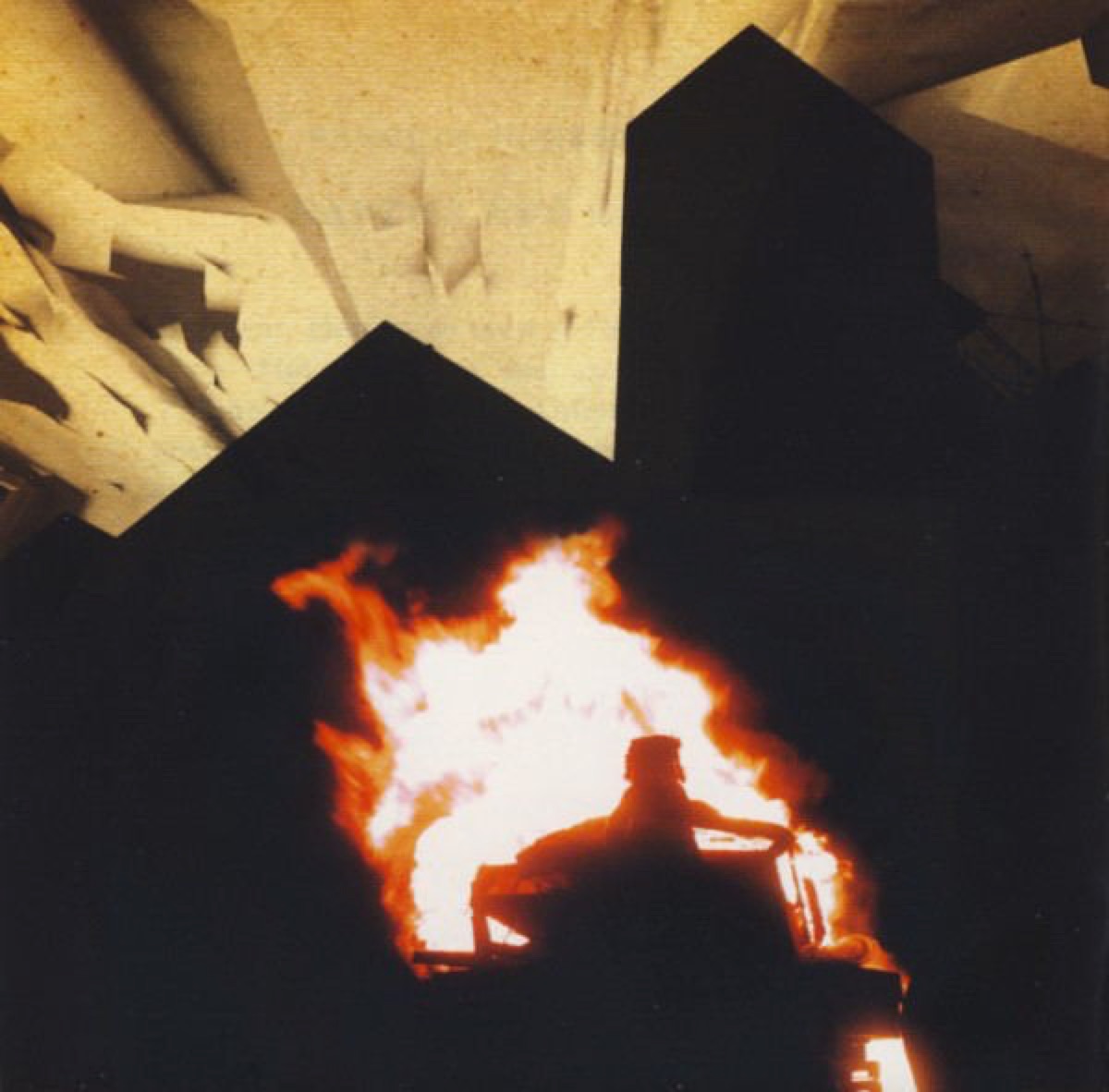
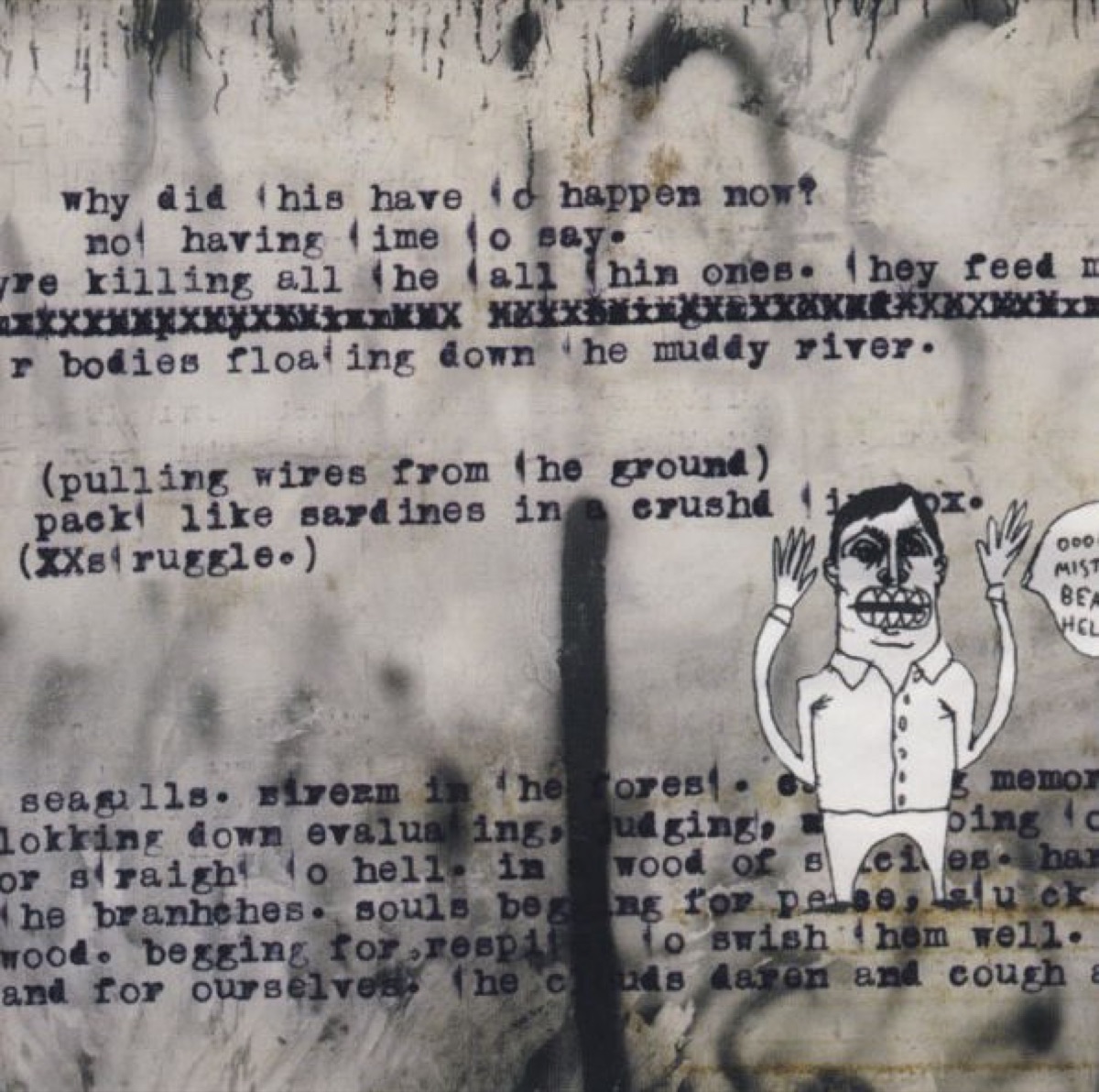
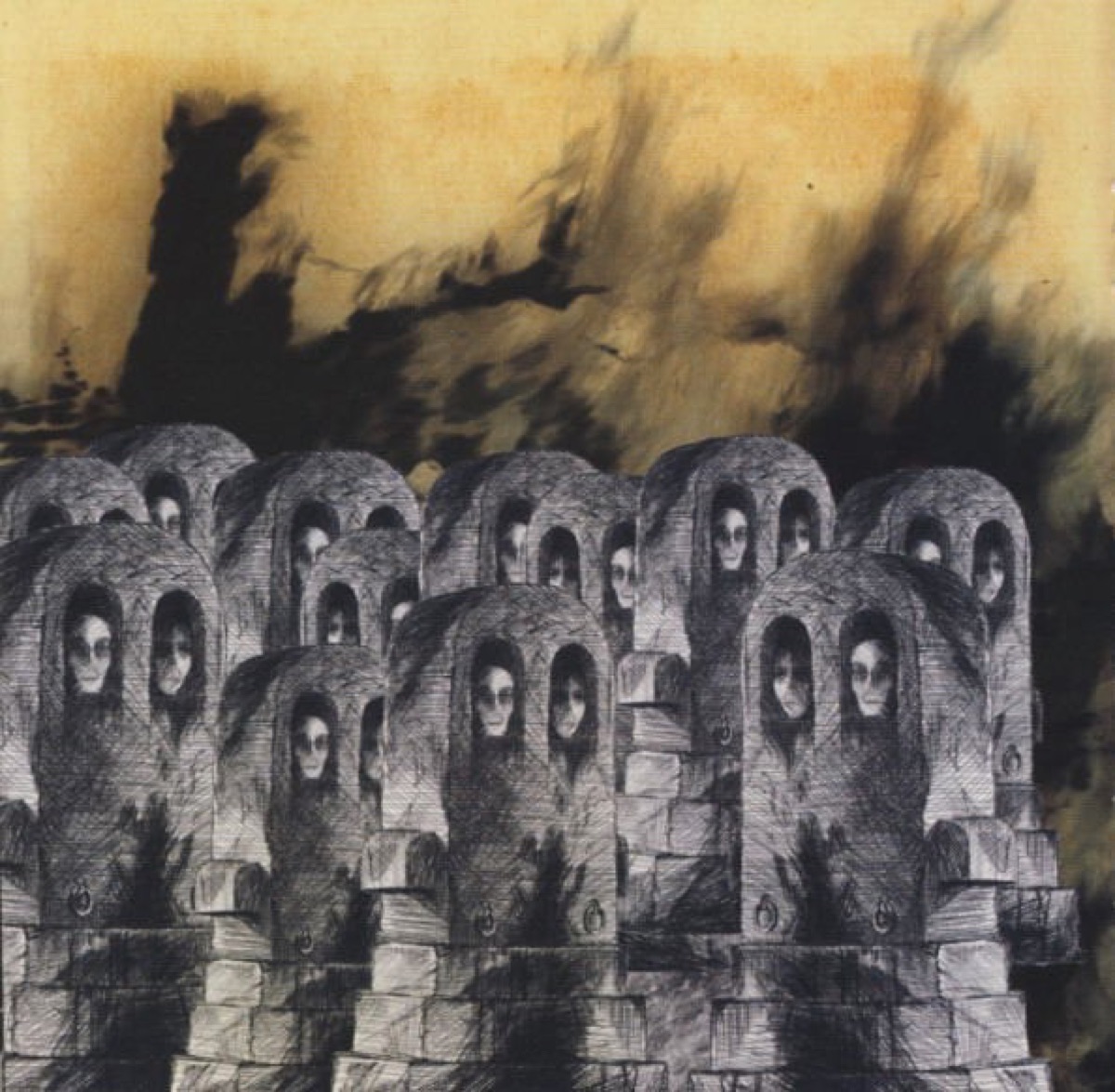
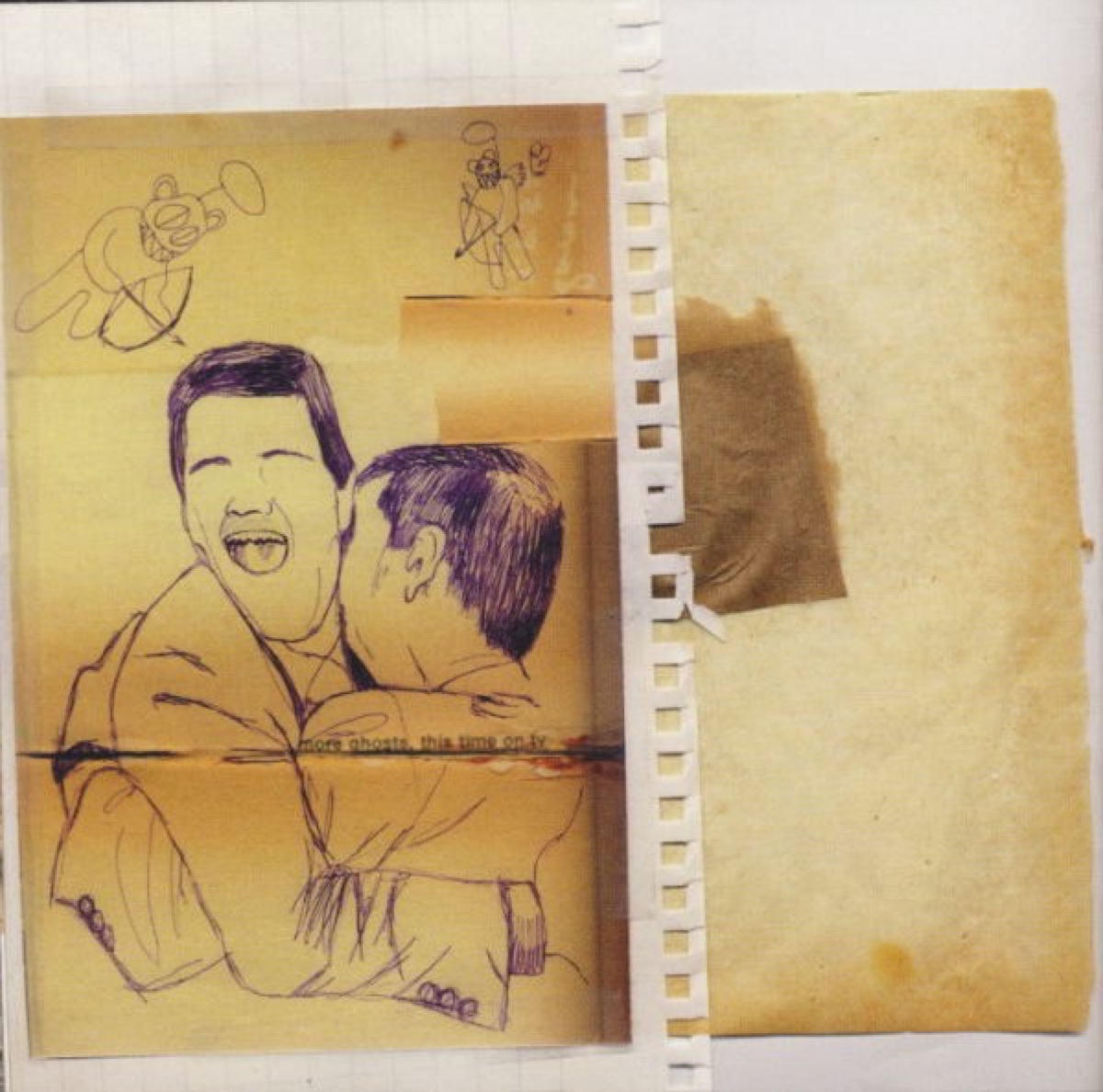
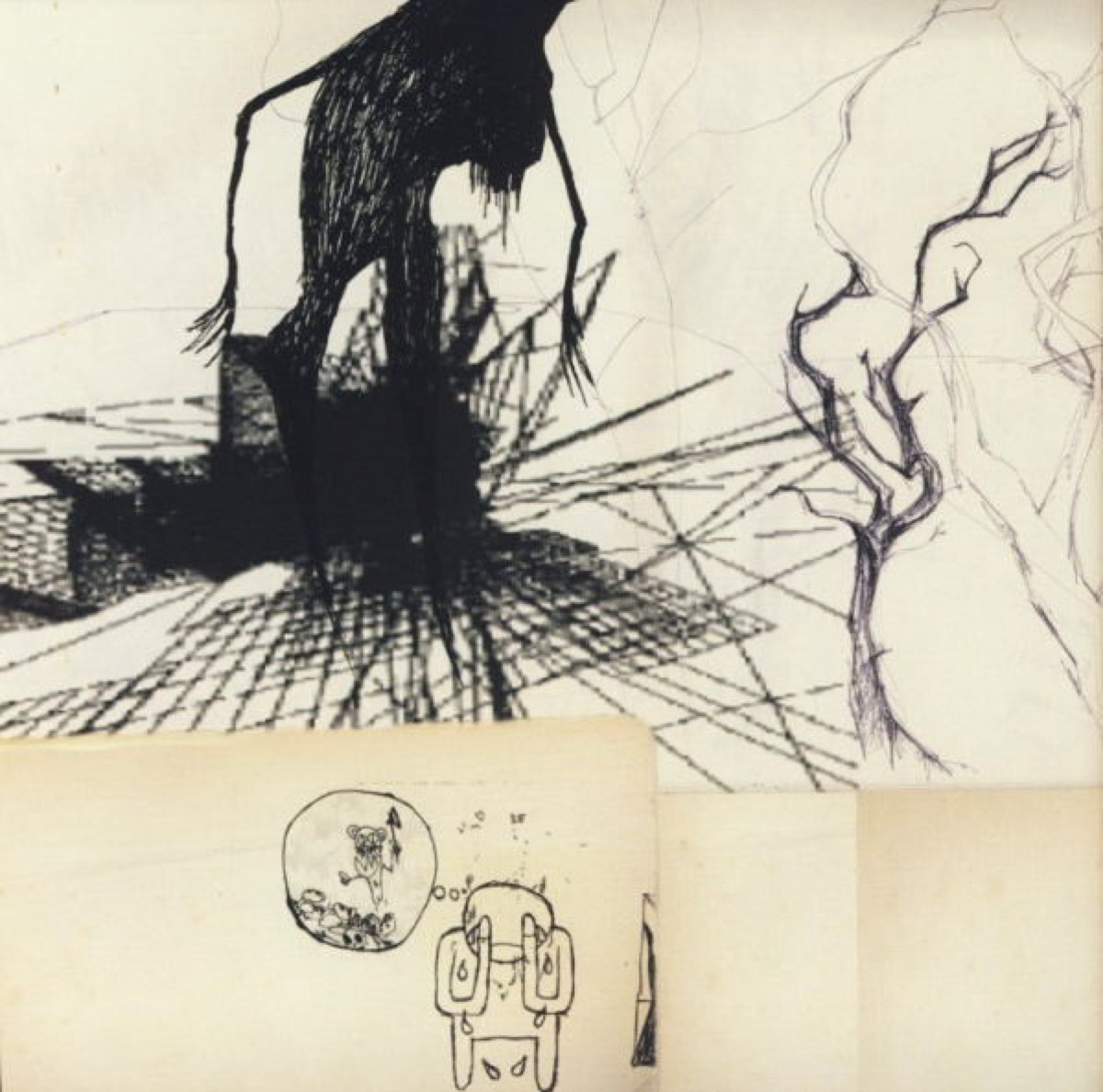
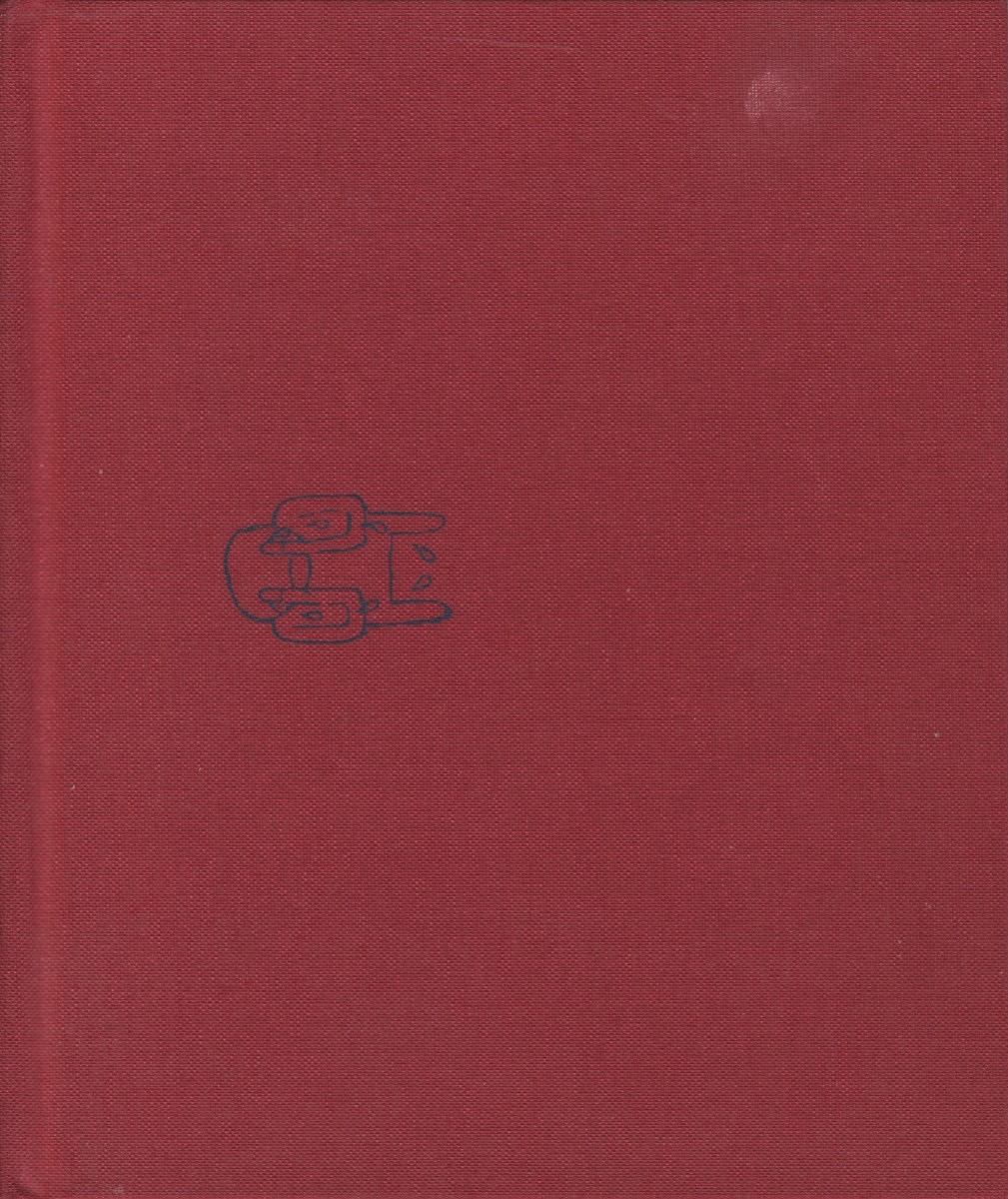
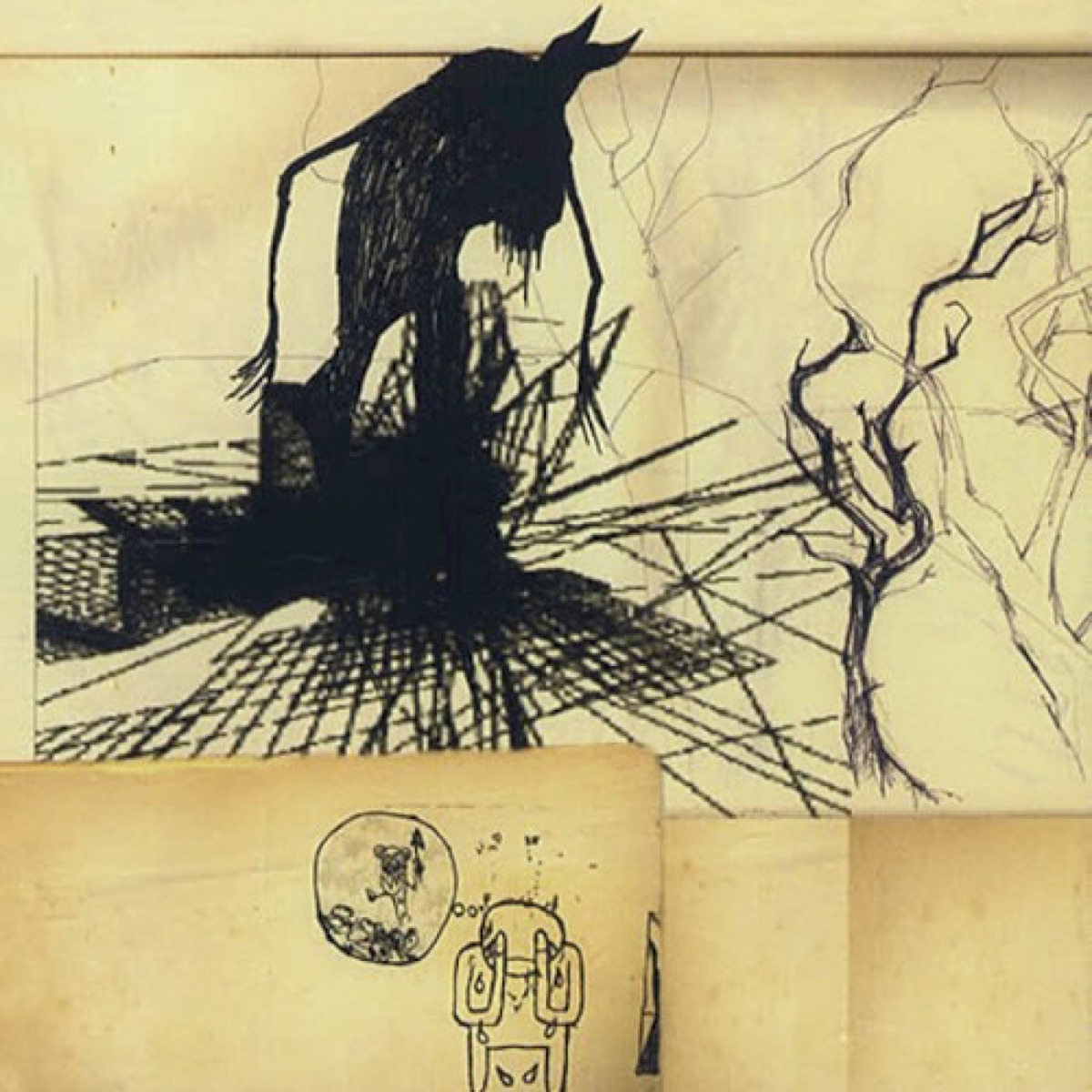
The cover is a photograph of a worn red clothbound book, threads hanging from its spine, a small weeping figure drawn on it in pencil. NME described it on 2 April 2001, the day the band posted it, as a creature hiding its eyes behind its own limbs. Stanley Donwood made the artwork with Yorke, credited as Tchocky, and has said the figure is a minotaur. He spent the period walking London taking notes, came to think of the city as a labyrinth, and borrowed from Piranesi's Imaginary Prisons. Wikipedia's account, drawn from Donwood's 2019 book, has him scanning blank pages from old books and laying over them fireworks, Tokyo tower blocks, Piranesi and lyrics typed by Yorke on a broken typewriter. Yorke told The Big Issue in January 2001 that a faulty photocopier was making the sleeve.
Amnesiac was songs that had been left in a drawer in an old dusty chest of drawers that had been left in an attic.
stanley donwood · the guardian, 4 november 2021
In the booklet the minotaur shares the pages with typed lyrics, a burning tower block, hooded rows of figures and two men in suits embracing. Yorke described the creatures in 2021 as the false voices that battled the band while they worked, faceless terrorists and self-serving politicians among them.
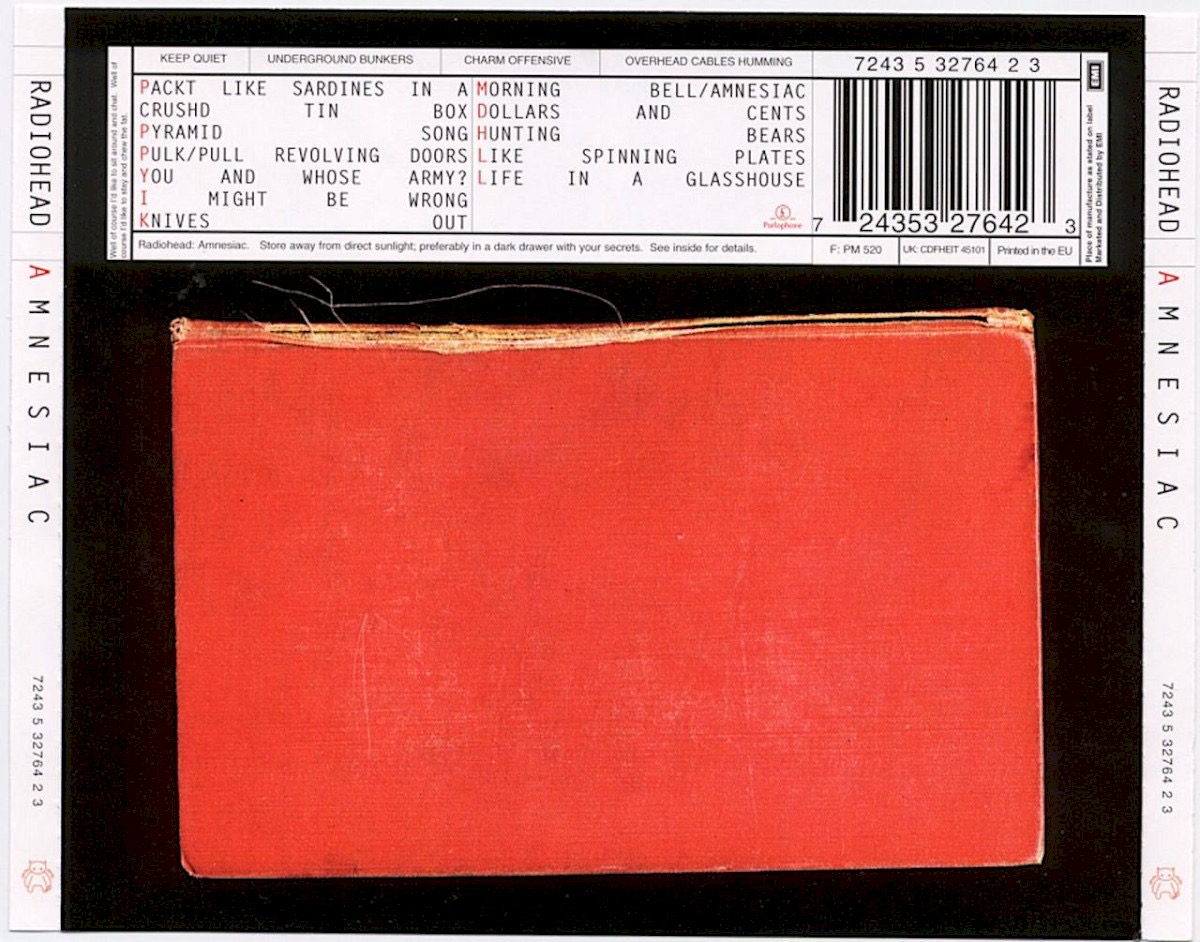
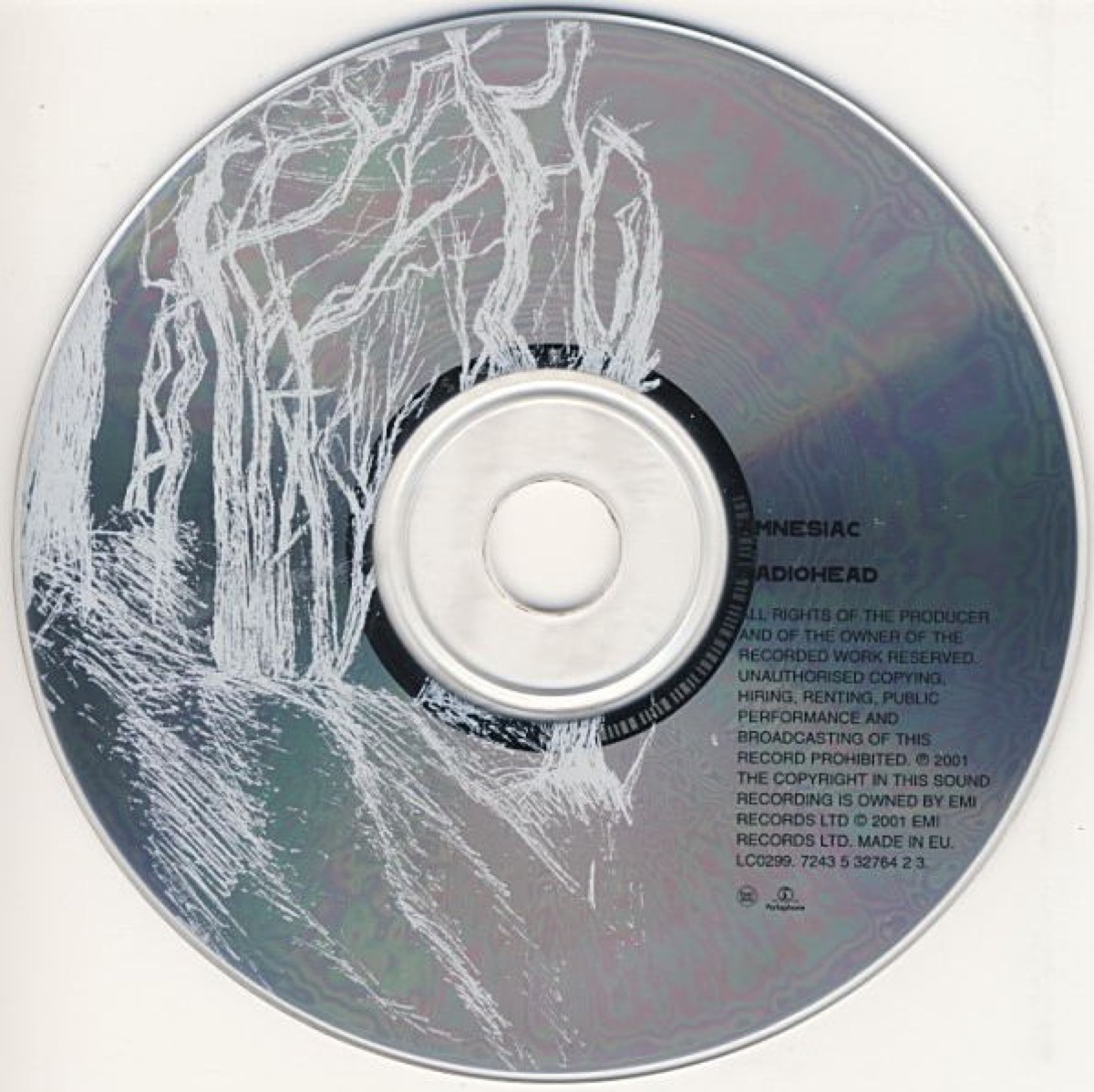
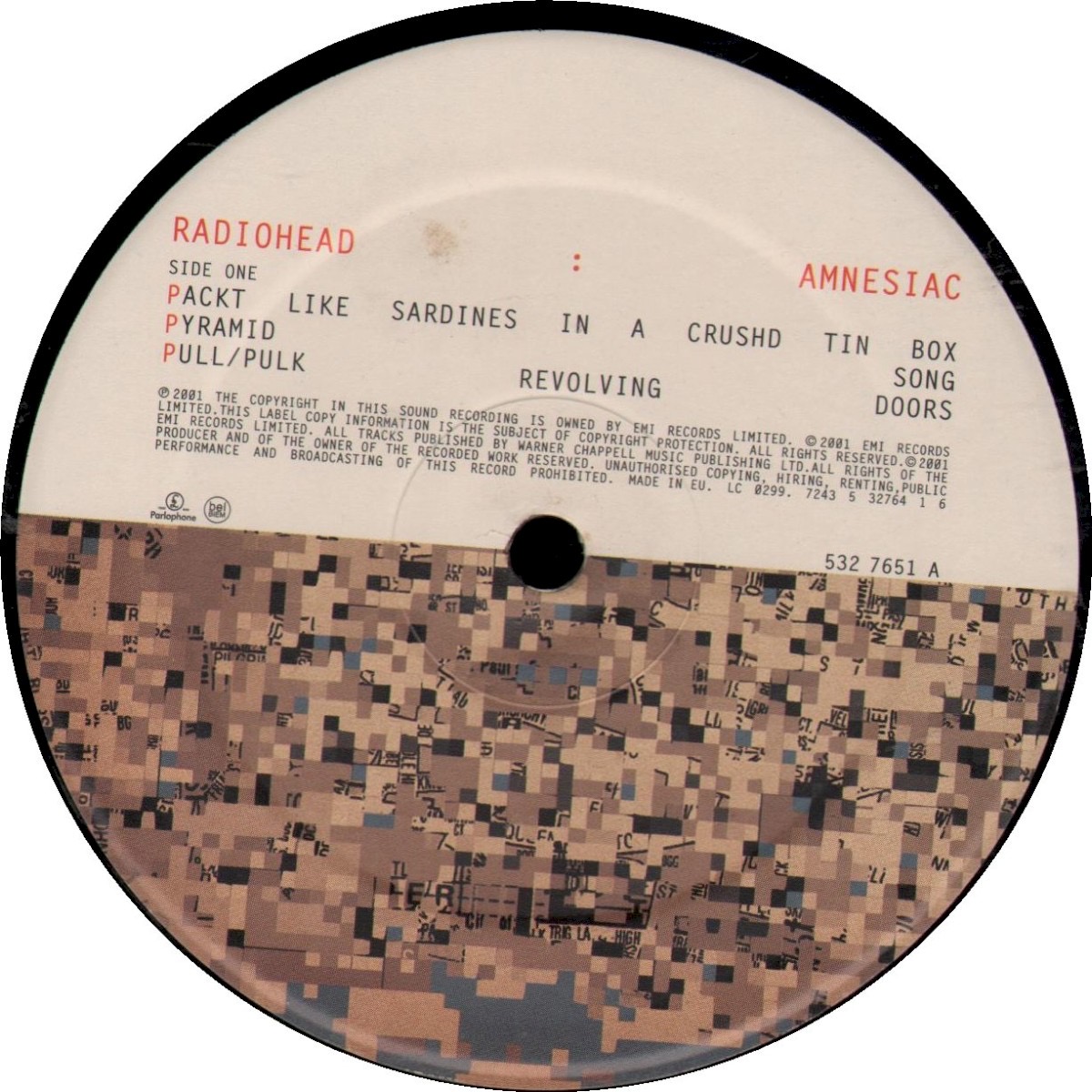
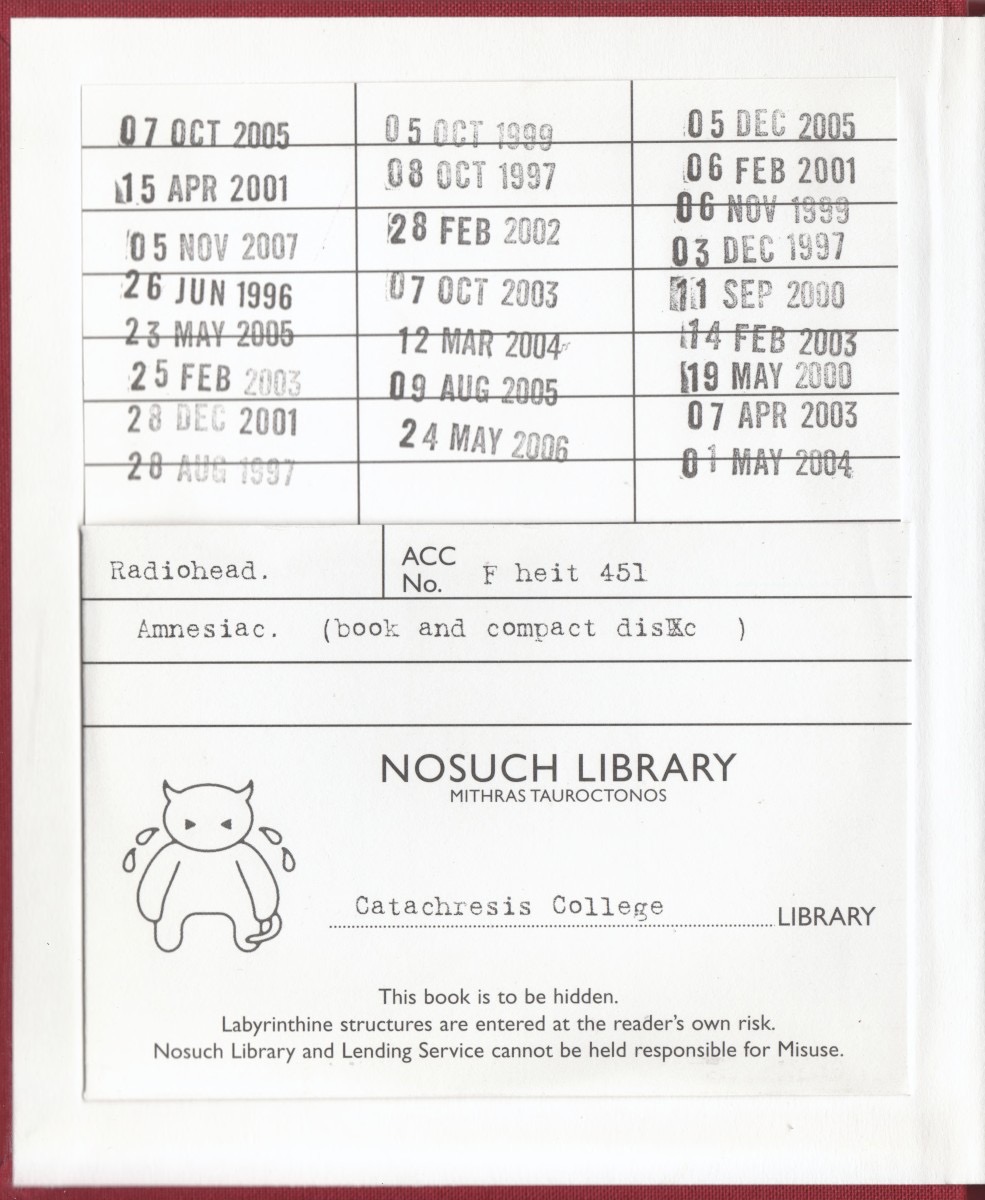
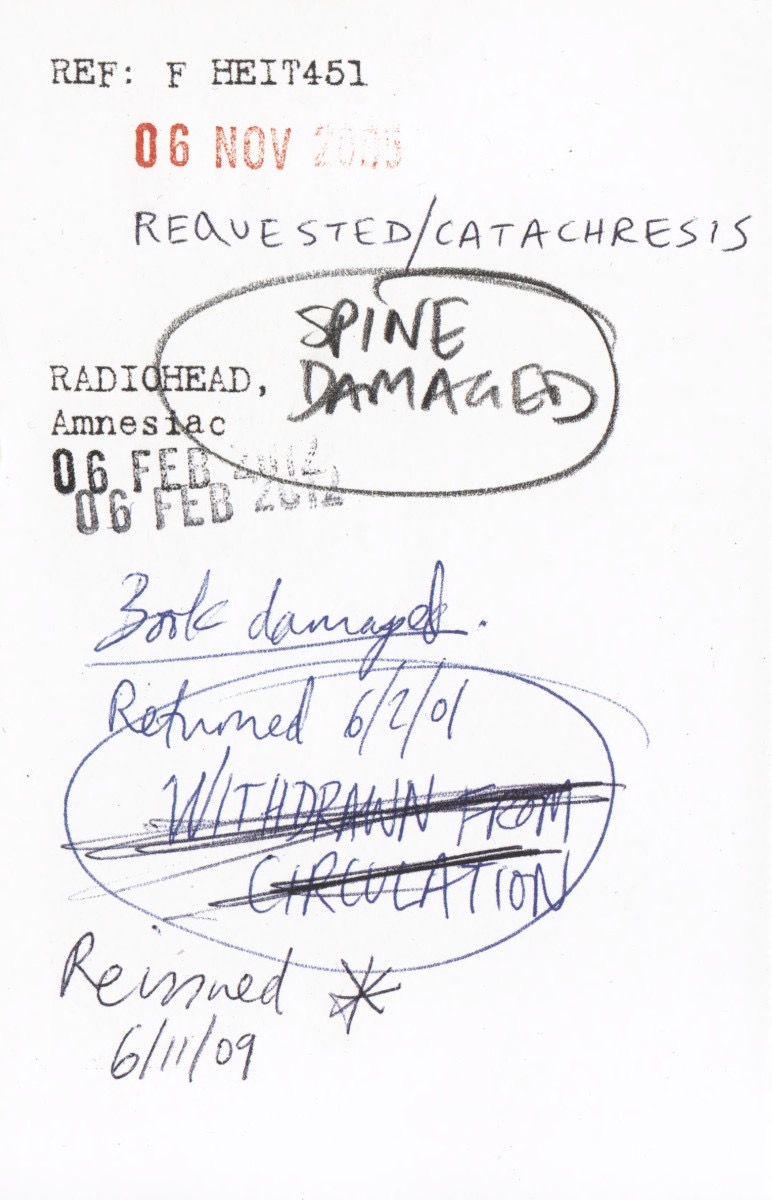
The special edition took Donwood's idea literally. It is a red hardback with the disc in a library-card pocket inside the cover. The card belongs to the Nosuch Library, at Catachresis College, and warns that the book is to be hidden and that “labyrinthine structures are entered at the reader's own risk”. Its accession number, F heit 451, matches the British catalogue numbers, CDFHEIT 45101 for the CD and LPFHEIT 45101 for the ten-inch vinyl, and spells out Fahrenheit 451, Ray Bradbury's novel about burning books. The loan stamps run from 26 June 1996, well before any of it was recorded, and a slip tucked in with them marks the book damaged, withdrawn from circulation, and reissued.
It won Best Recording Package at the 44th Grammy Awards on 27 February 2002, with Donwood and Tchocky as art directors, ahead of R.E.M.'s Reveal and David Byrne's Look Into the Eyeball. The album itself lost Best Alternative Music Album to Coldplay's Parachutes.
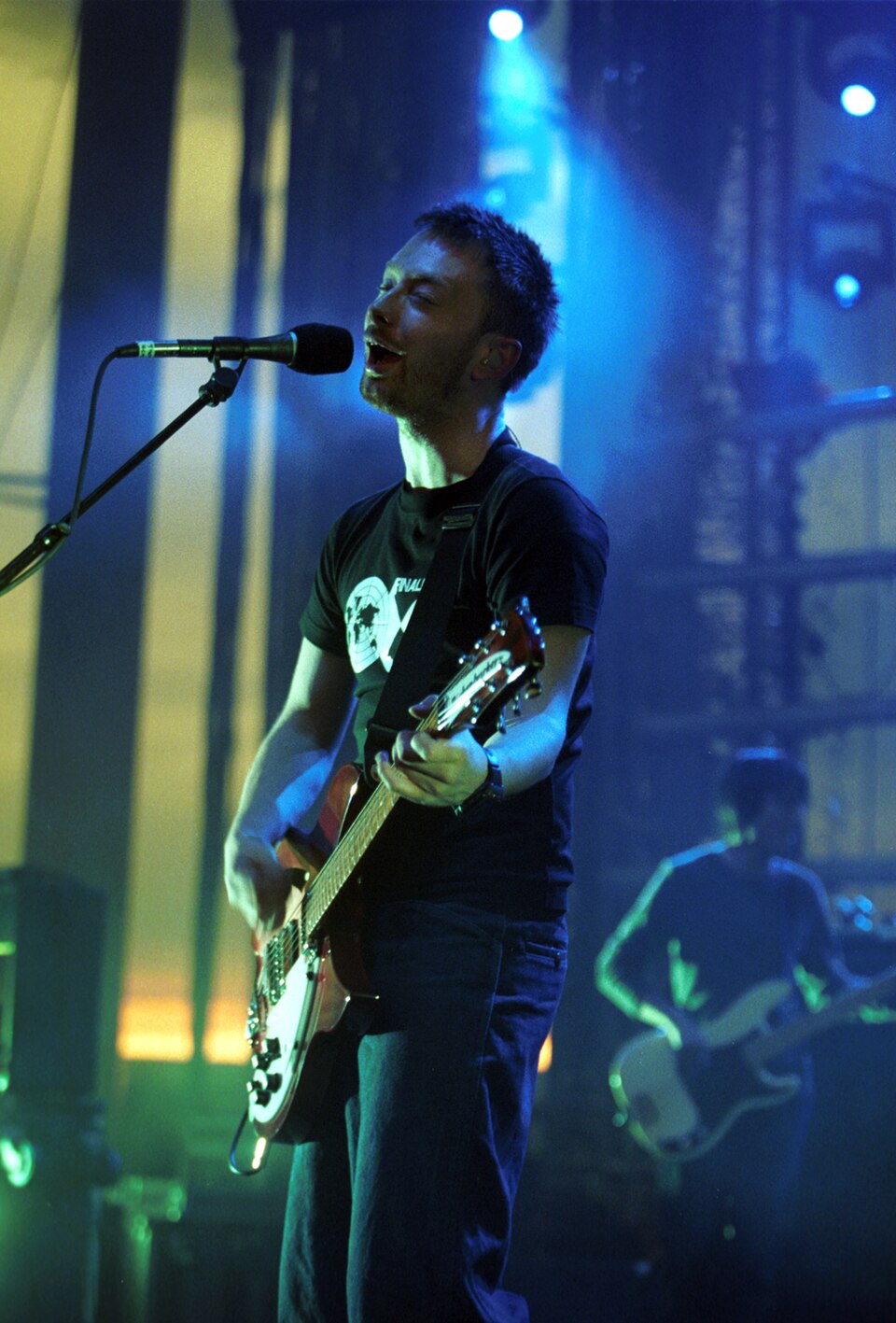
photo
Photo: Goldberg · CC BY-SA 2.0 · Wikimedia Commons
2001
singles, a bot and a midnight sale
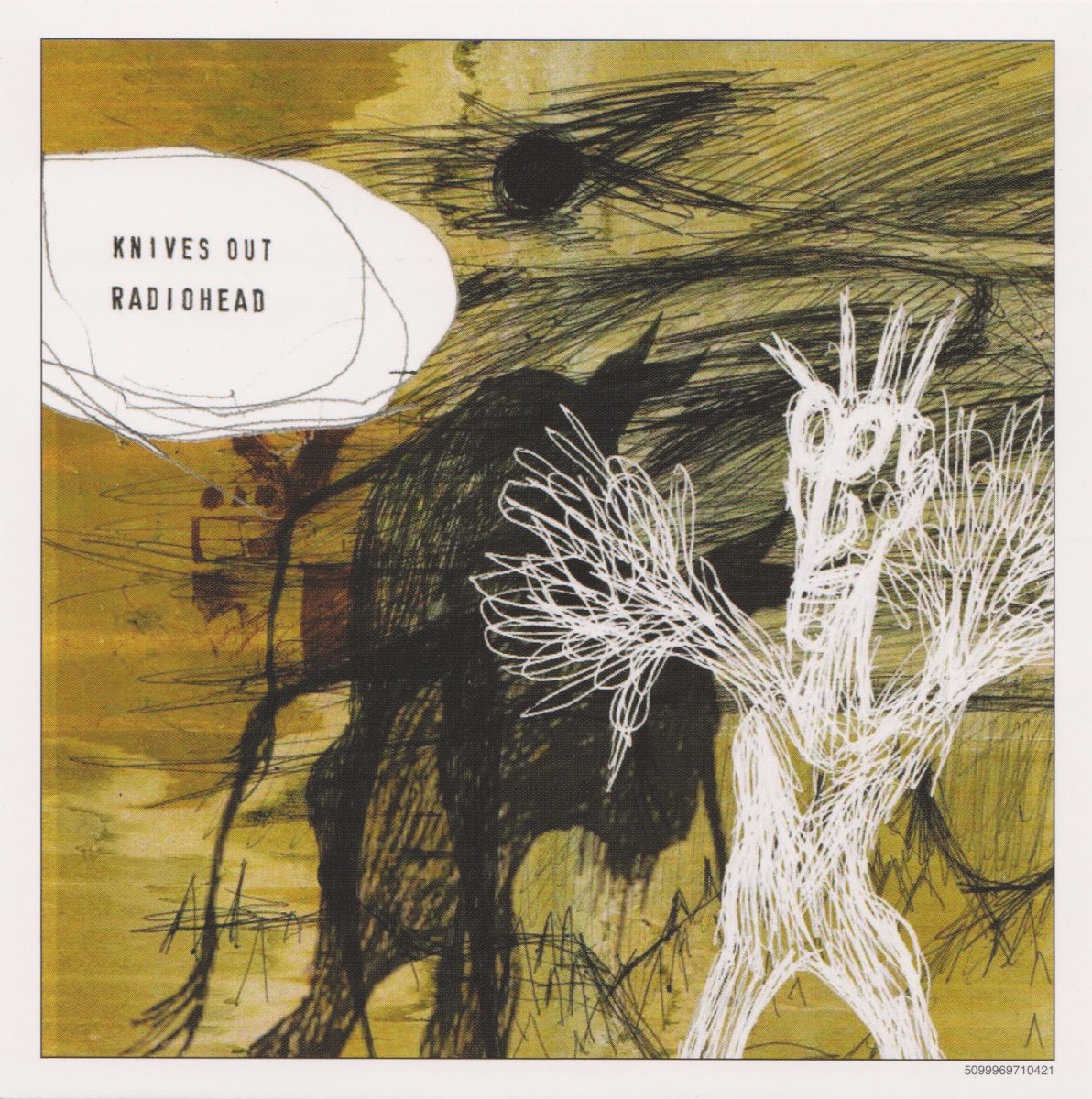
Kid A had gone out with no singles, and Yorke had said he regretted it: the first verdicts had been left to the critics. In January he promised the opposite in a post on the band's site, with singles, videos and dance routines on the list, and only some of it was a joke. “Pyramid Song” came out in Britain on 21 May and was kept off number one by DJ Pied Piper and the Master of Ceremonies, the daftest dance record since Jive Bunny in the view of the Guardian's Alexis Petridis. “Knives Out” followed in August and “I Might Be Wrong” went to radio as a promotional single in June.
Capitol worked America through the internet. Ed O'Brien and Colin Greenwood presented two of the new songs in a webcast from the Sundance Film Festival in January; six tracks were played to invited journalists at a bar called Plush during South by Southwest in March; a promotional CD had Chris Douridas of KCRW interviewing the same two. By early April the whole album was on Napster, Rolling Stone reported. On the day of release in Britain, 4 June, Capitol switched on GooglyMinotaur, a chatbot for AOL Instant Messenger built by ActiveBuddy. The band named it after a character in the artwork. By the time it was retired in March 2002 it had, by the account of the label's new media staff, sent about 60 million messages to nearly a million people.
Alex Ross, reporting for The New Yorker, found an 18-year-old from Long Island queuing at a Virgin Megastore for the midnight sale. When MTV's Gideon Yago called the album a collection of outtakes from the Kid A sessions, Selway told him to try again.
june 2001
number one, and two
It came out in Japan on 30 May, on Parlophone in Britain on 4 June and on Capitol in America the next day. In Britain it went straight to number one, displacing Shaggy's Hotshot. In America it sold 231,469 copies in its first week, about 25,000 more than Kid A, which had gone to number one. Amnesiac went in at two, some 13,000 copies behind Staind's Break the Cycle.
The reviews ran from relief to impatience. Victoria Segal in NME gave it eight out of ten and argued it was no retreat from Kid A. Petridis, who had disliked Kid A, reviewed it for the Guardian under the headline “Relax: it's nothing like Kid A” and welcomed the band back as “the world's most intriguing and innovative major rock band”. Jon Pareles in Rolling Stone thought it slightly padded and heard “I Might Be Wrong” as “like ZZ Top kidnapped by Autechre”. Ryan Schreiber at Pitchfork gave it 9.0 and still preferred Kid A. Entertainment Weekly and Spin both reached for “Kid B”. Ross noted that Q gave the album four stars and then called it “numb, petty, desolate”.
It was shortlisted for the Mercury Prize, which went on 11 September to PJ Harvey's Stories from the City, Stories from the Sea, a record with Yorke singing on it.
2001
the american summer
The tour opened on 18 June at the Cynthia Woods Mitchell Pavilion outside Houston, Radiohead's first North American tour in three years. The band had wanted to bring the tent they used in Europe in 2000, and gave up. Yorke blamed Clear Channel and Ticketmaster, and the band played where they could instead: Hutchinson Field in Grant Park, Chicago, where the first 16,000 tickets went in four minutes, and Liberty State Park on the Hudson. The Observer called it “the most sweeping conquest of America by a British group” since the Beatles, the shows selling out without a poster or a newspaper advert.
In between came Oxford. On 7 July they played South Park to more than 42,000 people, their first show in the city for five years, with Humphrey Lyttelton, Sigur Rós, Supergrass and Beck on the bill. Drapes beside the stage carried the weeping figure from the artwork. Ross watched the grass fill with foam cups printed with the Amnesiac logo, and thought it might have been the largest public gathering in Oxford's history. The night raised £145,000 for 14 Oxfordshire charities. The Orchestra of St John's got £20,000 of it.
after
the twin
EMI reissued it as a double LP in 2008 and in two-disc and three-disc Collector's Editions in August 2009, the second disc of B-sides and a Canal+ session from Paris on 28 April 2001, with no input from the band. Scott Plagenhoef, reviewing that set for Pitchfork, gave it 9.5 and called Amnesiac the start of a messy, rewarding era. XL took over the catalogue in 2016 and put it out on vinyl that year. In 2021 it went back out beside Kid A as Kid A Mnesia, with a third disc of the sessions.
Rolling Stone put it at 25 among the albums of the 2000s and at 320 in its 2012 list of the 500 greatest; Pitchfork had it at 34 for the decade. Set beside its twin it will always lose something. Set beside what Selway wanted from it, it is the album where five people can still be heard playing in a room, and its guitar songs and its jazz funeral have aged better than the “Kid B” jokes.
On 4 June 2026 the band marked the anniversary on YouTube with a “You and Whose Army?” filmed at Rock im Park in Nuremberg two days before the album was in British shops, and a caption of three words: “Amnesiac is 25.”
on film
NPR's Throughline on making Kid A and Amnesiac at the turn of the millennium.· NPR Podcastswatch on youtube →
videos(8)
the sleeve
the booklet (7)
the art and the editions
the press
the press release
from radiohead.com · Thom Yorke
dated jan 2001
We are definitely having singles, videos, glossy magazine celebrity photo-shoots, children's television appearances, film premier appearances, dance routines and many interesting interviews about my tortured existence
the reviews
8/10
NME
Victoria Segal · 30 may 2001
read it →It sounds like a piano dying in a blizzard.
3.5/5
Rolling Stone
Jon Pareles · 29 may 2001
read it →Radiohead turn most of their self-indulgences into advances.
4/5
The Guardian
Alexis Petridis · 1 jun 2001
read it →strikes a cunning and rewarding balance between experimentation and quality control
3.5/4
Los Angeles Times
Richard Cromelin · 3 jun 2001
read it →a richer, more engaging record
9.0
Pitchfork
Ryan Schreiber · 4 jun 2001
read it →highlights were undeniably worth the wait, and easily overcome its occasional patchiness
9/10
Drowned in Sound
Dale Price · jun 2001
read it →Thankfully, I'm pleased to say this is much better than Kid A.
C+
Entertainment Weekly
David Browne · 8 jun 2001
read it →their inward turn is beginning to feel like an act of hostility and contempt
no mark
Billboard
BB · 16 jun 2001
read it →Don't listen to the philistines.
7/10
Spin
Sasha Frere-Jones · jul 2001
read it →Radiohead are turning down the bed in your head
4/5
Uncut
David Stubbs · jul 2001
read it →
later
- looking backPitchfork · Scott Plagenhoef · 26 aug 2009 9.5Amnesiac is the kickoff of a messy, rewarding eraread →
- looking backStereogum · Chris DeVille · 4 jun 2021you could almost slag it off as a god-tier B-sides collectionread →
- looking backThe Quietus · Toby Manning · 30 may 2026The fact that Amnesiac has been subject to a cultural amnesiaread →
- on the listsPitchfork, The Top 200 Albums of the 2000s, no. 34 · Matthew Solarski · 1 oct 2009If only all “afterthought” albums could be this A-list.read →
- on the listsRolling Stone, 500 Greatest Albums of All Time, no. 320 · 31 may 2012The greatest sequel since The Godfather: Part II.read →
sources26
- David Fricke, “Radiohead warm up with Amnesiac”, Rolling Stone, 24 May 2001, for the two-day meeting, Selway, O'Brien on OK Computer, the managers' barn, the title post and Donwood.
- David Fricke, “Radiohead: making music that matters”, Rolling Stone, 2 August 2001, for the second day in Copenhagen.
- Jonny Greenwood on KCRW, 12 October 2000, as transcribed by Citizen Insane, for the double album.
- Greg Kot, “'It's difficult justifying being a rock band'”, Chicago Tribune, 31 July 2001, for Yorke on the split, the EPs and the American promoters.
- Chris DeVille, “Amnesiac turns 20”, Stereogum, 4 June 2021, for the closed system and the collection.
- Amnesiac special edition, Parlophone F HEIT451, 2001: credits, the Nosuch Library card and slip, the loan stamps; UK CD, Parlophone CDFHEIT 45101, and LP, LPFHEIT 45101, scans via the Cover Art Archive.
- Ed O'Brien's studio diary, radiohead.com, 1999 and 2000, mirrored here, for Batsford, “Egyptian Song”, the line on the board, the autumn joke and the string day.
- Wikipedia, “Amnesiac (album)”, for the studios, the Piranesi and typewriter detail from Stanley Donwood's There Will Be No Quiet (2019), Bob Ludwig's credit, the Japanese release and the 2008 and 2016 reissues.
- “Godrich 'The Man' for new Radiohead, Travis albums”, Billboard, 12 February 2001, for Gateway Mastering.
- NME news items: “Bright Yorke!”, 31 January 2001 (the laptop); “Phew, what a scorcher!”, 16 January 2001, relaying The Big Issue (finished six months, the fire, the photocopier); “Radiohead remember new album title”, 12 December 2000; “Radiohead forget to release album”, 12 January 2001 (June, four months, two minutes a month); “Talking 'Head!”, 28 February 2001; “Drawn from memory loss”, 2 April 2001 (the sleeve).
- Christina Saraceno, “Radiohead reveal new album details”, Rolling Stone, 4 January 2001, for “Po Pad” and Yorke's promise of singles; Fricke, 24 May 2001, for Napster.
- Thom Yorke and Stanley Donwood, “'We had a fierce anger and suspicion'”, The Guardian, 4 November 2021, for the drawer, the labyrinth and the false voices.
- Simon Vozick-Levinson, “Thom Yorke on the visual secrets of Kid A and Amnesiac”, Rolling Stone, 3 November 2021, for the minotaur and Piranesi.
- Recording Academy, 44th Grammy Awards, Best Recording Package and Best Alternative Music Album; the treefingers news story of 27 February 2002.
- Alexis Petridis, “Relax: it's nothing like Kid A”, The Guardian, 1 June 2001, for the review and DJ Pied Piper.
- Jonathan Cohen, “Billboard Bits”, Billboard, 24 January 2001 (Sundance); Matt Ashare, The Boston Phoenix, April 2001 (Plush); “At Ground Zero” promotional CD, Capitol, 2001.
- Annie Zaleski, “The oral history of Radiohead's GooglyMinotaur”, The A.V. Club, 23 June 2016, for the bot, its name and its numbers.
- Alex Ross, “The Searchers: Radiohead's unquiet revolution”, The New Yorker, 20 August 2001, for the midnight sale, Yago, Q's verdict, the cups and the size of the South Park crowd.
- “Staind hold off Radiohead”, Rolling Stone, 13 June 2001, for the American first-week figures; “Radiohead rules again on U.K. chart”, Billboard, 12 June 2001, and BBC News, 10 June 2001, for the British number one.
- Victoria Segal, NME, 30 May 2001; Jon Pareles, Rolling Stone, 29 May 2001; Ryan Schreiber, Pitchfork, 4 June 2001; David Browne, Entertainment Weekly, 8 June 2001; Sasha Frere-Jones, Spin, July 2001.
- BBC News, 11 September 2001, for the Mercury Prize.
- Billboard, 19 June 2001, for the opening night; NME, “'Heading for the top again?'”, 8 June 2001, for Liberty State Park; Ed Vulliamy, “How Radiohead took America by stealth”, The Observer, 19 August 2001.
- BBC News, “Radiohead dazzle home crowd”, 8 July 2001, for the crowd; “Charities reap rewards from Radiohead concert”, Oxford Mail, 18 September 2001, for the £145,000; NME, 7 July 2001, for the drapes.
- Scott Plagenhoef, review of the Special Collectors Edition, Pitchfork, 26 August 2009.
- Rolling Stone, 100 best albums of the 2000s, 2011, and 500 Greatest Albums of All Time, 2012; Pitchfork, top 200 albums of the 2000s, 2009.
- Radiohead, “You and Whose Army? (Live in Nürnberg, June 2001)”, YouTube, 4 June 2026.