Song · OK Computer era (1996–98)
Paranoid Android
Three unfinished songs were welded into one, and a fourteen-minute organ outro was cut out of it.
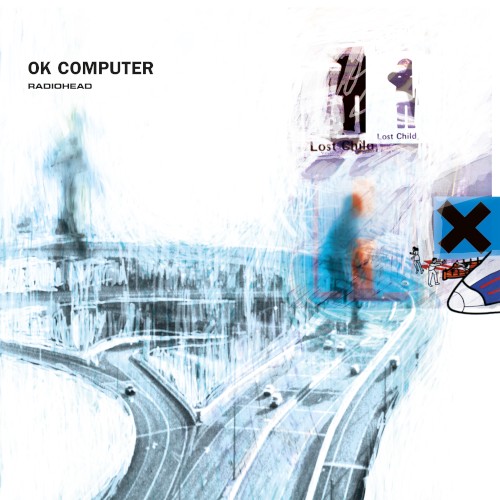 OK Computeralbum
- 1997released
- 6:23length
1996
three songs, one track
It began as salvage. Radiohead had fragments that would not grow into songs on their own, and the way out was the through-composed shape of “Happiness Is a Warm Gun”: fuse the parts and let the joins show. Bohemian Rhapsody and the Pixies were in the room too, and the band knew exactly how absurd the result was.
We felt like irresponsible schoolboys… Nobody does a six-and-a-half-minute song with all these changes. It's ridiculous.
colin greenwood
The title came from Marvin, the depressive robot in The Hitchhiker's Guide to the Galaxy, and Yorke meant it as a joke about how he was being read.
It was like, ‘Oh, I'm so depressed.’ And I just thought, that's great. That's how people would like me to be… The rest of the song is not personal at all.
thom yorke · jam!, 2 june 1997
1996–97
st catherine's court
They recorded it with Nigel Godrich at St Catherine's Court, a 15th-century house near Bath. The first version ran past fourteen minutes and ended in a Hammond organ solo from Jonny Greenwood that everyone involved now describes as an ordeal.
We'd be pissing ourselves while we played. We'd bring out the glockenspiel and it would be really, really funny.
ed o'brien
Yorke called that version a Pink Floyd cover. Greenwood said the organ solo was “hard to listen to without clutching the sofa for support”. Godrich was blunter: “Nothing really happened with the outro. It just spun and spun and it got very Deep Purple and went off.”
Taking the editing of Magical Mystery Tour as the model, they cut the song to six and a half minutes and replaced the organ with a short guitar solo. Yorke shouted gibberish into a Dictaphone for the ending. Godrich spliced the pieces together on 24-track tape and enjoyed himself.
It's a very hard thing to explain, but it's all on 24-track and it runs through… I was very pleased with myself. I sort of stood there and said, ‘You guys have no idea what I've just done.’ It was pretty clever.
nigel godrich · rolling stone, 16 june 2017
The long version eventually escaped anyway, on the 2019 minidisc leak.
the shape
four sections, 6:23
The opening is in G minor at 82 beats per minute: acoustic guitar and shaken percussion, then electric guitar and voice over the top, the first vocal line covering an octave and a third. Two minutes in, the second section shifts to A minor, keeps the tempo and changes the rhythm, and ends with Jonny Greenwood's distorted solo running from 2:43 to 3:33, his tone routed through a Mutronics Mutator.
The third section is Greenwood's own, the tempo dropped to 62, the harmony a looped progression like a Baroque passacaglia split between C minor and D minor, the vocals multi-tracked into a choir. Dai Griffiths noted that the chord sequence would ordinarily “sound seedy, rather like something by the band Portishead”. At 5:35 the second section returns briefly as a coda, and the song ends the way that section did, on a chromatic descending motif.
Was something I had floating around for a while and the song needed a certain burn. It happened to be the right key and the right speed and it fit right in.
jonny greenwood · guitar world, october 1997
the words
a bar in los angeles
Yorke wrote the lyrics after a night in a Los Angeles bar surrounded by strangers high on cocaine. A woman turned violent when a drink was spilled on her, and he could not sleep afterwards.
There was a look in this woman's eyes that I'd never seen before anywhere… Couldn't sleep that night because of it.
thom yorke
She became the “kicking squealing Gucci little piggy” of the second section. Yorke described the song as three moods written in three different states of mind, and said the sneer in “with your opinion, which is of no consequence at all” points the other way: it is his own opinion he means.
26 may 1997
the least likely single
Capitol backed the choice of a six-minute song with no chorus as the lead single. Colin Greenwood knew what it was not: “hardly the radio-friendly, breakthrough, buzz bin unit shifter [radio stations] have been expecting”. The band wanted it first because it told listeners what the album was going to be.
Radio 1's Evening Session premiered it in April, nearly a month early. It was released on 26 May 1997 and reached number three, which is still Radiohead's highest UK chart placing. As it caught on, Radio 1 played it up to twelve times a day; Yorke later named that as one of his proudest moments of the era. In Australia it reached 29.
Each format carried B-sides: “Polyethylene (Parts 1 & 2)” and “Pearly” on CD1, “A Reminder” and “Melatonin” on CD2, and OK Computer's “Let Down” on the Japanese release. Stanley Donwood and Yorke made the artwork, credited to “dumb computers”: a hand-drawn dome carrying the song's last line, with the pig and the handshake from the album sleeve, both borrowed from Pink Floyd covers.
1997
robin, benjamin and the censored mermaids
Everyone expected another “moody and black and dark” video after “Street Spirit”. The band wanted the opposite, so they went to the Swedish animator Magnus Carlsson, whose series Robin they loved. Carlsson had been angling to do “No Surprises” and had no idea what to do with this one; he locked himself in his office for more than twelve hours, stared out of the window with the song on repeat, and wrote down images. The band deliberately withheld the lyrics so the film would not illustrate them.
Robin and his friend Benjamin move through a world of miserable EU delegates, bullying drinkers, a prostitute, kissing leathermen, mermaids and an angel who plays table tennis. The band appear in a bar cameo, badly drawn on purpose.
There was no way that we could appear in it to perform in it because that would be so Spinal Tap.
colin greenwood · circus, august 1997
MTV put it in heavy rotation in America and cut the mermaids' breasts out; a later US version dressed them in bathing suits. MTV Europe ran it uncut for two weeks because the censor was off sick.
We would've understood if they had a problem with some guy chopping his arms and legs off, but I mean, a woman's breasts! And mermaids as well! It's fucked up.
colin greenwood
1996–2025
on stage
It reached a stage before it reached a shop: Oxford, 2 July 1996. Seventy-eight performances followed in 1997. The archive has it at 465 nights and counting, most recently Copenhagen on 16 December 2025, and thirty-five of those nights ended with it.
after
the magnum opus argument
NME made it Single of the Week and described it as “not unlike ‘Bohemian Rhapsody’ being played backwards by a bunch of Vietnam vets high on Kings Cross-quality crack”. The Sydney Morning Herald called it “a titanic guitar opera in three movements and 6½ minutes”. Slant heard “a multipart anti-yuppie anthem whose ambition is anything but ugly”; Andy Gill thought it the most ambitious single since “MacArthur Park”.
You can watch ‘Paranoid Android’ a hundred times and not figure it all out.
lewis largent, mtv · spin, january 1998
It was nominated for Best British Single at the 1998 Brit Awards. Rolling Stone put it at 256 in its 500 greatest songs, Pitchfork at 4 in the tracks of the 1990s, and the Guardian at number one among Radiohead's own. The 2006 anime Ergo Proxy plays it over its end credits: the band said no at first, then watched a preview and agreed.
the video
Magnus Carlsson's animation, made from the sound alone.· Radioheadwatch on youtube →
takes(3)
explained
Rick Beato goes through the suite section by section with the multitracks.· Rick Beatowatch on youtube →
videos(3)
Live history
| Times played | 465 shows |
|---|---|
| Live debut | Tuesday 2 July 1996 · Oxford |
| Last played | Tuesday 16 December 2025 · Copenhagen |
| Closed the night | 35 times |
| Longest absence | 7 years · back on Tuesday 4 November 2025 · Madrid |
Nights played include broadcasts; opened and closed count gigs only. A cancelled night has no setlist. All setlist stats →
Tabs (3)
sources14
- Andy Greene, “Radiohead's ‘OK Computer’: An Oral History”, Rolling Stone, 16 June 2017.
- John Sakamoto, “Radiohead talk about their new video”, Jam!, 2 June 1997.
- Mark Sutherland, “Return of the Mac!”, Melody Maker, 31 May 1997, and “Rounding the Bends”, 24 May 1997.
- Mac Randall, Exit Music: The Radiohead Story, pp. 150–151, 166–168, 201, 214–215, 242–243.
- Tim Footman, Radiohead: Welcome to the Machine, pp. 51–54, 126, 144–150, 160, 168, 171–174.
- Dai Griffiths, OK Computer (33⅓), pp. 33, 52–53, 92.
- Brad Osborn, Everything in its Right Place: Analyzing Radiohead, Oxford University Press.
- Bob Gulla, “Radiohead: At Long Last, a Future for Rock Guitar”, Guitar World, October 1997.
- Simon Williams, “Paranoid Android”, NME, 24 May 1997.
- Mark Kemp, “OK Computer”, Rolling Stone, 10 July 1997.
- Adrian Glover, “Radiohead: Getting More Respect”, Circus, August 1997.
- Pat Blashill, “Radiohead: Band of the Year”, Spin, January 1998.
- Craig McLean, “Don't worry, be happy”, The Sydney Morning Herald, 14 June 2003.
- Jazz Monroe, “Radiohead's 40 greatest songs, ranked!”, The Guardian, 23 January 2020.