Song · Kid A / Amnesiac era (2000–01)
How to Disappear Completely
A dream after a bad night in Dublin, a sentence Michael Stipe gave Thom Yorke, and a string score that looked unplayable.
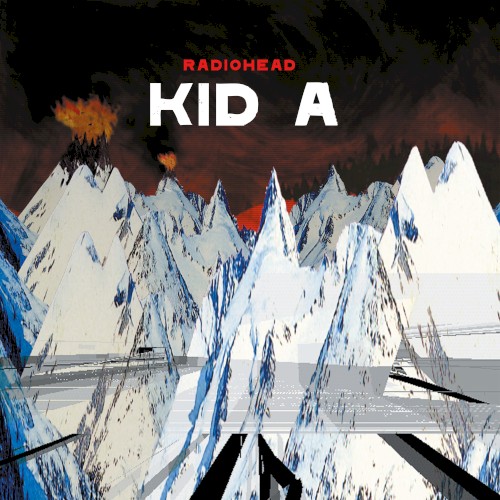 Kid Aalbum
- 2000released
- 5:56length
june 1997
dublin, and a tidal wave
Yorke began writing it in Toronto in June 1997, in the middle of the OK Computer tour. Later that month the band played the RDS Arena in Dublin, their biggest show to that point, in wind and rain. He dreamed that night that he was running naked down the Liffey with a tidal wave behind him.
Ed O'Brien traced the song to that show and to what the touring was doing to Yorke. A week later at Glastonbury the equipment failed and Yorke nearly walked off; O'Brien talked him into staying.
I just needed a break. And in fact, I didn't get one for another year and a bit, by which point I was pretty much catatonic.
thom yorke · bbc news
the line
i'm not here, this isn't happening
The refrain was not his. It was advice from Michael Stipe, a way of getting through a tour: tell yourself you are not there. By July 1997 Yorke was already telling an interviewer in Canada that he had written a song with that chorus.
The loan went back the other way. Stipe wrote “Disappear” for R.E.M.'s Reveal after hearing it, then rang Yorke to apologise for taking the idea, and Yorke pointed out whose idea it had been first.
The title came from Doug Richmond's 1985 manual How to Disappear Completely and Never Be Found, a book about erasing an identity and starting another one. The working titles were “This Is Not Happening” and the book's full title. Some accounts attach the song to Richey Edwards of the Manic Street Preachers, who vanished in February 1995.
1997–99
the version they threw away
Yorke played an acoustic version at a New York soundcheck in August 1997; the footage is in Meeting People Is Easy. Through 1998 they stretched it live to seven and ten minutes. Yorke introduced it one night “for the benefit of the bootleggers”. Melody Maker, reviewing a 1998 performance, said it sounded like Radiohead covering Unbelievable Truth, his brother Andy's band.
In early 1999 they recorded it properly at Guillaume Tell in Paris, and Yorke killed it: “That sounds great, but it sounds like old Radiohead.” They tried again on 27 July at Batsford Park, then moved to their own mobile studio at Sutton Courtenay. The early arrangement had been guitar-led; they threw the rock instrumentation out and decided the song would be carried by strings instead.
dec 1999 – feb 2000
the score the orchestra laughed at
Selway's drums went down on 1 December 1999. The next day Jonny Greenwood, the only one of them with formal training, started writing the string parts with Godrich, multi-tracking his ondes Martenot, an instrument he had come to through Messiaen. He took a month over it. Yorke, by his own account, had almost nothing to do with the song from that point: Greenwood finished it alone.
On 4 February 2000 they booked three hours at Dorchester Abbey, a 12th-century church five miles from the studio, and the Orchestra of St John's under John Lubbock played it. They had been chosen because they played Penderecki and Messiaen. When Greenwood handed out the score the players burst into giggles: by conventional standards it was unplayable. Lubbock told them to try anyway.
Greenwood avoided consecutive long notes so the strings would not sit there like “a row of balloons”. The orchestra and the ondes Martenot were captured in a single take on a handful of microphones and Godrich's G3. The orchestra's concerts director called the session more experimental than anything they usually did.
The bare string track was released on its own in 2021, on Kid A Mnesia, as “How to Disappear into Strings”.
the sound
f minor, and the first clear voice on the record
It is an acoustic ballad at 102 beats per minute in F minor, opening on a discordant string harmony before the strummed guitar and a bassline that owes something to Chris Squire. O'Brien's reverb and delay drift a melody between two chords. At 5:23 everything converges on one sustained high note, the ondes Martenot buried under the strings.
It is also the first moment on Kid A where Yorke's voice arrives unprocessed, after “Everything in Its Right Place”, “Kid A” and “The National Anthem” have each done something to it. Q heard a ghostly waltz-time folk song; the Guardian called it a masterpiece that “orchestrates a stage-fright reverie with fragments of Robert Wyatt and Penderecki”. The strings owe their shape to Penderecki's Threnody to the Victims of Hiroshima, the same source as “Climbing Up the Walls”, though the scholar Peter Carney argues that Greenwood folds atonal fragments into a tonal frame and owes as much to Mingus.
27 sep 2000
released, not as a single
It came out as the fourth track of Kid A on 2 October 2000. The press expected it to be the single; the band released no singles from that album at all. Promotional CDs appeared in Poland and Belgium. In America it was paired with “Idioteque” as a double A-side promo. NME read the chorus as a straight account of where Yorke had been left by the OK Computer tour.
1998–2025
in the set
The first live performance was in Los Angeles on 1 April 1998, two and a half years before the record. The archive counts 188 nights, and it has closed the show twenty times; the most recent was Dublin, 20 June 2017.
on stage
Live, 1998.· Davidwatch on youtube →
takes(2)
explained
Jonny Greenwood's string writing: the clusters and the glissandi.· Listening Inwatch on youtube →
videos(2)
Live history
| Times played | 188 shows |
|---|---|
| Live debut | Wednesday 1 April 1998 · Los Angeles |
| Last played | Tuesday 9 December 2025 · Berlin |
| Closed the night | 20 times |
| Longest absence | 7 years · back on Tuesday 4 November 2025 · Madrid |
First played live in 1998, 2 years before it was released.
Nights played include broadcasts; opened and closed count gigs only. A cancelled night has no setlist. All setlist stats →
Tabs (2)
Remixes & alternate versions (1)
- How to Disappear into Strings
sources11
- “Q&A: Thom Yorke Talks Dreams, Creative People, Fitting Format”, Rolling Stone, 25 December 1997.
- “People of the Year: Thom Yorke of Radiohead”, Rolling Stone, 14 December 2000.
- Radiohead interview, Lamacq Live, BBC Radio 1, 18 September 2000.
- “Thom Yorke ‘nearly walked off stage’ during Radiohead's 1997 Glastonbury performance”, BBC News, 8 June 2017.
- Ed O'Brien's online diary, 1999–2000.
- Jonny Greenwood and Colin Greenwood, interview, Mixing It, BBC Radio 3, 20 January 2001.
- “Radiohead's Runaway Guitarist”, The New York Times, 9 March 2012.
- James Oldham, “‘I was a complete fucking mess when OK Computer finished’”, NME, 30 September 2000.
- Tom Seabrook, “Colours In My Head: The Making of Kid A and Amnesiac”, Record Collector, 11 August 2013.
- “Radiohead leaves studio with enough for two albums”, National Post, 7 July 2000.
- Jazz Monroe, “Radiohead's 40 greatest songs, ranked!”, The Guardian, 23 January 2020.