Radiohead EP · The Bends era (1994–96)
My Iron Lung
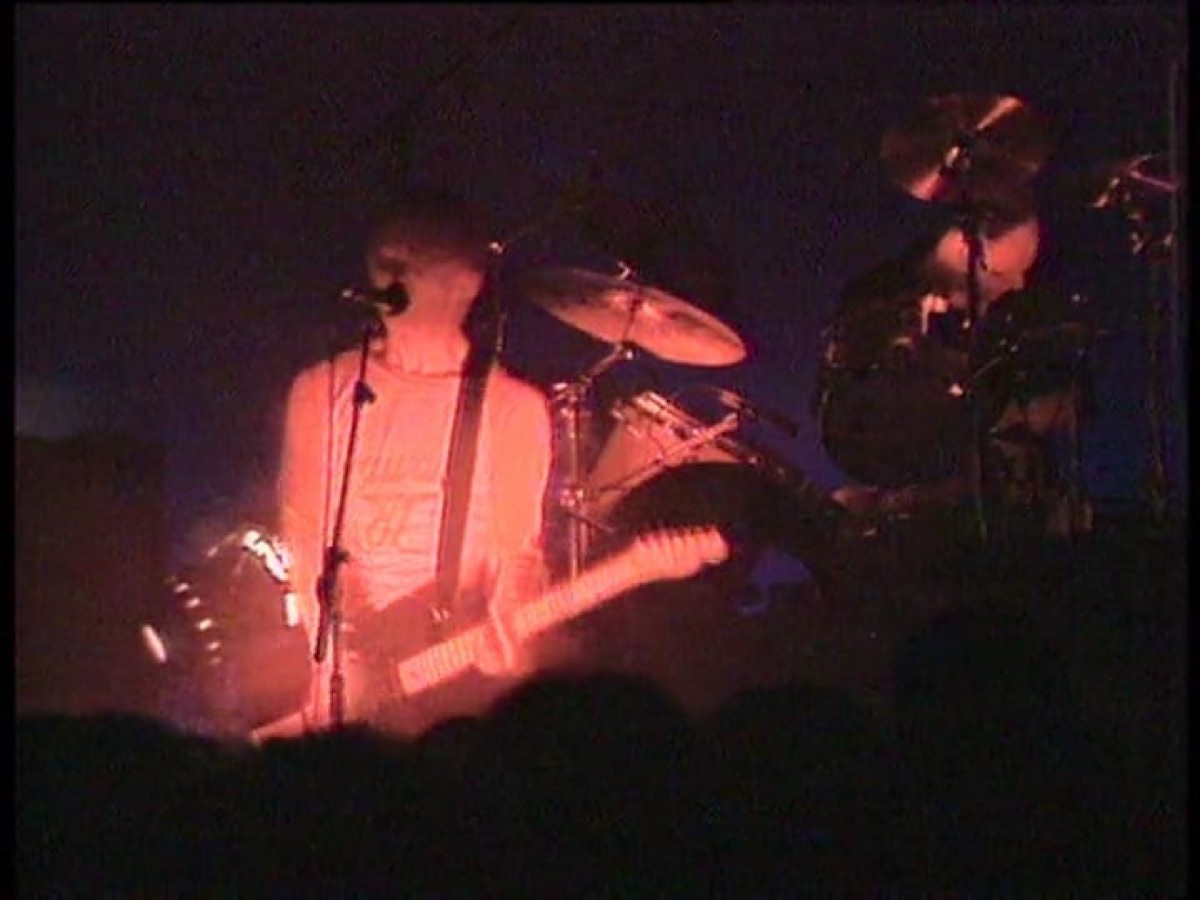
Yorke's song against “Creep”, taped live at the Astoria, with six B-sides behind it and the first Stanley Donwood sleeve.
the sessions
- Aug 1993Reading FestivalYorke starts the song the morning the band pull out
- Winter 1993US tour busThe second half written, most of it in a day
- Feb 1994RAK Studios, LondonThe B-sides recorded with John Leckie and Nigel Godrich
- 21 Feb 1994Royal Berkshire Hospital social club, ReadingFirst played live, with “The Trickster”
- 27 May 1994London AstoriaThe live take that becomes the single
- 26 Sep 1994Parlophone, UKOut on two CDs, a numbered 12-inch and cassette
- 27 Sep 1994GlasgowThe UK tour behind it begins
- 8 Oct 1994UK singles chartEnters at number 24
- Nov 1994Capitol, USA shorter EP goes to college and modern rock radio
1993
the morning of reading
Thom Yorke started writing it on the morning Radiohead pulled out of the Reading Festival in August 1993, his voice gone. That summer a Harley Street specialist had felt his neck and told him it was like concrete. He finished most of the second half in a day on the American tour bus that winter, in the months when he had decided to leave the band. At college he had kept a picture of a child in a 1950s iron lung, only a head showing out of the machine. It fitted, because “Creep” was keeping the band alive and they could not get out of it.
He told Stuart Bailie of the NME that the song was him trying to kill the beast.
It's not just a full-stop on 'Creep', it's a full-stop on everything that was turning us into something we didn't want to be.
thom yorke · nme, 1 october 1994
The words say “we” where “Creep” said “I”. Yorke told Melody Maker he had started using it all the time because he was sick of projecting things onto himself.
feb–may 1994
a hospital social club and the astoria
It was first played on 21 February 1994 at the social club of the Royal Berkshire Hospital in Reading, with a different second verse and “The Trickster” also heard for the first time. A song named after a hospital machine had its first night at a hospital.
Then it went into RAK, where John Leckie was starting on the second album, and would not come right. Months of takes produced nothing the band liked better than the one Leckie heard them play at the London Astoria on 27 May. That version is the record, with the audience taken out and Yorke's vocal sung again; Record Collector said later that new guitars went on too, but Jonny Greenwood and Ed O'Brien, in the fan club's own booklet, said only the vocal changed. Leckie, as Mac Randall quotes him, was pleased with how much they got from a tape made in a lorry outside the venue.
having not done a very good version in the studio, we thought that it sounded much better from this concert
jonny greenwood · glamour guide for trash, quoted in rolling stone, 13 march 2020
The single was meant for May. It was not ready, and the band's summer newsletter blamed coffee, the cat and the bus before admitting they had not been able to decide what to put out. It was rescheduled for September.
1994
six songs that missed the album
Yorke said in November that the six other new songs were too diverse to sit on the album, and were there for the fans who had been waiting since the last records. Leckie produced “The Trickster”, “Lewis (Mistreated)”, “Punchdrunk Lovesick Singalong” and “Lozenge of Love”, with Leckie, Chris Brown and Nigel Godrich engineering. “Lozenge of Love” was written by Yorke and Jonny together, and Bailie heard Nick Drake in it.
The other two came from elsewhere. “Permanent Daylight” is credited to Godrich and Radiohead as producers and mixed by Jim Warren, the band's live sound engineer. It is the first time Godrich's name stands on a Radiohead record as producer. “You Never Wash Up After Yourself” was, the sleeve says, recorded live in a fruit farm by Warren. Halfway through it Phil Selway can be heard putting down his sticks and walking out; he thought it was a rehearsal.
the sleeve
legs and a limo
It was the first Radiohead sleeve by Stanley Donwood, who had known Yorke at Exeter and had never heard “Creep”. In 2025 he told The Guardian how the call went.
Our record sleeves are shit, do you want to come and have a go?
thom yorke, as remembered by stanley donwood · the guardian, 7 august 2025
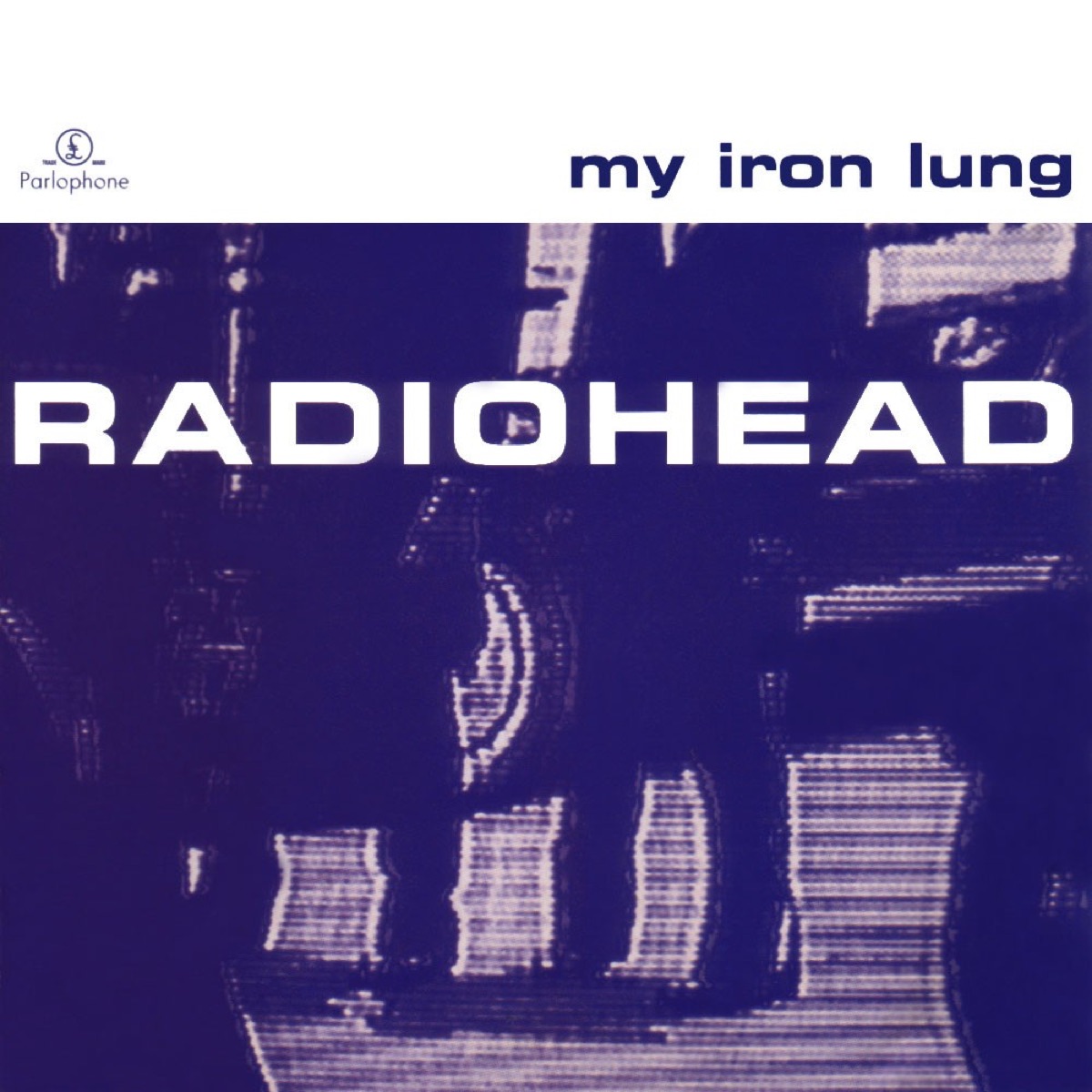
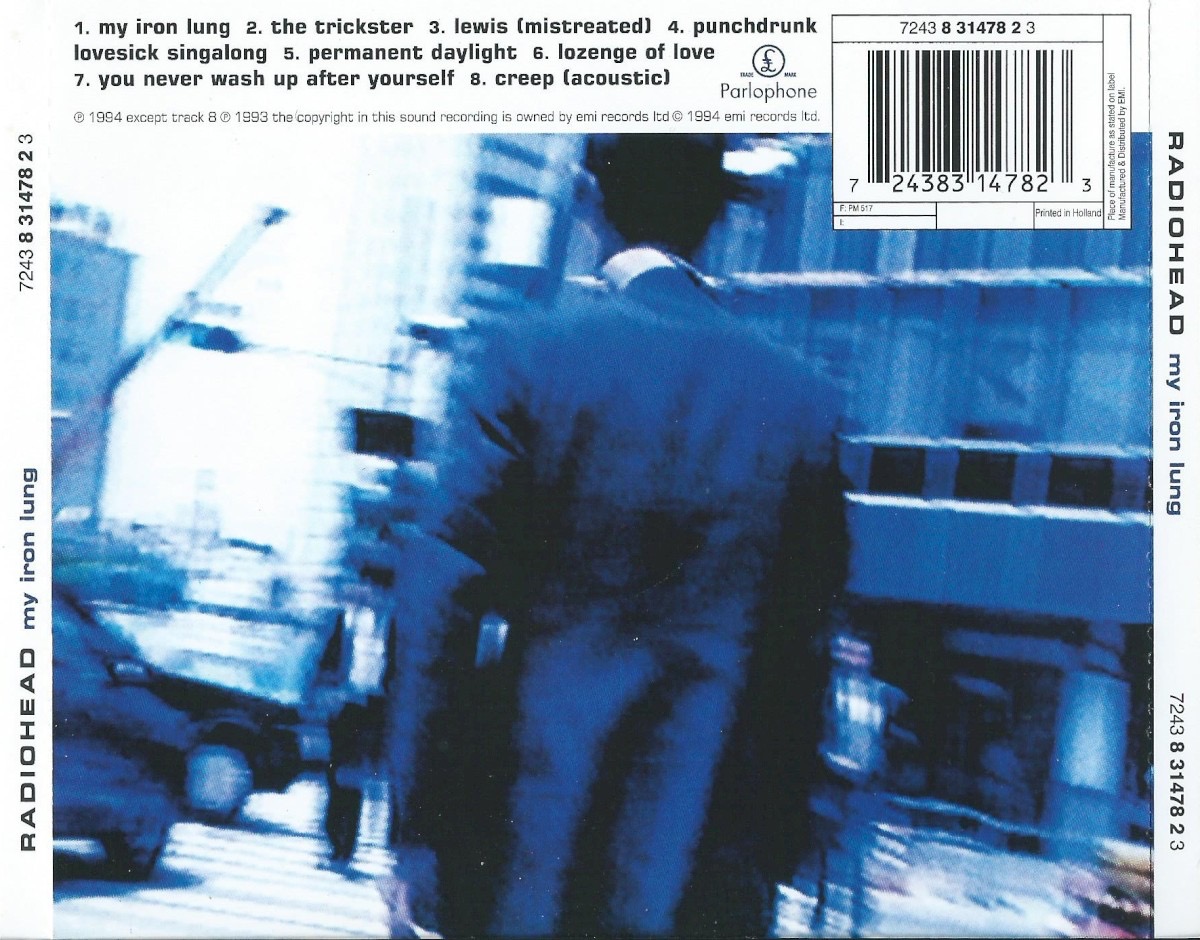
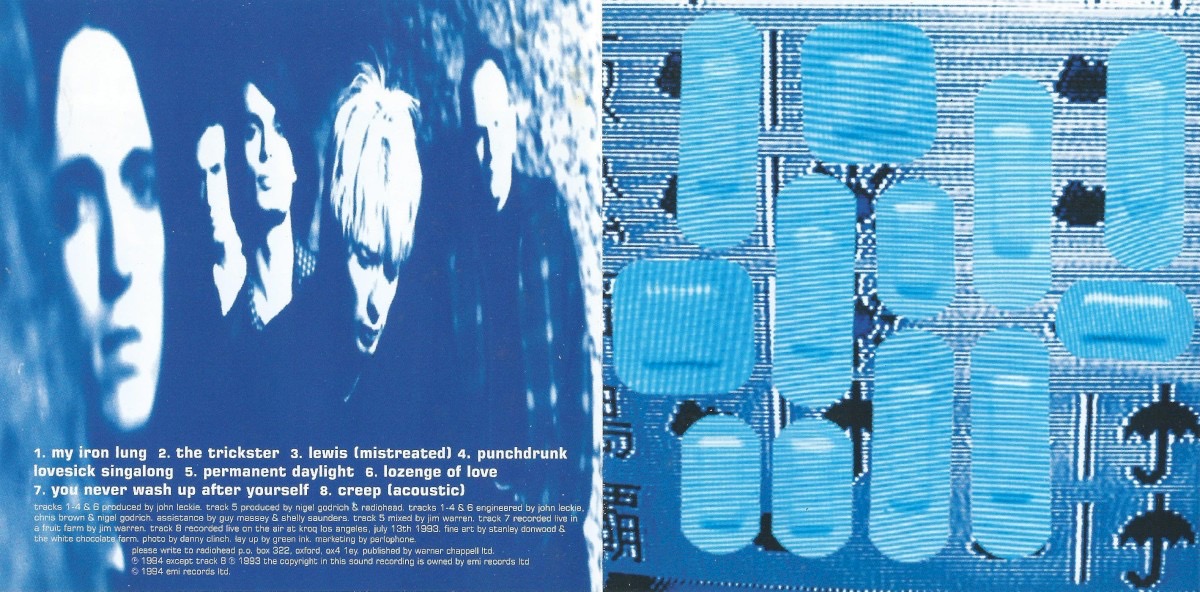
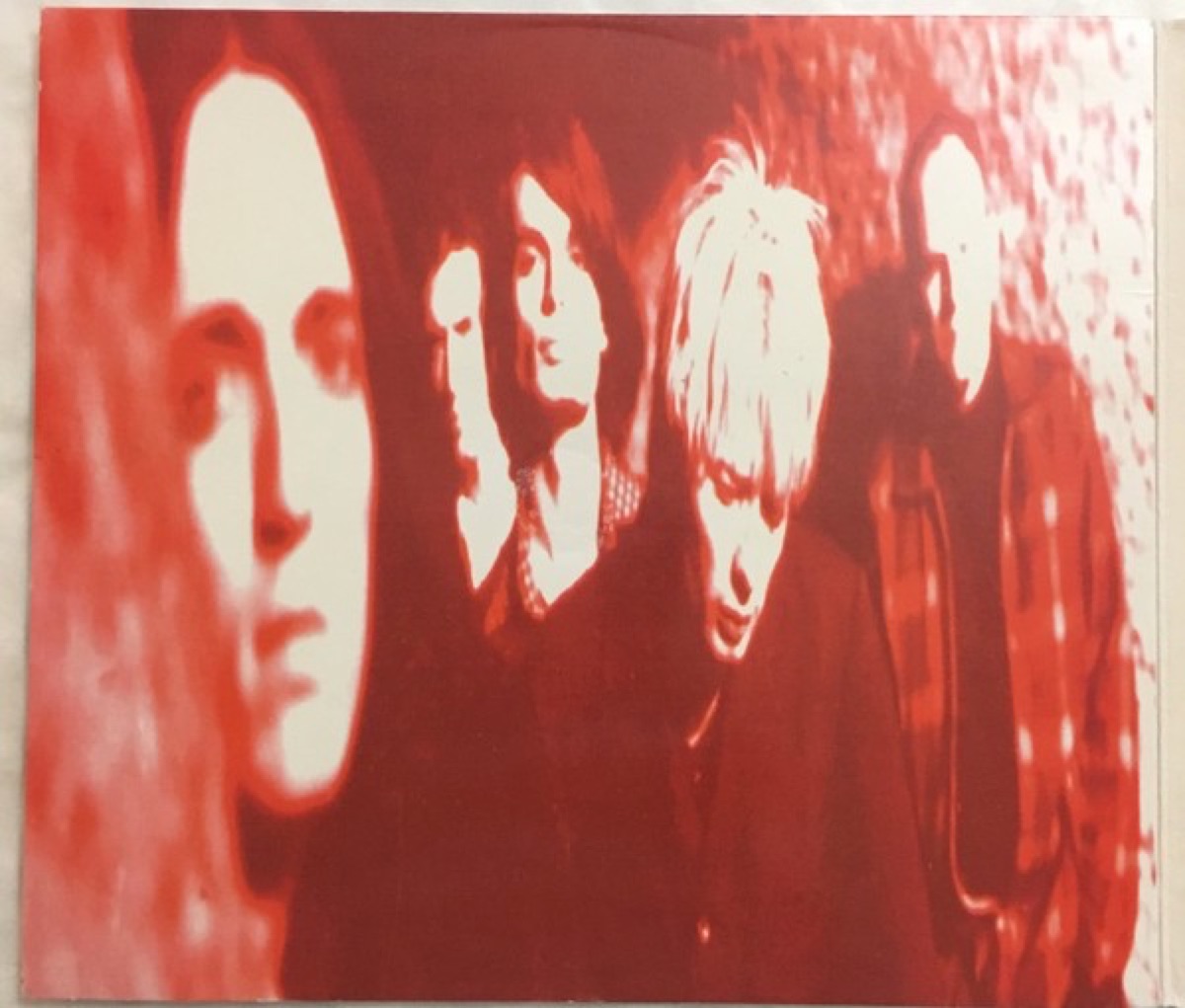
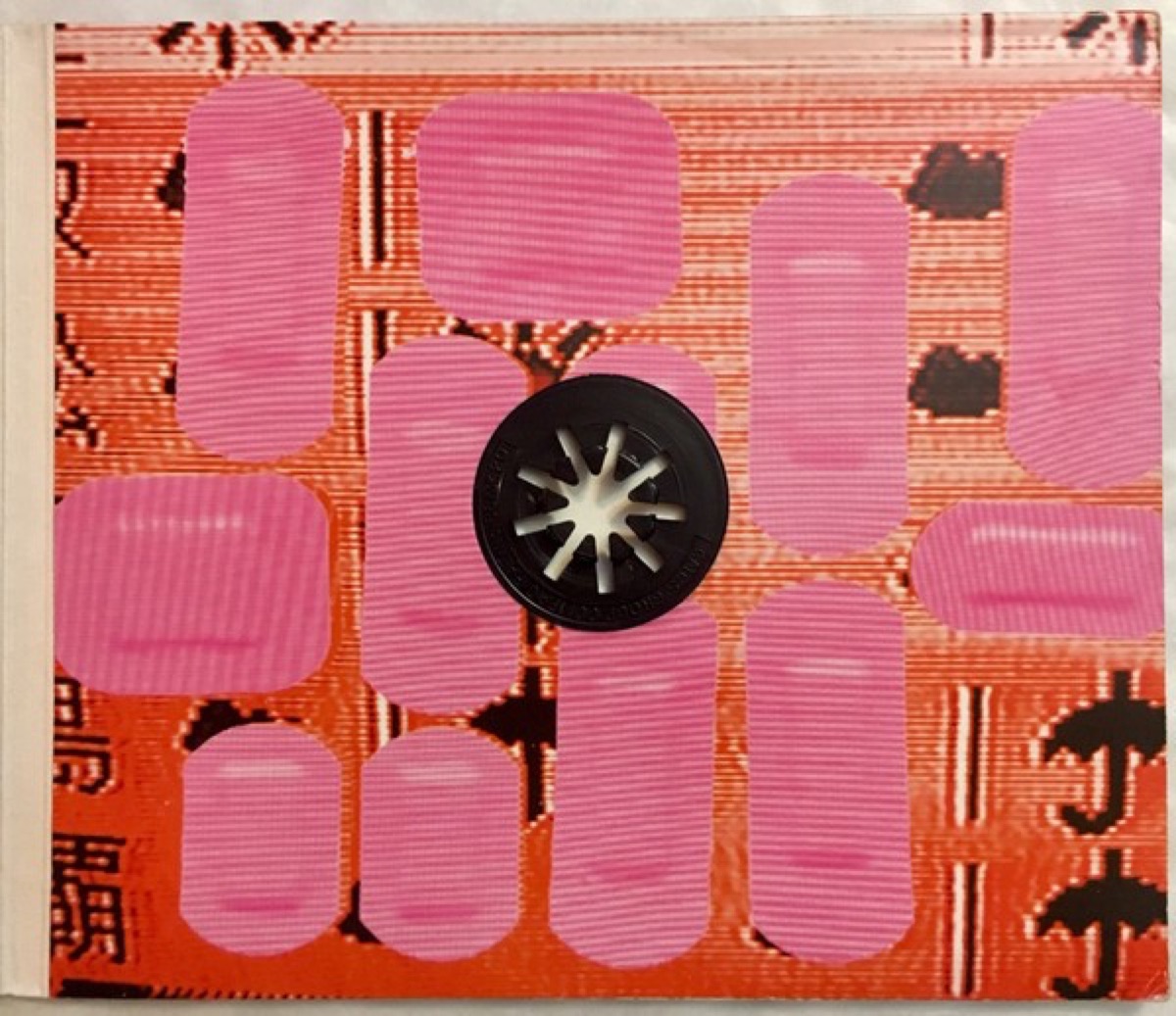
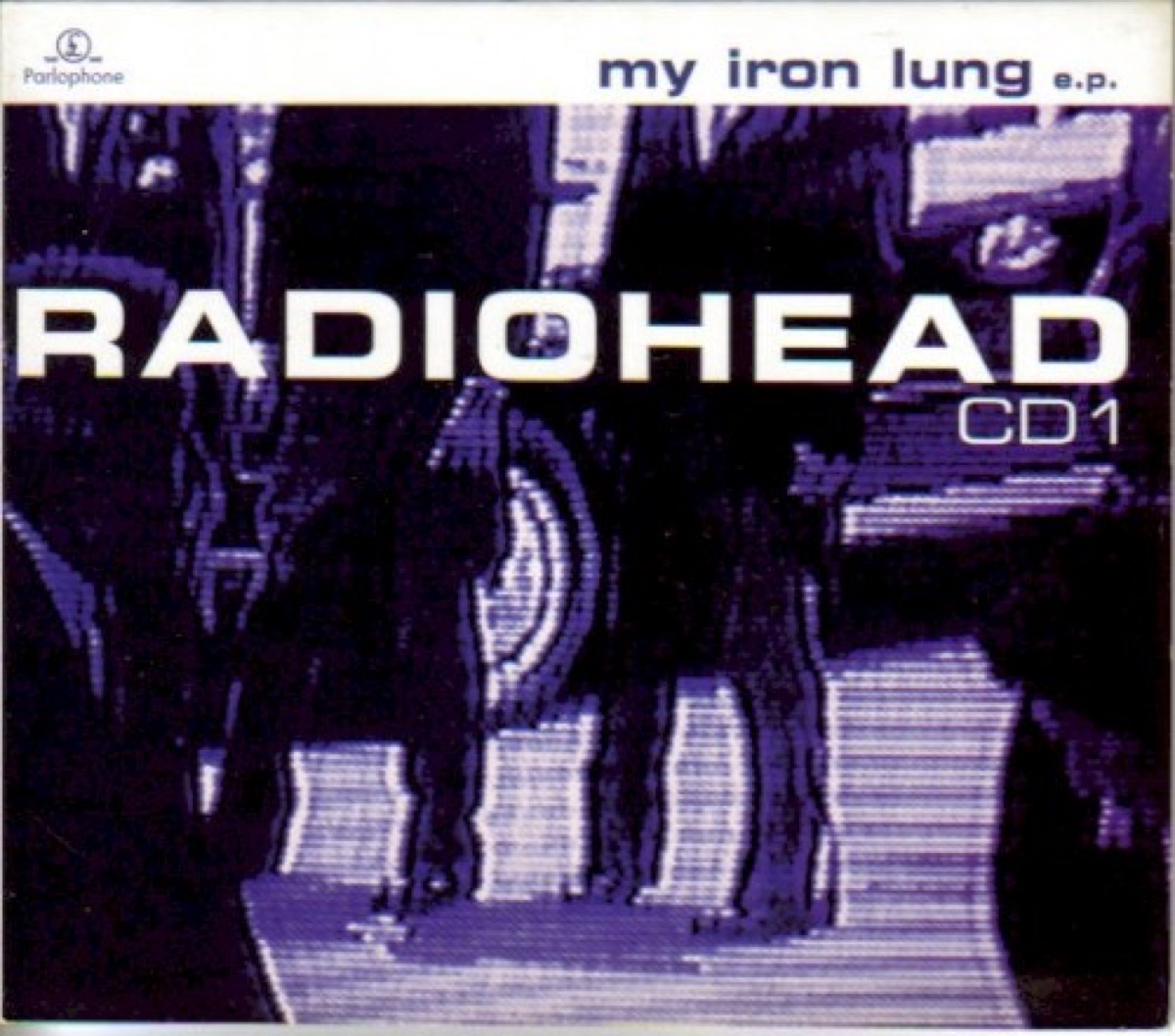
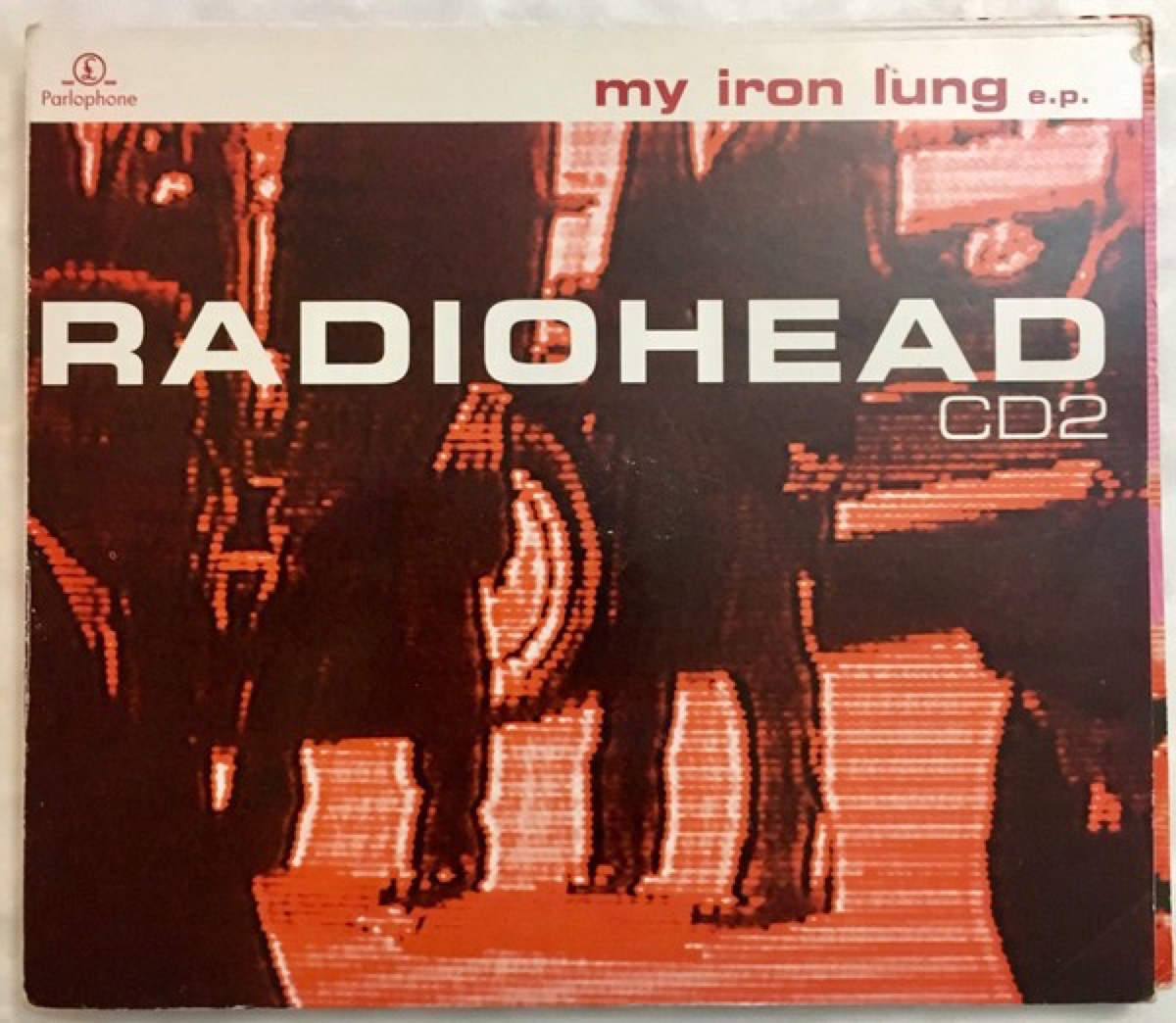
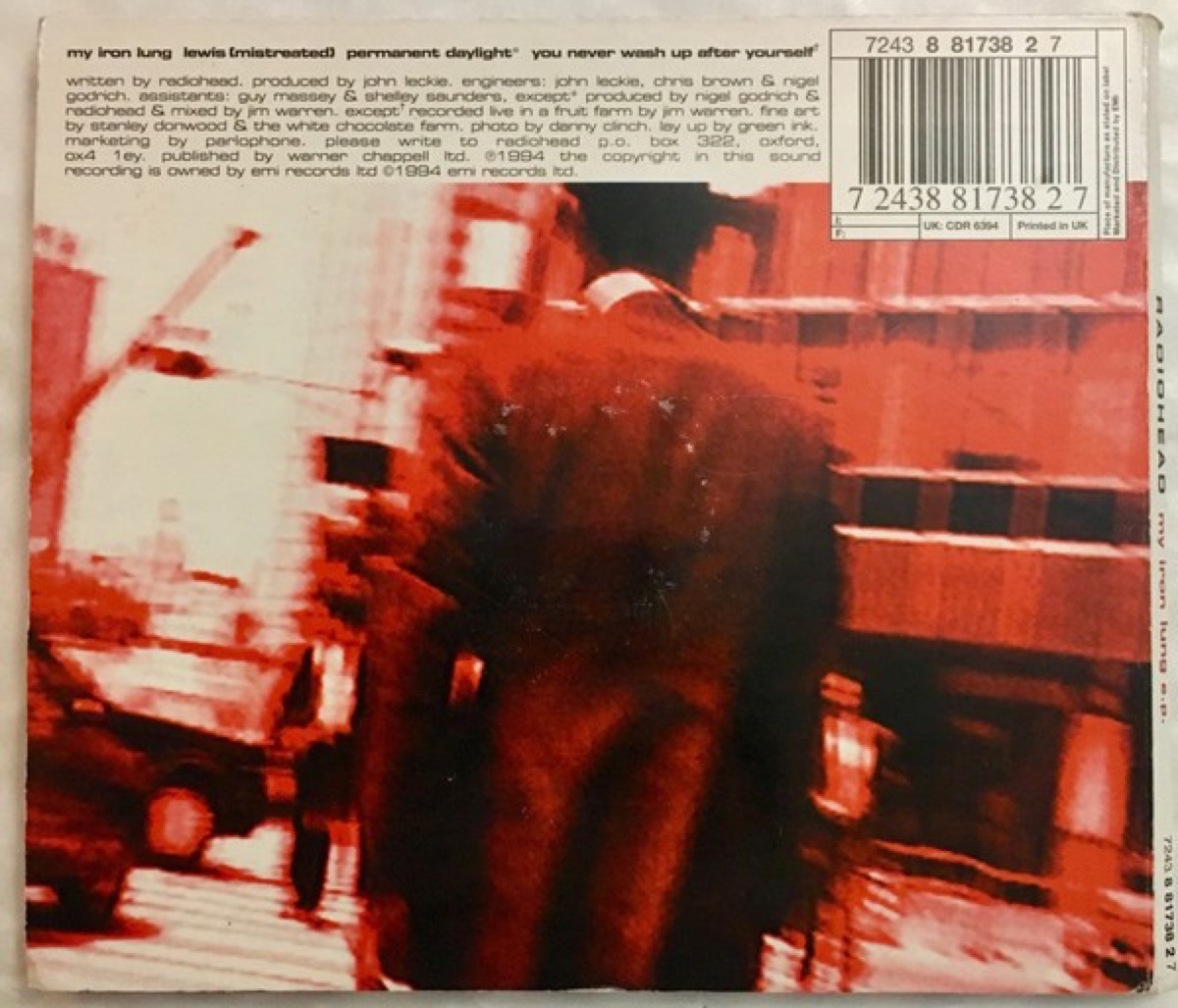
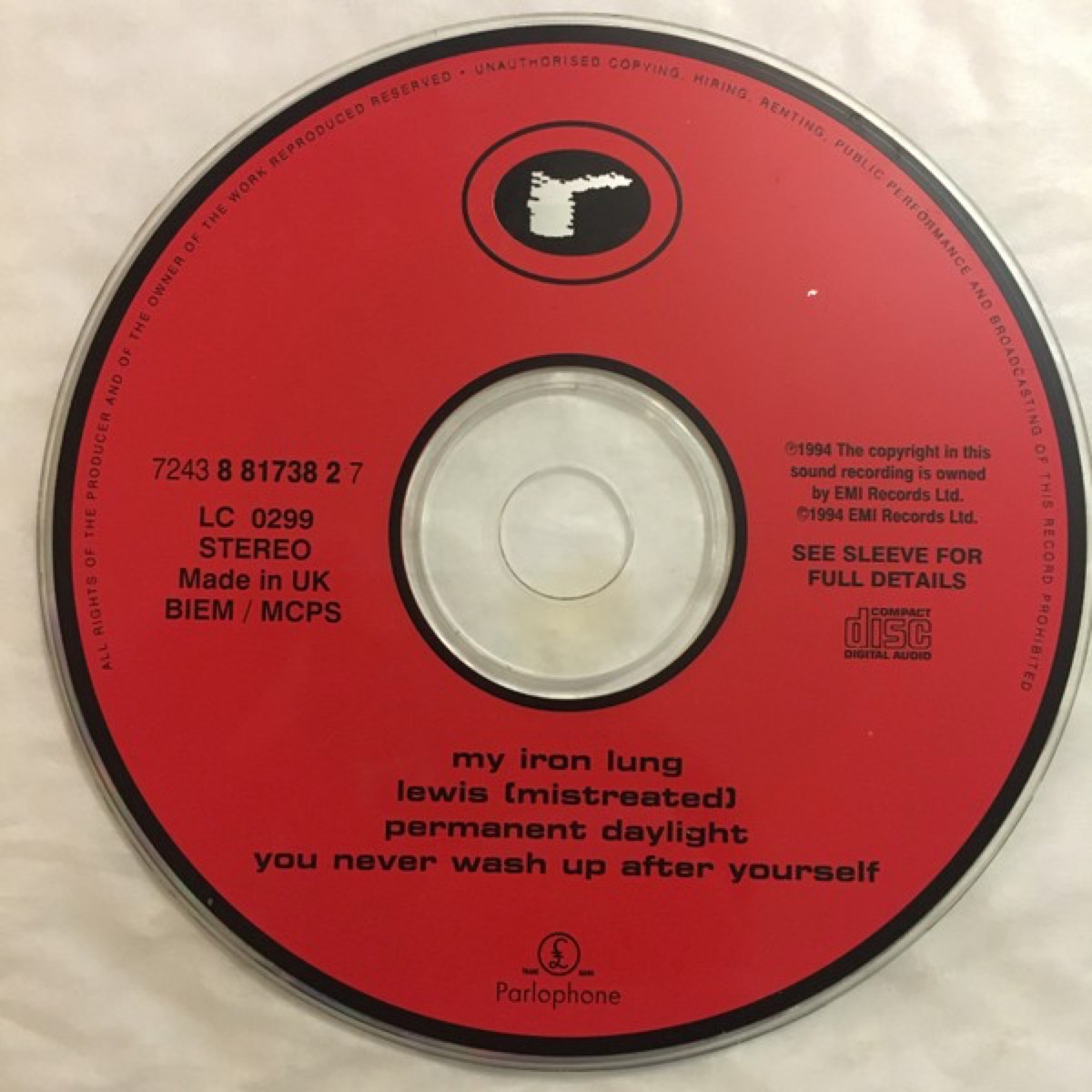
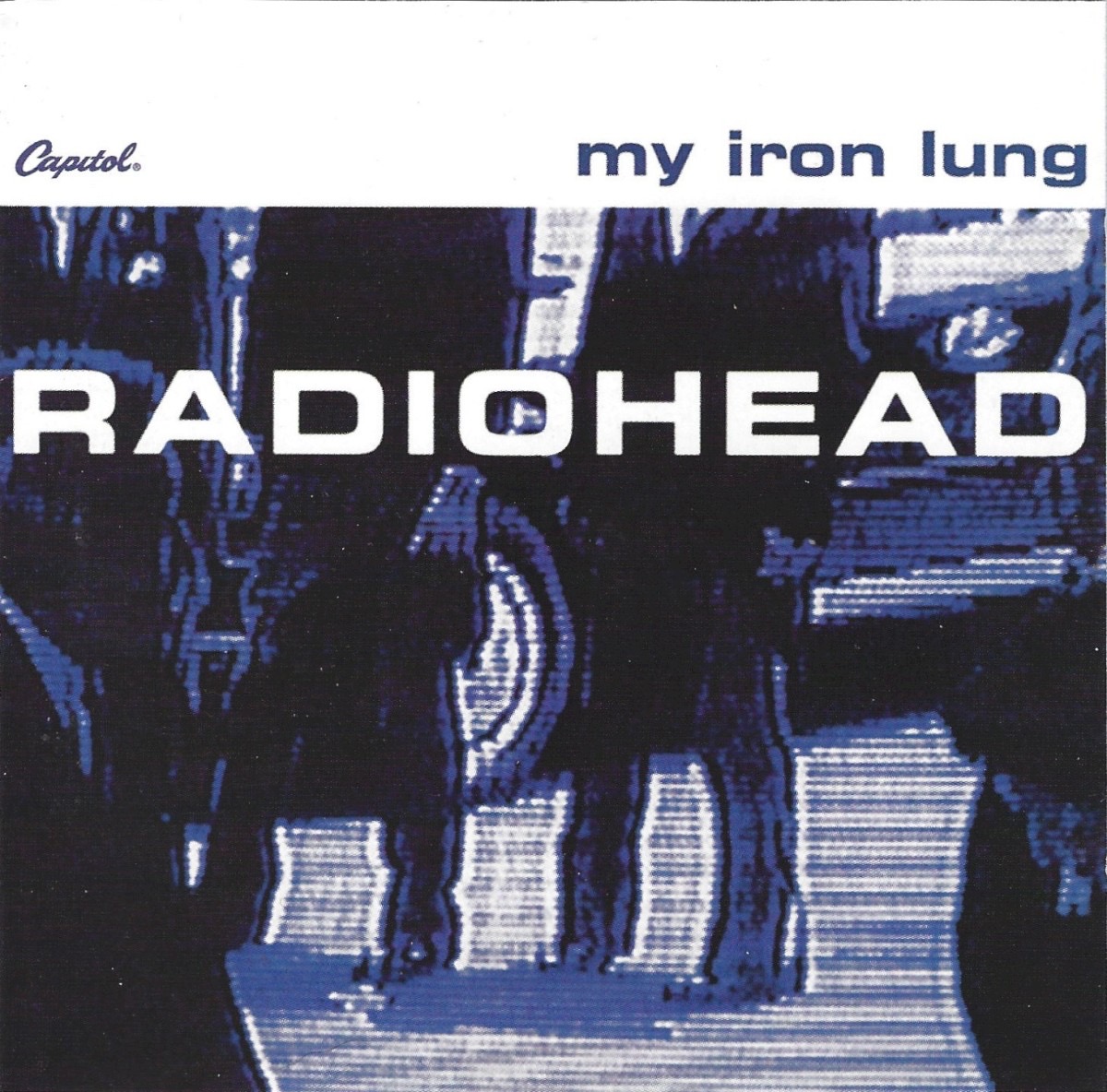
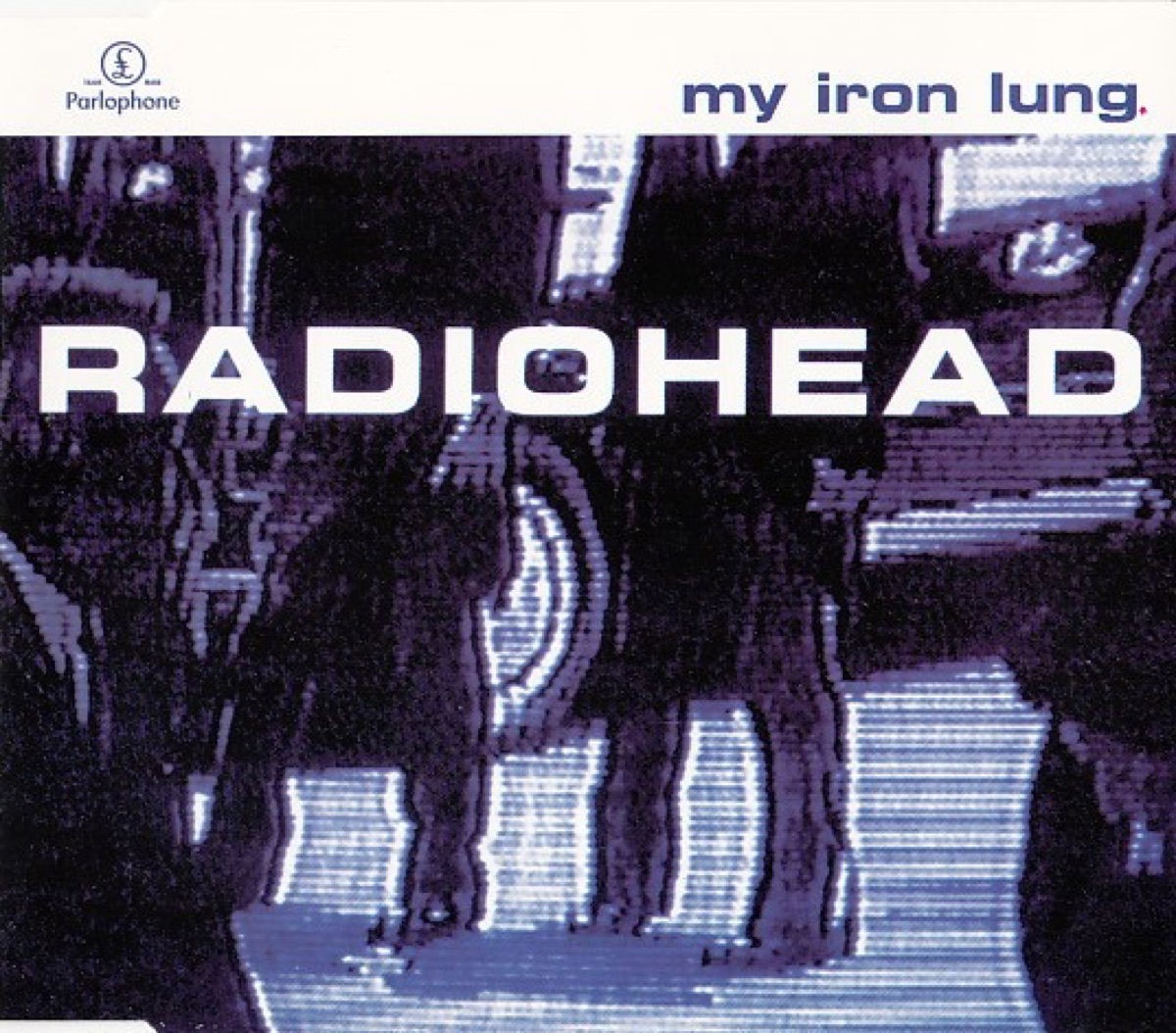
The plan was to film a real iron lung, and that hospital trip ended up on the cover of The Bends instead. The picture they used here is, as the NME described it, a television image four video generations down, “some legs and a limo”. On the front it is a dark band of shapes and scan lines under RADIOHEAD in white capitals and the title in lower case. The credits give the fine art to Donwood and The White Chocolate Farm, the name Yorke worked under, the layout to Green Ink, and the band photograph to Danny Clinch. The first CD is purple and blue, the second red. Inside, a panel of pale rounded shapes, like pills or plasters, sits over a television picture of East Asian characters and umbrella symbols. The back says to write to P.O. Box 322, Oxford.
sep–oct 1994
two cds and a cassette
Parlophone released it on Monday 26 September as two CDs, a numbered 12-inch and a cassette. Each CD carries the title track and three new songs not on the other, so a fan needed both to have the six, and Music Week's Martin Aston noted that a seven-track EP was not the usual way to preview an album. Radio 1 had already judged it too raucous and kept it off the A-list. It entered the chart at 24 on 8 October, dropped to 53, and was gone. By the winter, the band's newsletter put the sales at 30,000.
The tour behind it opened in Glasgow the day after release and ended at Shepherd's Bush Empire on 8 October. In Bangkok that month a crowd of about 4,000 knew every word of it, and in Mexico it went into the chart at number 11.
The reviews were mixed. Smash Hits gave it four out of five and called it a song made for jumping off the bed; Music & Media found the Nirvana-style switch from soft to loud a trick the band had already played on “Creep”, and others heard “Heart-Shaped Box”. In Melody Maker Jennifer Nine called it a staggering return. Asked if it was pure In Utero, Jonny said he did not own the record, and nor did O'Brien.
nov 1994–95
america and the eight-track ep
Capitol put a shorter EP out in America in November and sent it to college and modern rock radio without pushing it as a single. Larry Flick in Billboard decided in December that the success of “Creep” had been no fluke.
That was only meant to be a fan-based item.
perry watts-russell, capitol · billboard, 25 february 1995
Mac Randall reports that it went to number one on the college charts and sold about 20,000 copies there, which in a country that bought few singles was a sign that an audience was waiting. Pitchfork's Scott Plagenhoef remembered it beating The Bends into American shops by some months, and hardly anyone noticing.
Alongside the singles came the full set, an eight-track EP pressed in Holland with all seven new songs and the acoustic “Creep” recorded live on KROQ in Los Angeles on 13 July 1993. EMI put it out from Greece, where it was a mini-album on vinyl, to Korea, Thailand and Argentina.
after
the one left off
Only the title track went onto The Bends, eighth in the running order. The EP came back in EMI's 2009 Collector's Edition of the album, made without the band, and that year Capitol pressed it again as a 180-gram 12-inch. When XL took over the catalogue it put the EP up for download on 13 May 2016 with seven of its eight tracks. The one left off was “Creep”.
on film
The official video for the title track, cut from live concert footage.· Radioheadwatch on youtube →
videos(3)
the sleeve
the booklet (3)
the art and the editions
the press
the press release
from W.A.S.T.E. newsletter no. 7 · Radiohead
dated jul 1994
I bet you're all wondering what happened to that May single we promised in our last newsletter... Not a very good excuse but you may be pleased to know that it's re-scheduled to come out in September
the reviews
4/5
Music Week
Martin Aston · 24 sep 1994
read it →The admirably fizzing, lurching title track heads two CDs
4/5
Smash Hits
Leesa Daniels · 28 sep 1994
read it →the kind of song that's designed for bedroom use
no mark
Melody Maker
Jennifer Nine · 1 oct 1994
read it →this one suggests they can do anything
no mark
Music & Media
29 oct 1994
read it →More psychedelic than before
no mark
Billboard
Larry Flick · 17 dec 1994
read it →The success of “Creep” was clearly no fluke.
later
- looking backentertainment.ie · 22 feb 2005the same spirit of anguish and fragility is still thrillingly familiarread →
- looking backAllMusic · Greg Prato 4/5read →
- looking backPitchfork · Scott Plagenhoef · 16 apr 2009new ways to pick apart and re-construct the typical alt-rock templateread →
- on the listsThe Guardian · Jazz Monroe · 23 jan 2020 no. 10Radiohead's 40 greatest songs, ranked, no. 10read →
sources18
- My Iron Lung EP booklet, inlay and disc, Parlophone 7243 8 31478 2 3, 1994; CD2 sleeve and disc, Parlophone CDR 6394; CD1 front, Parlophone CDRS 6394 (Cover Art Archive scans), for the producers, engineers, the fruit farm, the KROQ date, the art and photo credits, Green Ink, the P.O. box and the sleeve designs.
- Stuart Bailie, “The Lung And Whining Road”, NME, 1 October 1994, from the 2003 NME Originals reprint (fan transcription, web.archive.org copy), for Reading, the Harley Street specialist, the iron lung picture, the tour bus, Yorke's quotes, “Lozenge of Love”, Selway's walk-out and the sleeve's legs and limo.
- Jennifer Nine, “Radio-Unfriendly Unit Shifters”, Melody Maker, 1 October 1994 (fan transcription, web.archive.org copy), for “we”, Radio 1's verdict, In Utero and the review line.
- Angie Martoccio, “Radiohead's The Bends: 10 things you didn't know”, Rolling Stone, 13 March 2020, for Jonny Greenwood's quote from Glamour Guide for Trash.
- Mac Randall, “Radiohead's The Bends, 20 years later”, Guitar World, 15 May 2015, for the failed RAK takes and the Astoria; Randall, Exit Music, as cited by Wikipedia, “My Iron Lung”, for Leckie on the truck and the college chart and US sales (not checked against the book).
- W.A.S.T.E. newsletter 7, summer 1994 (Internet Archive OCR), for the late May single and the September date; W.A.S.T.E. newsletter 8, winter 1994–95, as summarised in this site's news archive, for 30,000 copies, Bangkok and the Mexican chart.
- Answerphone 01, the W.A.S.T.E. fan club booklet, 1995, as summarised in this site's news archive, for only the vocal being replaced.
- Pat Gilbert, Record Collector, November 1996 (Internet Archive OCR), for the new guitars, the mixed notices and “Heart-Shaped Box”.
- Alison Freebairn and Charlie Bravo, interview with Yorke and Colin Greenwood, Sun Zoom Spark, November 1994, as summarised in this site's news archive, for the B-sides being too diverse for the album.
- Alexis Petridis, “Stanley Donwood on creating Radiohead's artwork”, The Guardian, 7 August 2025, for the call, the iron lung plan and Donwood not having heard “Creep”.
- Martin Aston, “Market Preview: Alternative”, Music Week, 24 September 1994, p. 16, and “Single Releases”, p. 25 (World Radio History scan), for the review and the formats.
- Official Charts Company, “My Iron Lung EP”, for 24 on 8 October and 53 the week after.
- Radiohead World Service 3, January–March 1996, as summarised in this site's news archive, for the Radio 1 A-list.
- Leesa Daniels, “New Singles”, Smash Hits, 28 September 1994, p. 53 (Flickr scan); “New Releases: Singles”, Music & Media, 29 October 1994, p. 12 (World Radio History scan); Larry Flick, “Single Reviews”, Billboard, 17 December 1994, p. 55 (World Radio History scan).
- Brett Atwood, “Radiohead Creeps Past Early Success”, Billboard, 25 February 1995, p. 15 (World Radio History scan), for the November EP and Perry Watts-Russell.
- Scott Plagenhoef, review of the 2009 Collector's Editions, Pitchfork, 16 April 2009, for the American shelves.
- Discogs and MusicBrainz, My Iron Lung release groups (master 21541; MusicBrainz 99445a2b), for the North American five-track CD, the Dutch eight-track pressing, the 2009 Capitol 12-inch and the 2016 XL download with seven tracks.
- treefingers.com news: the 2009 Capitol vinyl singles (13 January 2009) and the 2009 Collector's Editions; the live archive: Reading, 21 February 1994 (the set), the London Astoria, 27 May 1994, and the autumn 1994 UK tour dates.