Radiohead studio album · Pablo Honey era (1992–93)
Pablo Honey
Three weeks in an Oxfordshire studio with two Americans, and a record its makers have been talking down ever since.
the sessions
- May 1992Courtyard Studio, OxfordshireDrill EP out; three of its songs are re-recorded later
- Summer 1992Chipping Norton Recording Studios, OxfordshireSlade and Kolderie catch “Creep” between takes
- Jul 1992Chipping Norton Recording Studios, OxfordshireThree weeks of album sessions, by EMI's account
- 21 Sep 1992UK“Creep” released as the first single; it reaches number 78
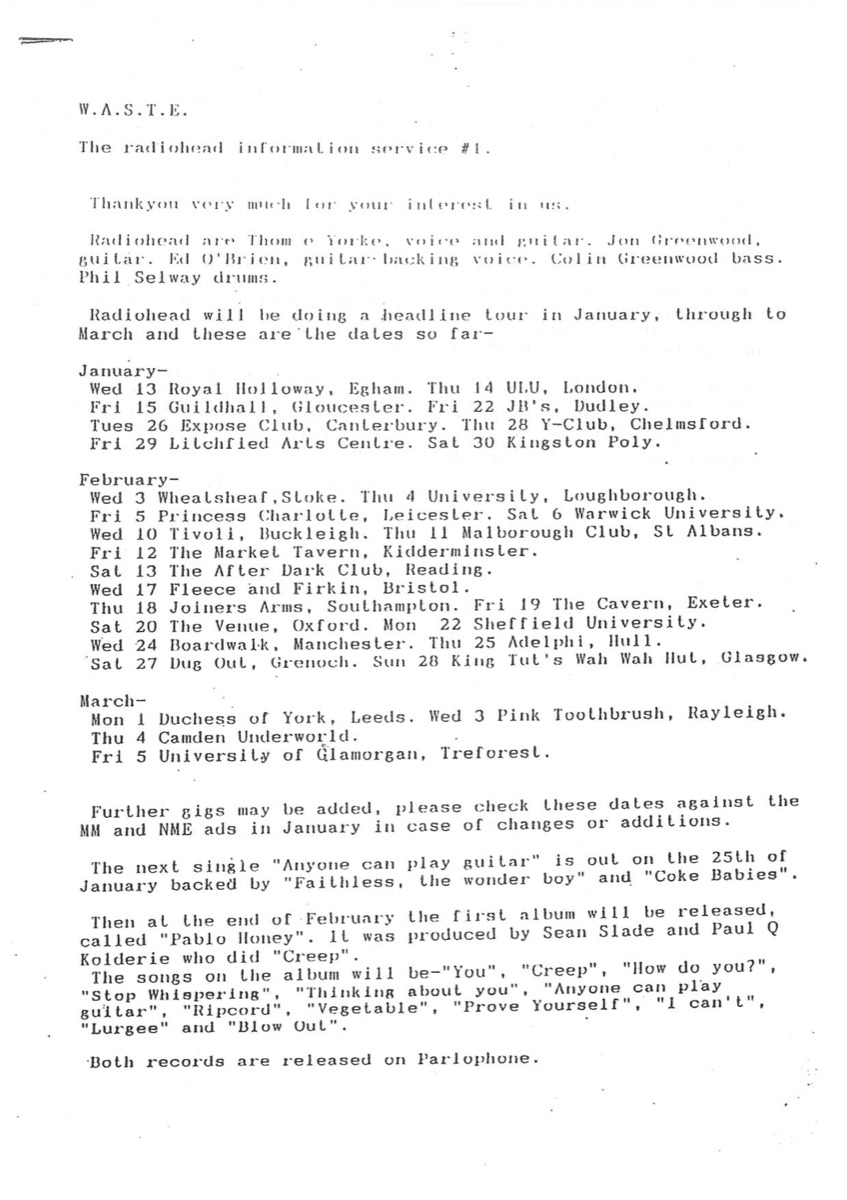
- Jan 1993P.O. Box 322, OxfordFirst mailing to fans names the album and its twelve songs
- 1 Feb 1993UK“Anyone Can Play Guitar” out; their first Top 40 single
- 22 Feb 1993UKParlophone releases the album on LP, cassette and CD
- 23 Feb 1993Maison de la Radio, ParisBlack Session, live on France Inter
- 20 Apr 1993United StatesCapitol releases it in America
- 7 Aug 1993United StatesPeaks at number 32 on the Billboard 200
1991–92
a deal and a flop
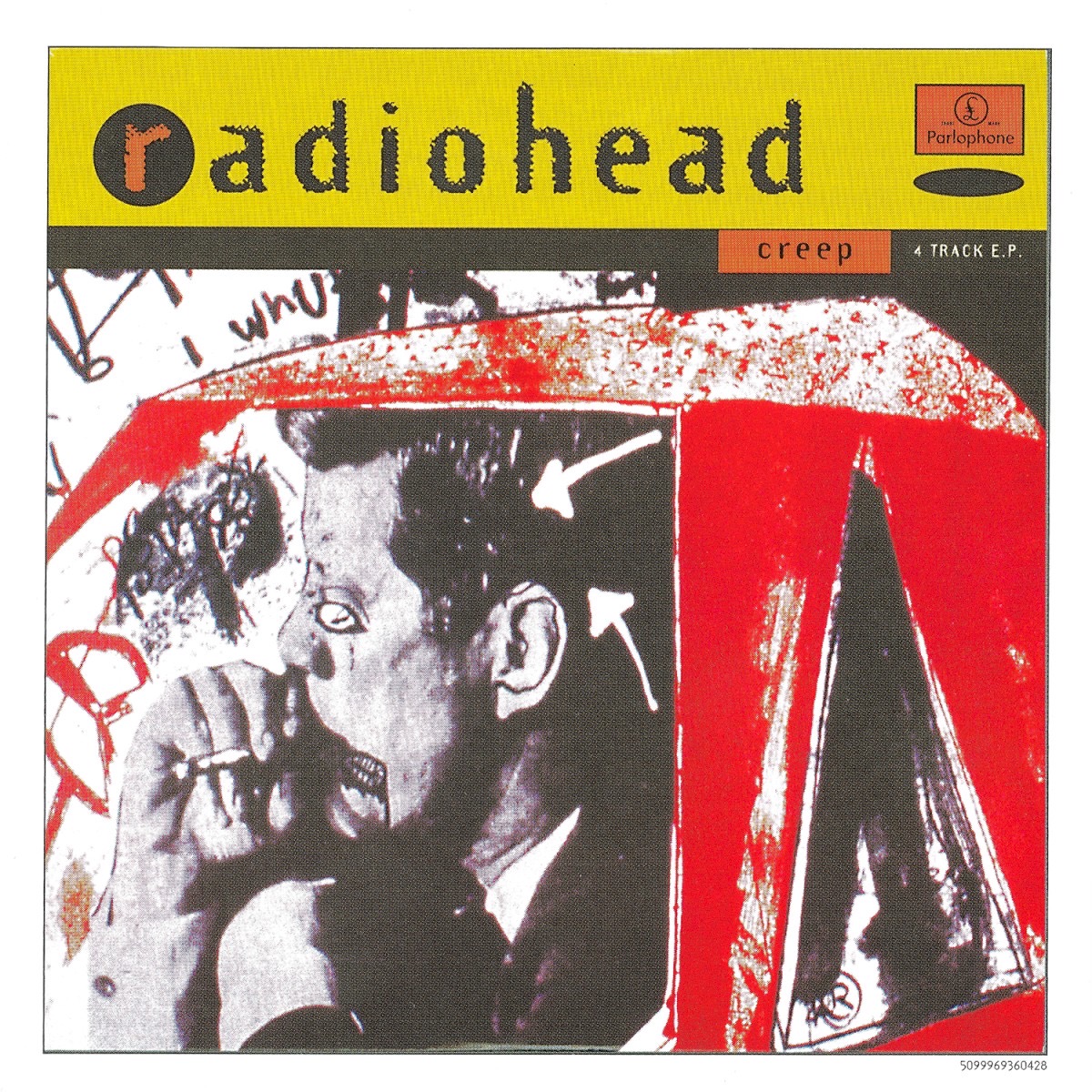
On a Friday signed a six-album deal with EMI at the end of 1991 and came out of it as Radiohead, on Parlophone. Their first release for EMI, the Drill EP in May 1992, was made with Chris Hufford, one of their two managers, at his Courtyard Studio in Oxfordshire. It reached number 101, and the first pressing ran to 3,000 copies of each format.
For the album Hufford and Bryce Edge wanted someone from outside. Steve Albini, who had made the Pixies' Surfer Rosa, was talked about, but he had not yet worked with a major act and EMI thought it too risky. The job went to Sean Slade and Paul Q. Kolderie, two American producers who had worked with the Pixies and Dinosaur Jr and happened to be in England looking for work. Kolderie came away from the first meeting more impressed by the managers than by the band.
summer 1992
chipping norton
EMI first sent the band to Chipping Norton Recording Studios, a residential studio in the Cotswolds, to make a single with Slade and Kolderie. The label wanted “Inside My Head” or “Lurgee”, and neither came right. What did come out of the room was “Creep”, played between takes, and once EMI had heard it the two Americans were kept on for the album.
The label's own biography of the band, sent out in the spring of 1993, says the album was made in three weeks in July 1992. Kolderie, in Mac Randall's book Exit Music, put the cost at more than £100,000, and said it was not an easy three weeks: the band knew little about studios and found it hard to call a track finished. The mixes, they insisted, had to have no reverb.
It was their first record and they wanted to be the Beatles.
paul kolderie · mojo, july 1997
Jonny Greenwood played the whole album, Guitar.com says, on one guitar: a tobacco-burst 1990 Telecaster Plus bought out of the EMI advance. It was stolen in Denver in 1995, along with Thom Yorke's Gibson SG and Ed O'Brien's Rickenbacker, which still had Pablo Honey stickers on it.
The tapes went back across the Atlantic to Fort Apache in Roxbury, Massachusetts, where Slade and Kolderie mixed them, and Chris Blair mastered the record at Abbey Road.
1991–92
the old songs
Five of the twelve songs were older than the record deal. “Creep” went back to Yorke's years at Exeter. “You”, “I Can't” and “Thinking About You” were on the Manic Hedgehog tape of October 1991, and “Stop Whispering” on an On a Friday demo from earlier that year. “You”, “Thinking About You” and “Prove Yourself” had already been on Drill and were recorded a second time. O'Brien later called the album “a collection of our greatest hits as an unsigned band”, and did not mean it kindly.
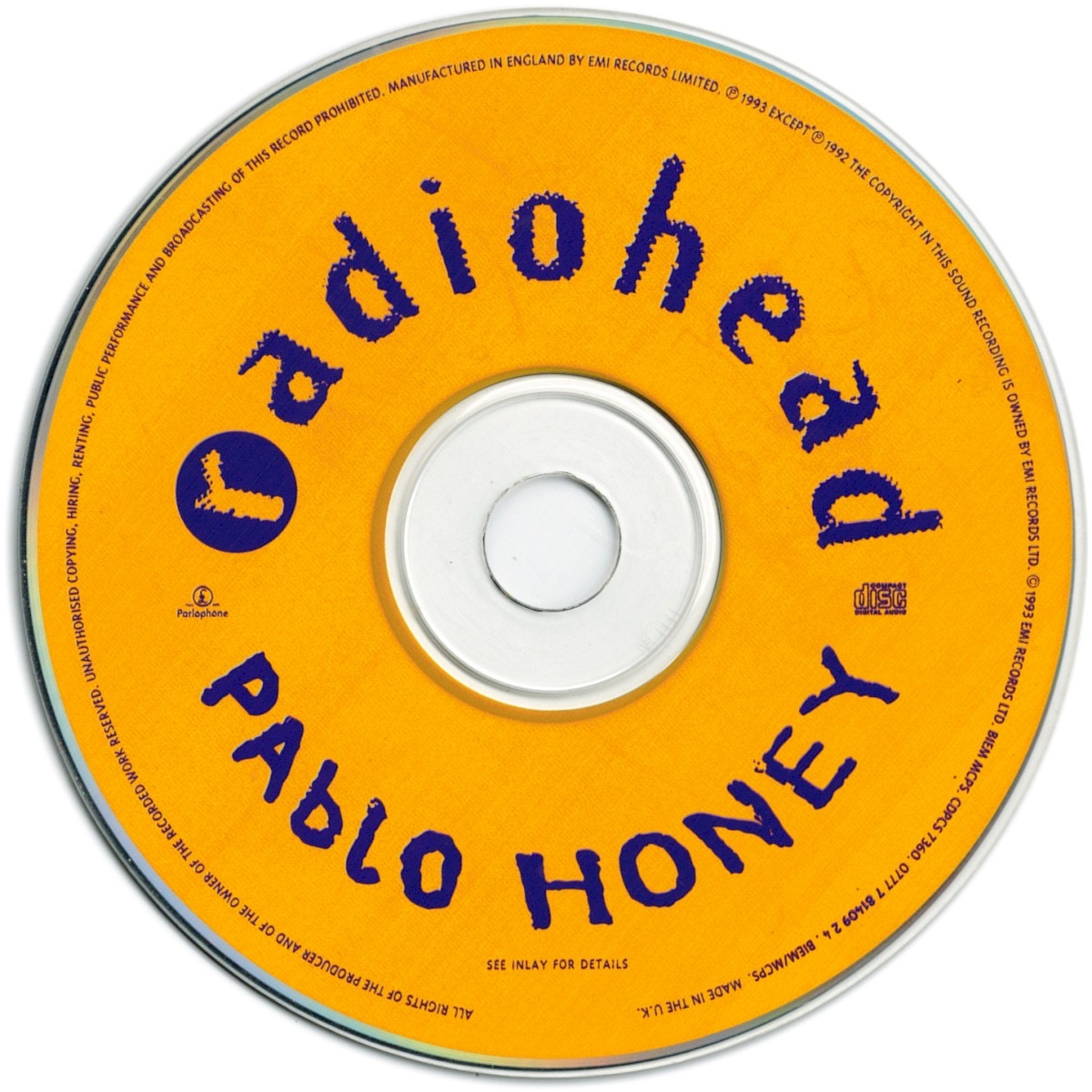
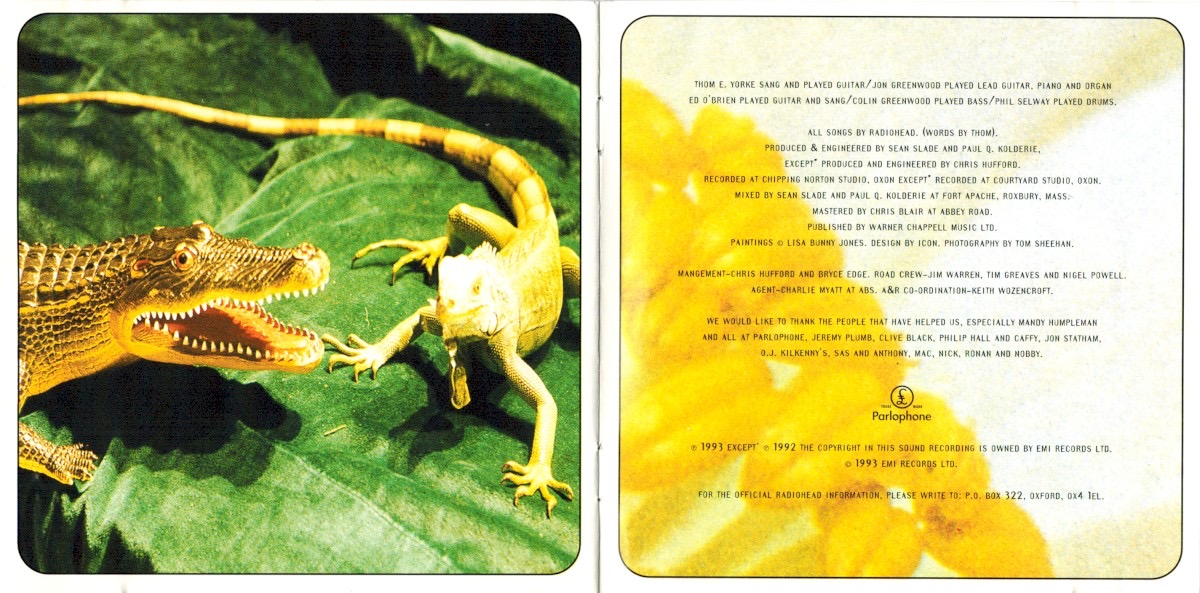
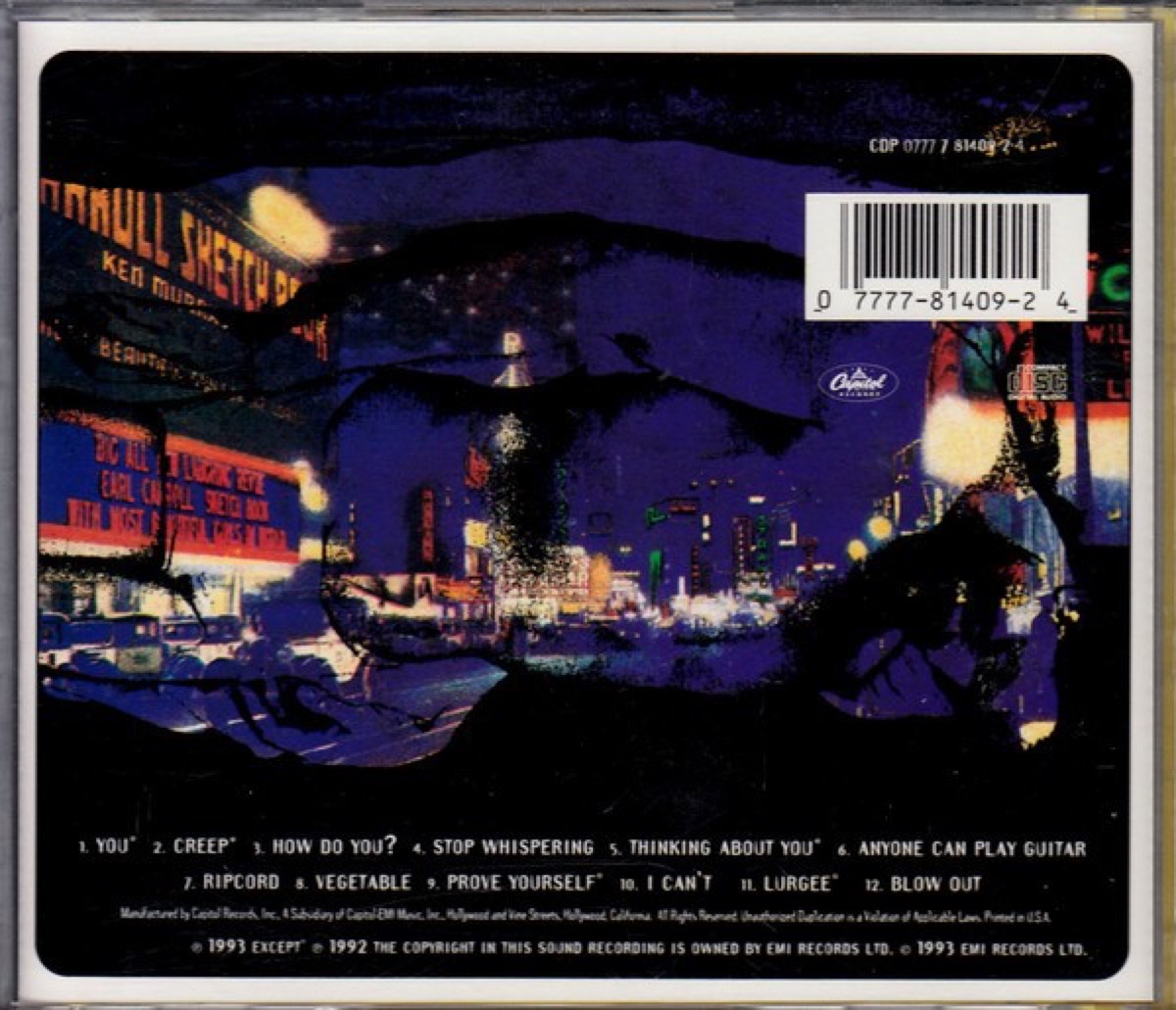
Two tracks never went near Chipping Norton. The booklet marks “I Can't” and “Lurgee” with an asterisk, produced and engineered by Hufford and recorded at Courtyard. The band had not liked the “Lurgee” they made with Slade and Kolderie, so they kept the one they already had, which had been on the back of “Creep” the previous September.
1993
pablo, honey
The Jerky Boys were two friends from Queens, Johnny Brennan and Kamal Ahmed, who made prank calls and taped them, and bootleg copies of the tapes were doing the rounds. Rolling Stone says it was Chapterhouse, another Thames Valley band, who passed one to Radiohead. The line the band took comes from a call in which one of the two, playing a muddled mother, moans “Pablo, honey? Please come to Florida.” Yorke said it suited a band of mothers' boys, and the sample turns up in “How Do You?”.
But the notion of phoning up people cold is so Nineties.
thom yorke · select, may 1993
1993
a baby in a flower
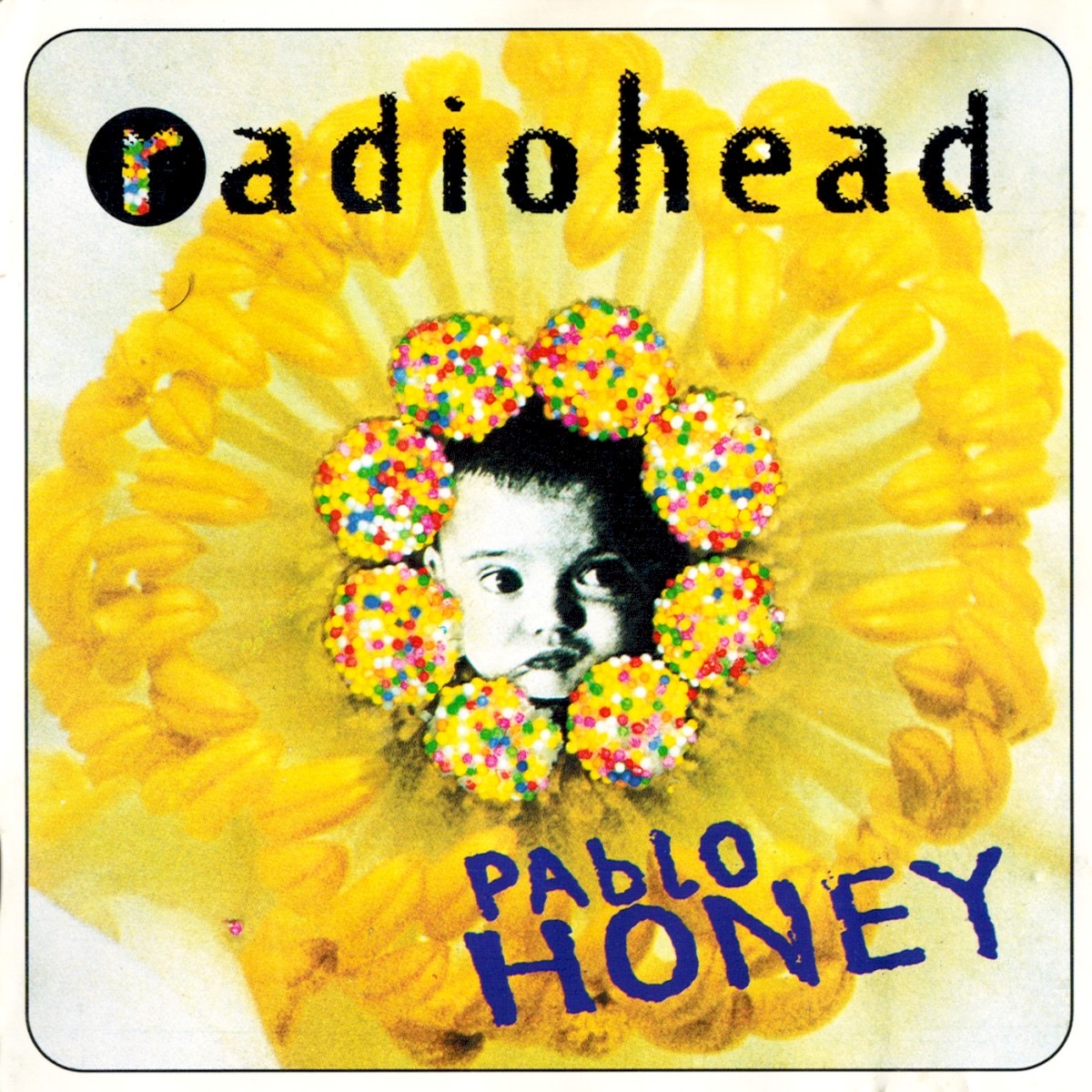
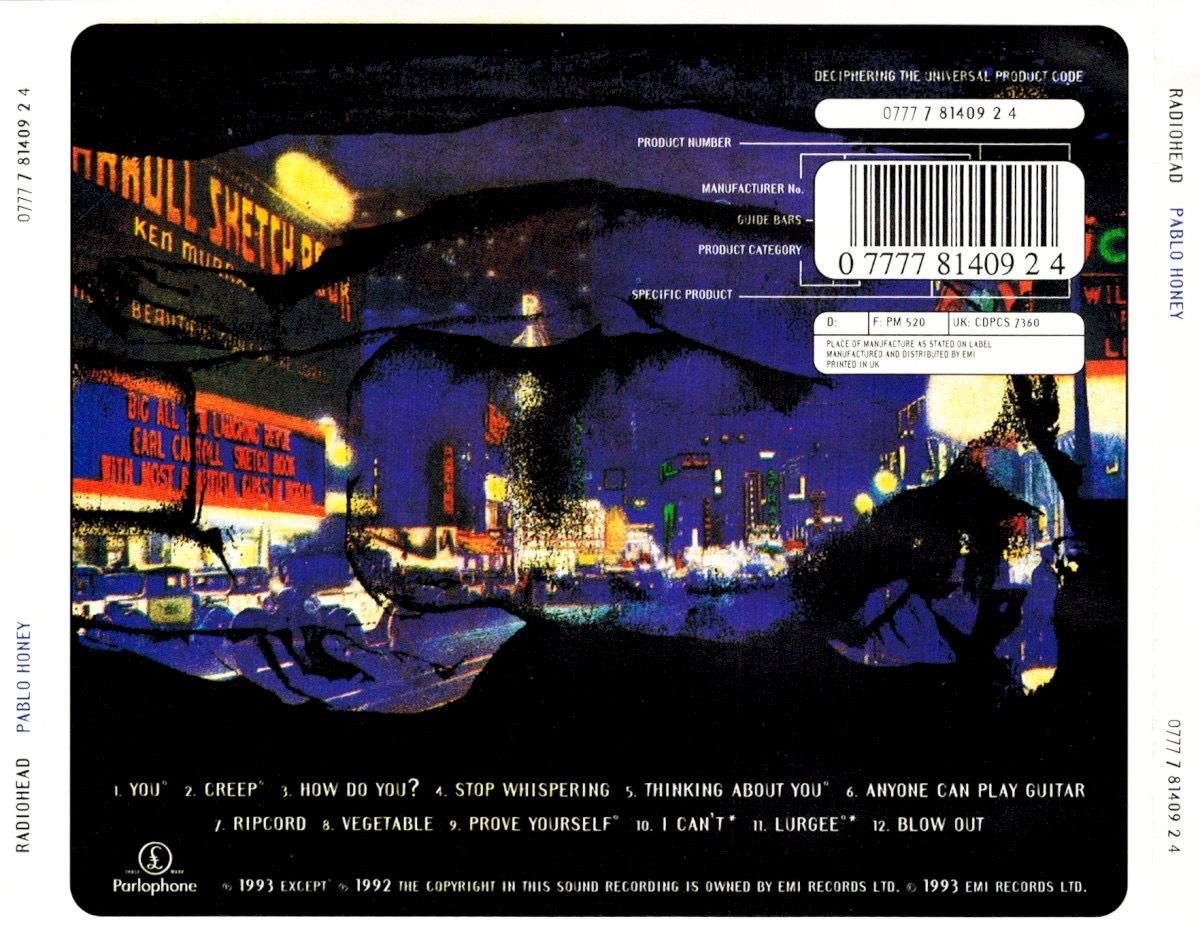
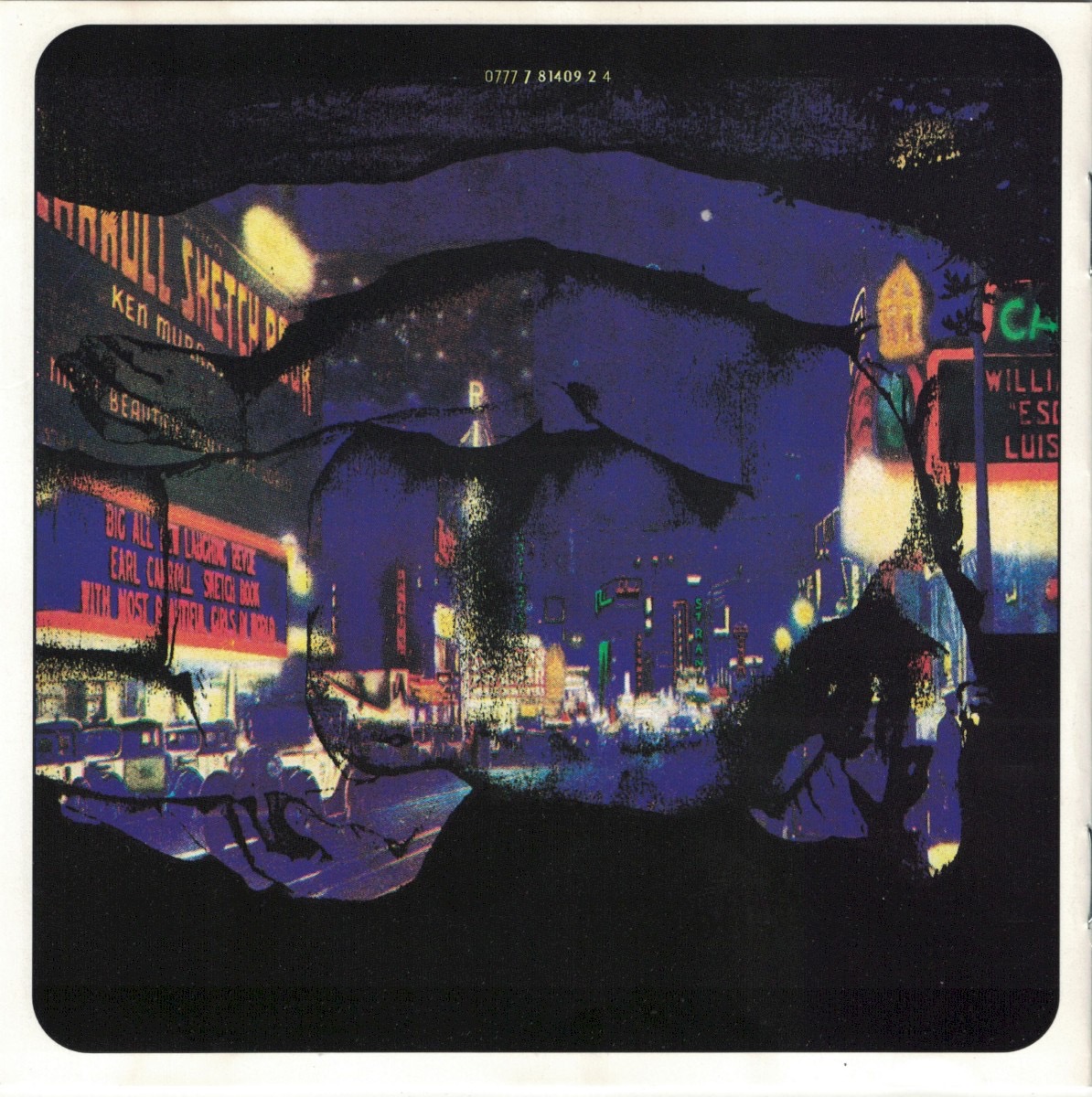
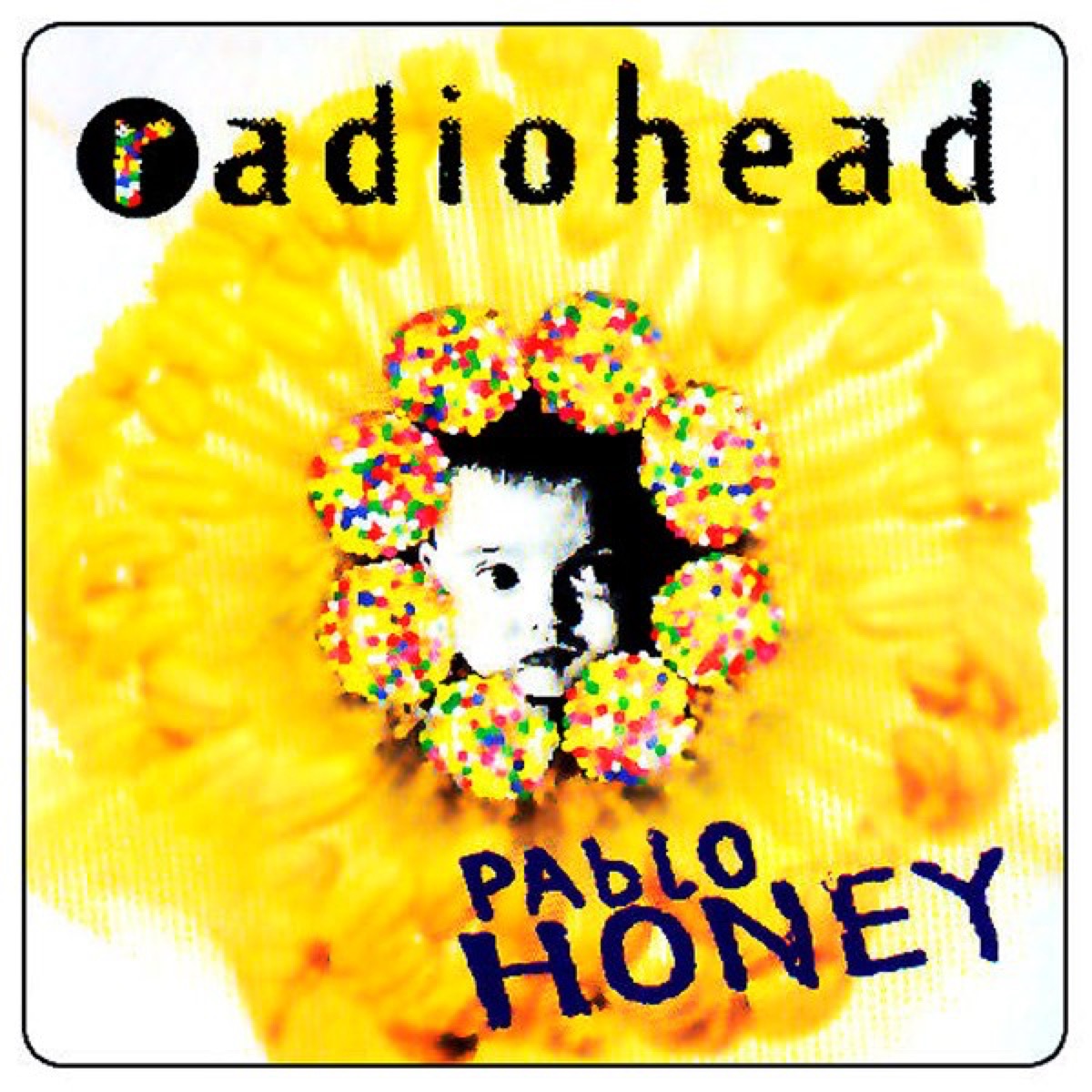
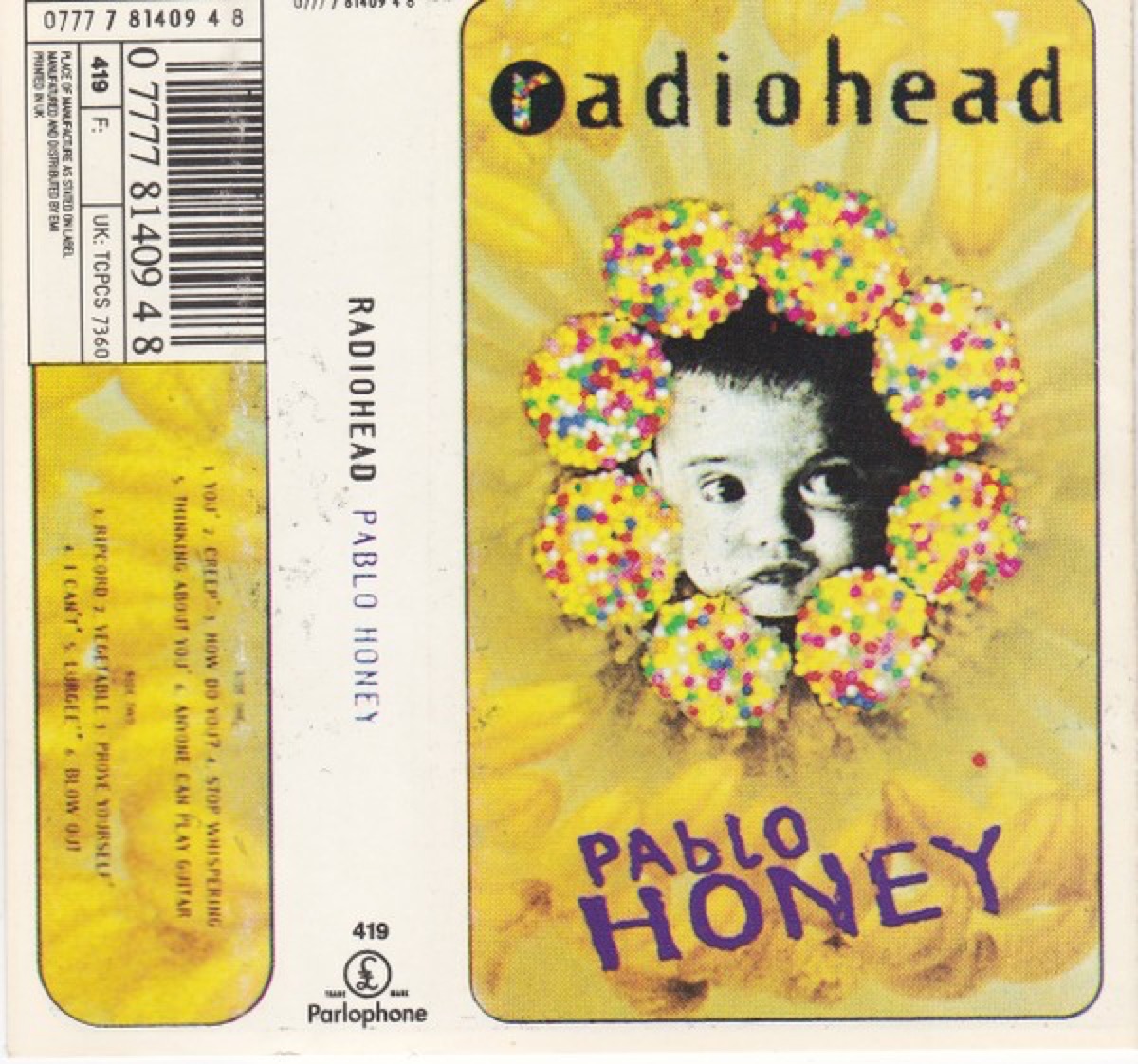
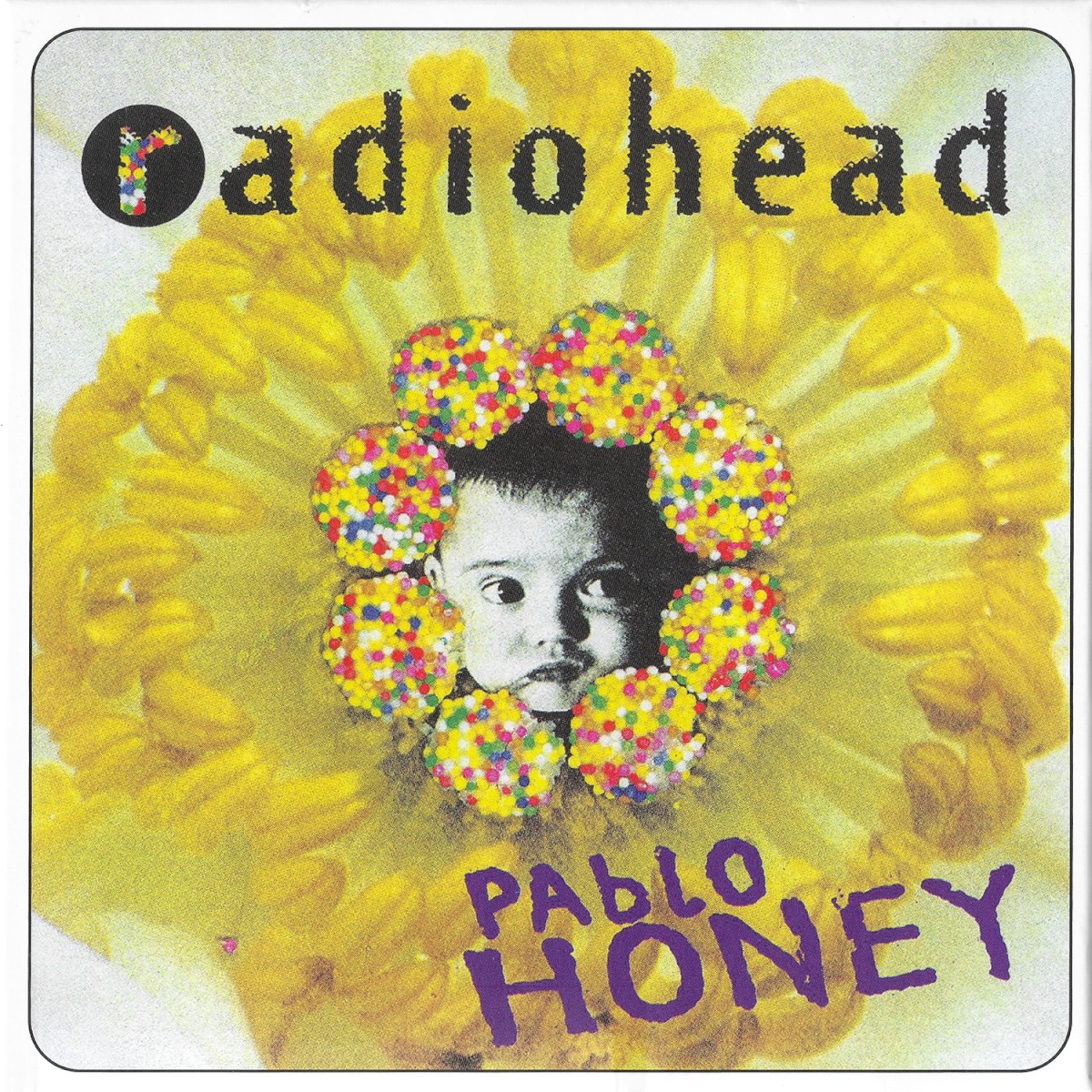
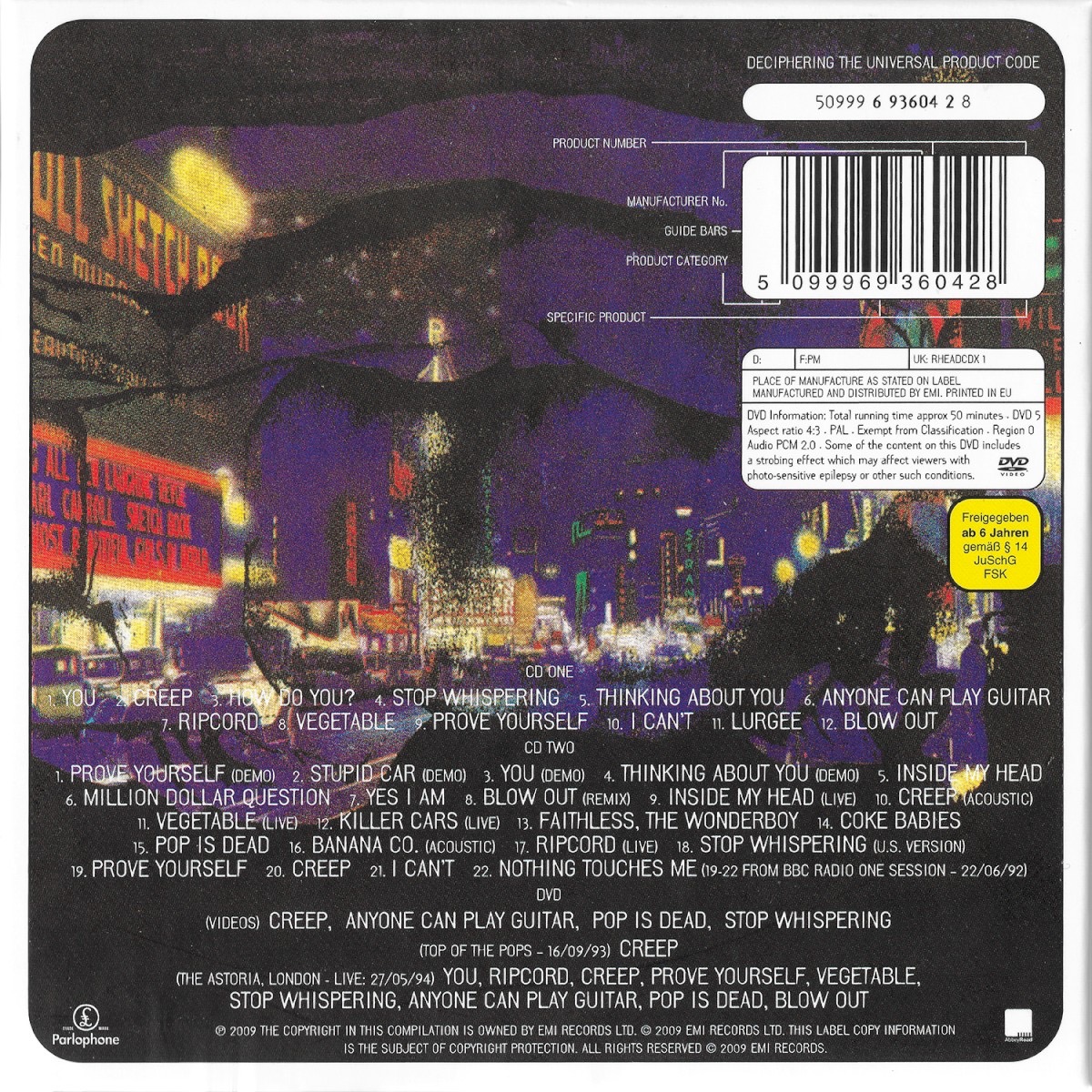
Parlophone's sleeve was put together by Icon, a design company, from paintings by Lisa Bunny Jones and photographs by Tom Sheehan. On the front a black-and-white baby looks out from the middle of a yellow flower, ringed by eight sweets rolled in hundreds and thousands. The band's name runs across the top in a ragged typeface, its “r” in a black circle and filled with the same sprinkles. On the back the titles sit under a night street of neon marquees, one of them for Earl Carroll's Sketch Book, half blacked out with paint.
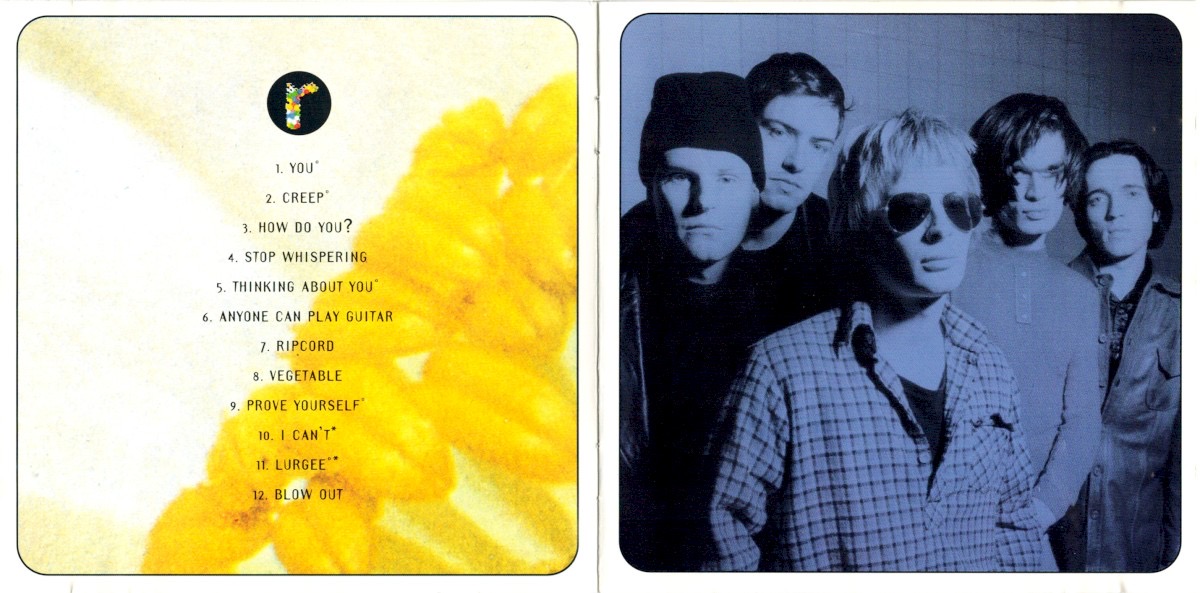
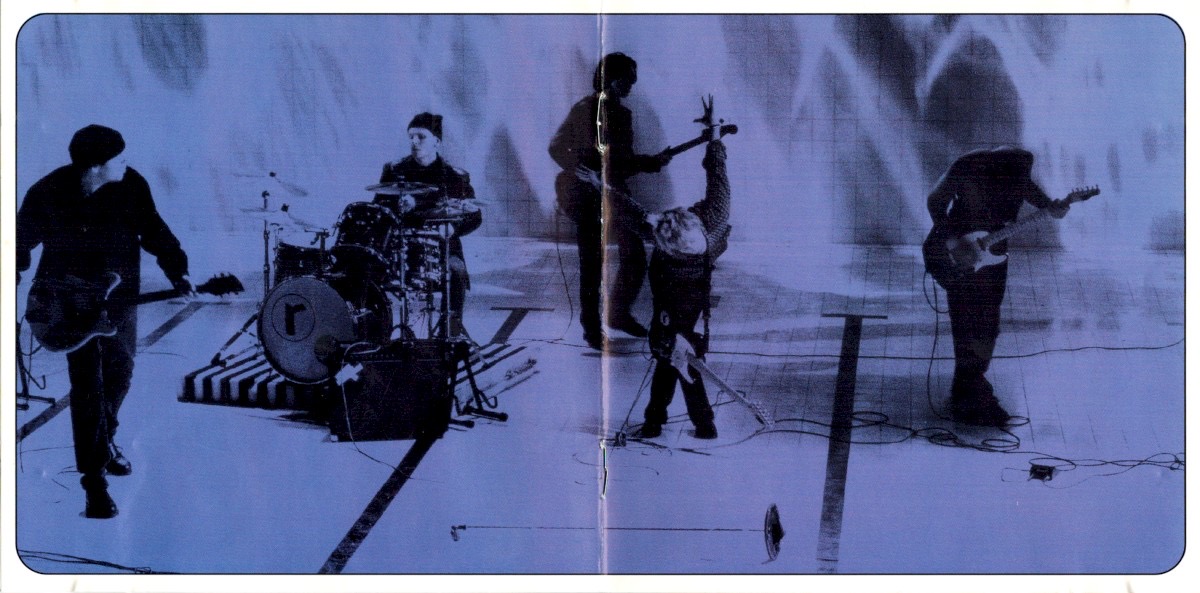
The eight-page booklet has the five of them washed blue against a tiled wall, the band on a bare painted floor with their gear, and a toy crocodile squaring up to a toy iguana on a leaf. The credits call the guitarist Jon Greenwood and the singer Thom E. Yorke, and the last line gives an address to write to: P.O. Box 322, Oxford.
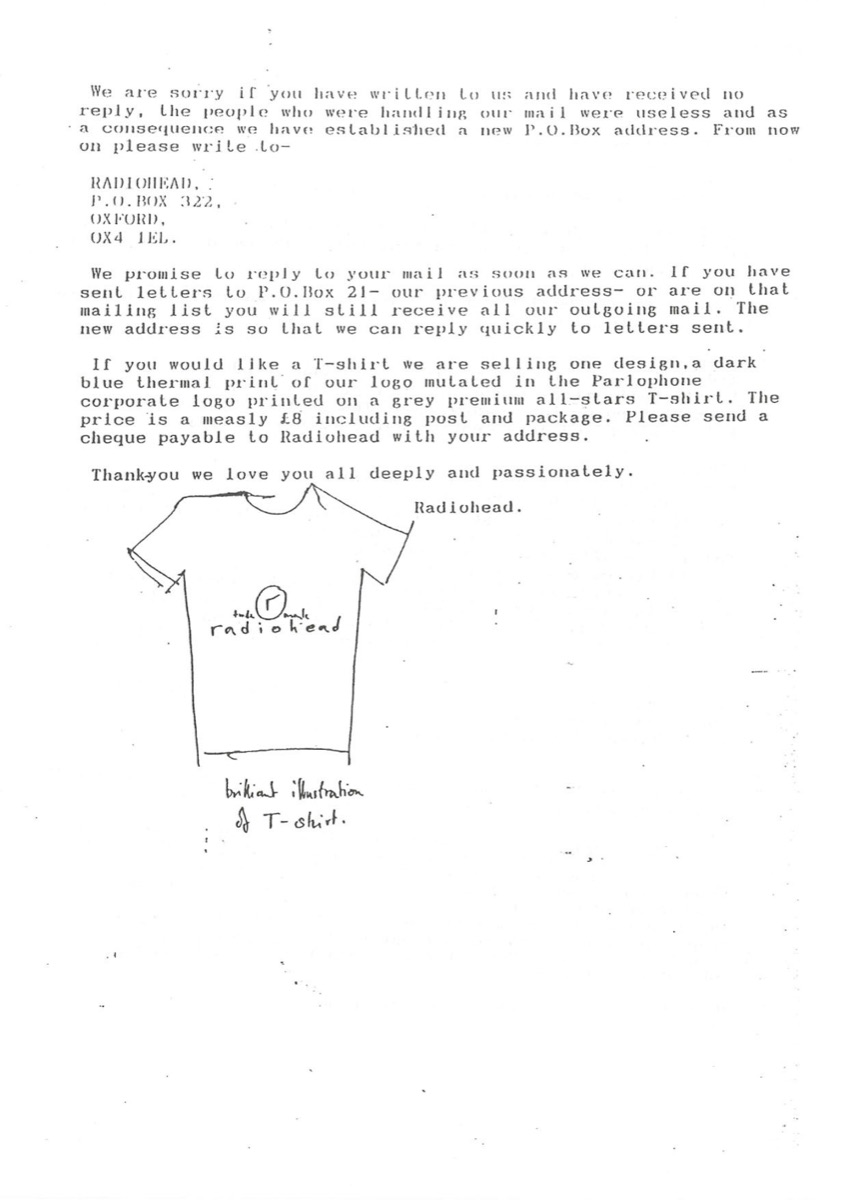
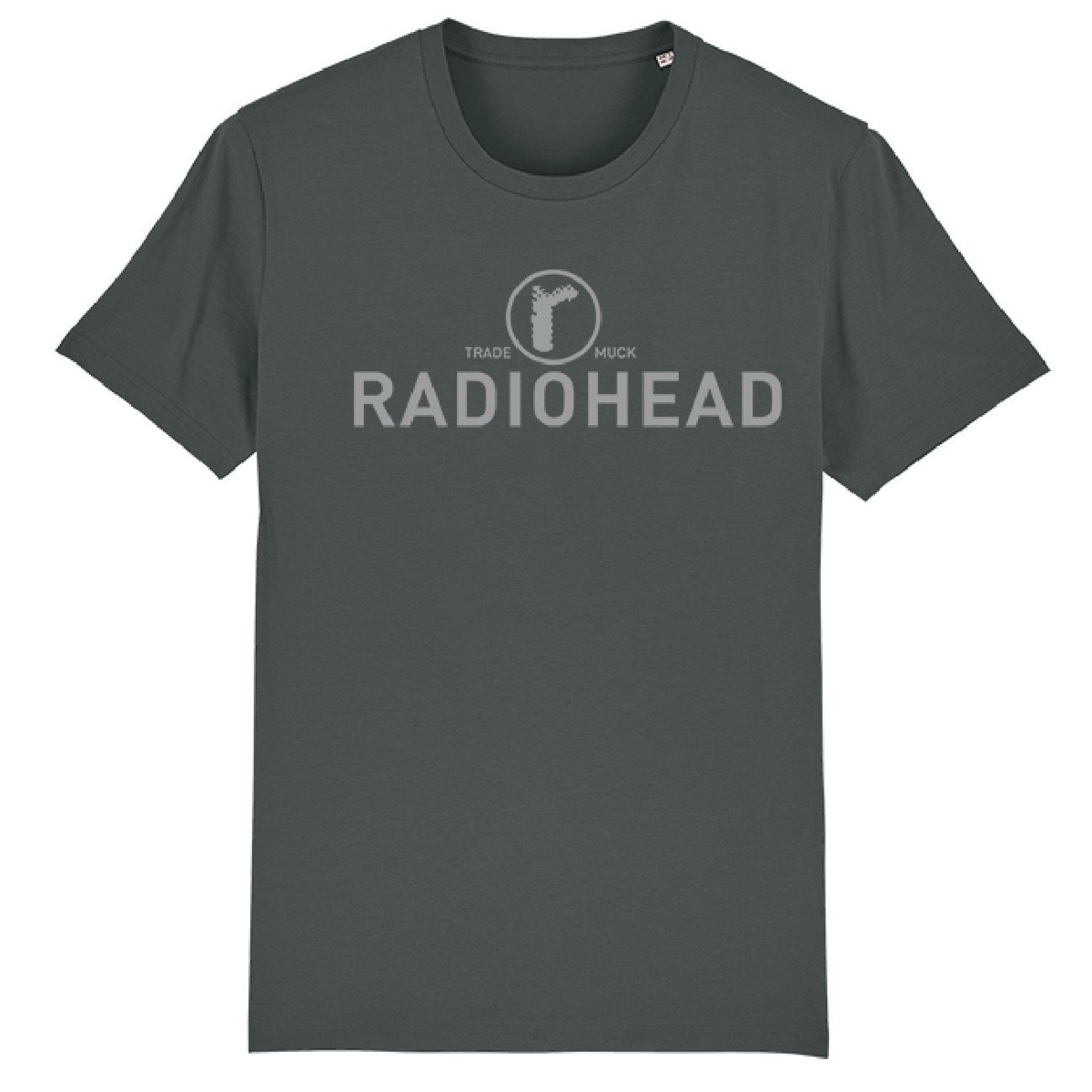
Yorke did not like it. He told The Art Newspaper in 2025 that the label had taken a generic approach to the art, and before the next album he rang Stanley Donwood, whom he knew from Exeter. The two of them have made the band's sleeves ever since. The band had already had their own go at the label's look: the first mailing to fans offered a T-shirt of the Radiohead logo crossed with Parlophone's, for £8 including post, with a pen drawing of it captioned “brilliant illustration of T-shirt”. The same logo, with trade muck where the trade mark should be, is in the Radiohead Public Library today.
feb–apr 1993
out on parlophone, then capitol
The mailing list heard first, in a typed sheet from the new P.O. box that listed the dates of the first headline tour and all twelve songs. Parlophone released Pablo Honey on 22 February 1993 on LP, cassette and CD, three weeks after “Anyone Can Play Guitar” had given the band their first Top 40 single. They played Sheffield University that night and a Black Session for France Inter in Paris the next day.
It went into the chart at number 25 on 6 March. EMI's count in the spring was about 20,000 copies. The next single, “Pop Is Dead” in May, was a new song and not on the album, and the band's second newsletter told fans to take it as a taste of things to come. It reached 42.
Capitol released the album in America on 20 April, three days after “Creep” went into Billboard's Modern Rock chart, and there the record had a hit to carry it. It entered the Billboard 200 on 29 May and peaked at 32 on 7 August. The Los Angeles Times put its American sales at 400,000 by the middle of August, and in October Melody Maker reported it gold. When Beavis and Butt-Head cheered the “Creep” video in an episode early in 1994, Capitol ran ads saying Beavis and Butt-Head said Radiohead didn't suck, and billed them as Oxford, England's rowdiest band. Platinum in America followed in September 1995.
Yorke was less sure of the place. On his second day of American press that spring he sat through an MTV interview he thought pointless until he asked the crew whether they got paid to do this, and he told Matt Ashare of the Boston Phoenix that the album had lots of faults. The same trip put the band on KROQ's Loveline in Los Angeles, answering callers' problems, and the fourth newsletter joked that the station's ratings fell as a result.
1993
the notices
The NME and Melody Maker reviewed it on the same day, 20 February, two days before it was in the shops. John Harris gave it seven out of ten in the NME. He was hard on “How Do You?”, and found that the old songs the band had recycled, which looked cynical, made the best moments on the record. His last line was that Radiohead were getting there. Q and Select gave it three out of five. Pippa Lang, who had seen them at Kingston Polytechnic in January, gave it a warm notice in Metal Hammer, of all places, and heard Bono in Yorke on “How Do You?”. By December the NME had it 35th in its albums of the year.
America wrote more about “Creep” than about the album. Marisa Fox in Entertainment Weekly rated “Creep” the last word in neurotic teen anthems, gave the album a B, and quoted the Jim Morrison line from “Anyone Can Play Guitar” back at Yorke.
You mean Morrissey.
marisa fox · entertainment weekly, 14 may 1993
Mario Munoz, in the Los Angeles Times, gave it two and a half stars out of four and heard too much of the Smiths and the Cure, though he rated “Creep” among the catchiest singles of the year. Robert Christgau in the Village Voice did not recommend the album and picked out “Creep” as its one cut worth having. Rolling Stone's Paul Evans got round to it in the year-end issue and thought the band worth watching, if their attitude did not sink them first.
1993–94
on the road
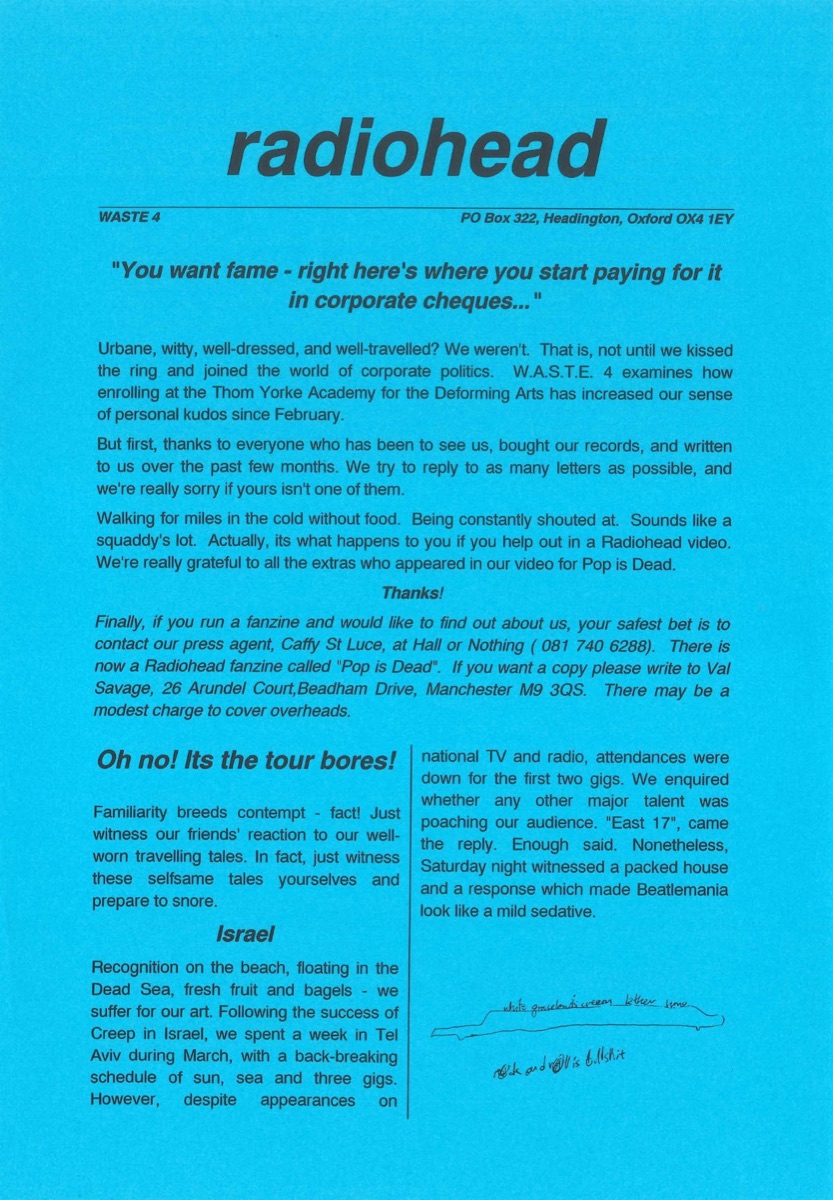
They toured it for most of two years. The first headline tour of Britain started in January; in March, with “Creep” a hit on Israeli radio, they spent a week in Tel Aviv and played three nights, the first two thin and the last packed. In June the fourth issue of W.A.S.T.E., the newsletter the band wrote themselves, opened by sending up how far they had come since February.
Urbane, witty, well-dressed, and well-travelled? We weren't.
radiohead · w.a.s.t.e. 4, june 1993
America started at Venus de Milo in Boston on 22 June. A sore throat took Yorke out of the Reading Festival in August. The reissued “Creep” went to number seven at home in September, when Yorke put the year's gigs at about 100, enough to turn them from amateurs into a working band. In the autumn they went back to America with Belly, drawing 3,000 to Roseland in New York, and turned down a support slot with Duran Duran; the year closed with five weeks opening for James. Kolderie credited the Pablo Honey tours for making them tight.
I like the first album, but we were very naïve. We didn't really know how to use the studio.
thom yorke · melody maker, 1993
“Creep” was up for Best British Single at the Brit Awards in February 1994 and lost to Take That. The album's last big night was the London Astoria on 27 May 1994, filmed by EMI and released on video the next year, by which time nearly half the set was songs that would be on The Bends.
1995–2026
talked down
The band have rarely had a good word for it. In 1997 O'Brien told Select they had been “in hock to Dinosaur Jr. and the Pixies up to our eyeballs”. Hufford said the band had never been happy with it, and called it “a snapshot of them developing”. In 2020 O'Brien called it “pretty shit apart from one song”, and in 2026 he told Uncut that without “Creep” EMI would very likely have dropped them.
We weren't that good but we worked hard and became good.
ed o'brien · the face, 6 february 2020
Their verdict is harder than the record deserves. John Harris had the measure of it in February 1993, when he found the old songs the best things on it, “Thinking About You” above all, and the band plainly on their way. In February 1998, with OK Computer sending new listeners back to the start, it reached its best British chart placing, 22, and Q's poll that month put it 61st among the greatest albums ever made. Pitchfork's line in 2007 was that Radiohead had stumbled into success on grunge's coattails and spent years saying sorry for it.
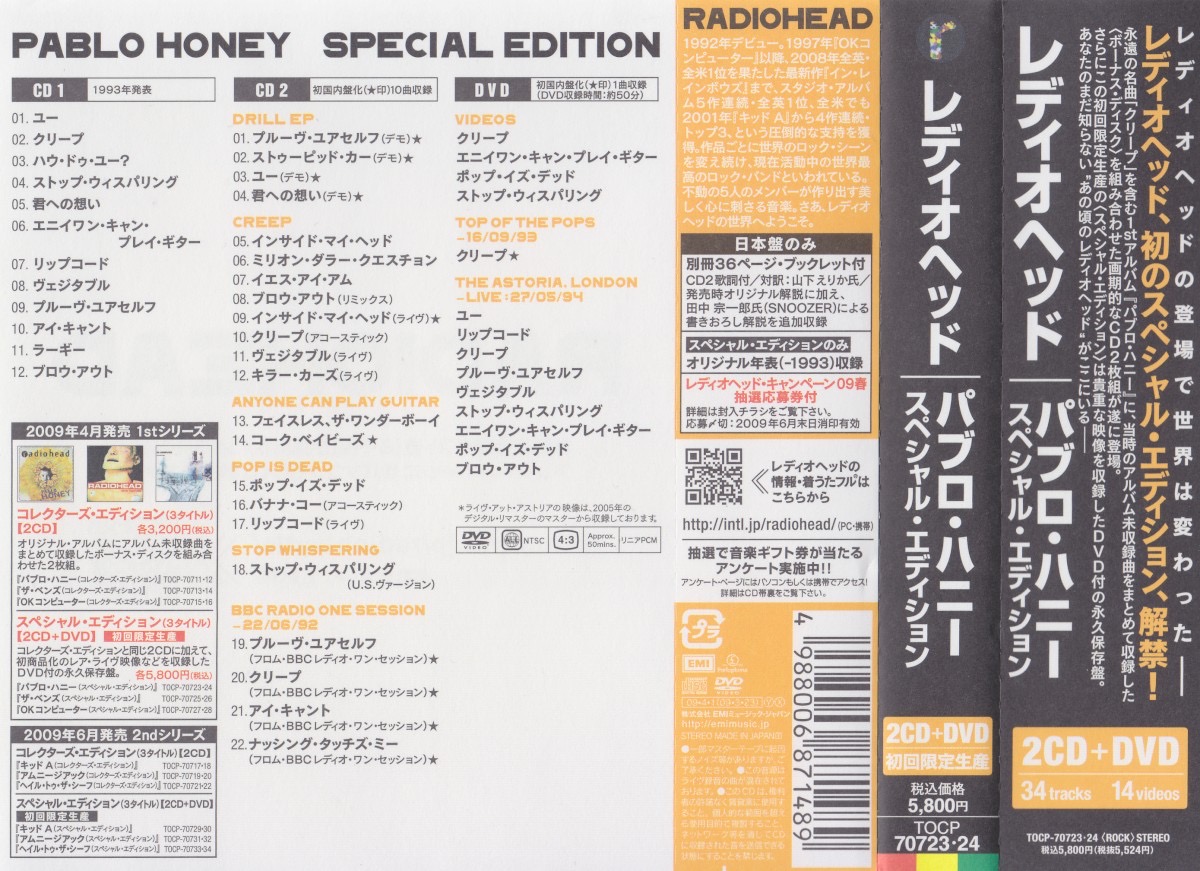
EMI boxed it with the rest of the Parlophone albums in 2007, after the band had left. In 2009 it came back as a Collector's Edition, with Drill, the B-sides, a 1992 Radio 1 session and, in the three-disc set, the videos and the Pablo Honey half of the Astoria show; the band had no say and nothing was remastered. Since 2016 it has come out on XL. In February 2025 O'Brien told Folha de S.Paulo that takes left off the record had turned up.
In April 2005 Britney Spears was photographed buying a copy.
on film
A long interview with Paul Kolderie, the album's co-producer, on Radiohead and the Pixies.· Daniel Swatch on youtube →
videos(7)
the sleeve
the booklet (4)
the art and the editions
the press
the press release
from W.A.S.T.E. · Radiohead
dated jan 1993
Then at the end of February the first album will be released, called “Pablo Honey”. It was produced by Sean Slade and Paul Q Kolderie who did “Creep”.
the reviews
7/10
NME
John Harris · 20 feb 1993
read it →a satisfying portion of this album gives out a very warm glow
no mark
Melody Maker
Simon Price · 20 feb 1993
read it →3/5
Q
apr 1993
no mark
Metal Hammer
Pippa Lang · apr 1993
read it →Radiohead are the way forward. Follow the signs.
B
Entertainment Weekly
Marisa Fox · 14 may 1993
read it →You mean Morrissey.
2.5/4
Los Angeles Times
Mario Munoz · 27 jun 1993
read it →doesn't really deliver anything you haven't heard before
no mark
The Village Voice
Robert Christgau · 1993
read it →no mark
Rolling Stone
Paul Evans · 23 dec 1993
read it →If they don't implode from attitude overload, Radiohead warrant watching.
later
- looking backAllMusic · Stephen Thomas Erlewine 3/5a rare power that is both visceral and intelligentread →
- looking backBBC Music · Al Spicer · 2008this remains one of rock's most impressive debutsread →
- looking backPitchfork · Scott Plagenhoef · 16 apr 2009 5.4“Creep” has oddly gotten better with ageread →
- looking backRolling Stone · Will Hermes · 30 apr 2009The grungy, glammy Brit pop of Pablo Honey (1993) was a worthy debutread →
- looking backClash · 22 feb 2013Their debut album points towards everything that they would go on to beread →
- looking backVice · Phil Witmer · 22 feb 2018a great band unleashing that greatness in fits and spurtsread →
- on the listsQ · feb 1998The 100 Greatest Albums in the Universe, no. 61
sources24
- Pablo Honey CD booklet and inlay, Parlophone CDPCS 7360, 1993 (studios, producers, Fort Apache mix, Abbey Road mastering, the Courtyard asterisks, the design credits, the names and the P.O. box), seen in Cover Art Archive scans of the first British pressing.
- Hall Or Nothing, Radiohead biography and discography, January 1996, and Pat Gilbert, Record Collector, November 1996, both summarised in this site's news archive (the Drill chart place and pressing).
- Mac Randall, Exit Music: The Radiohead Story, Omnibus, 2011, and Jim Irvin, “We have lift-off!”, Mojo, July 1997, as cited by Wikipedia, “Pablo Honey” (Albini, Slade and Kolderie's arrival, the managers, the failed single session, the £100,000, the reverb, the Courtyard “Lurgee”; not checked against the originals).
- Gary Walker, “The Genius Of… Pablo Honey by Radiohead”, Guitar.com, 15 February 2023 (Kolderie's Beatles line from Mojo, the £100,000, Greenwood's Telecaster and the Denver theft, Duran Duran, Q's 1998 placing).
- EMI, Radiohead band biography, spring 1993, Internet Archive scan (three weeks in July 1992, the chart entry and 20,000 copies).
- Jordan Runtagh, “Radiohead's ‘Pablo Honey’: 10 Things You Didn't Know”, Rolling Stone, 22 February 2018 (the Jerky Boys tape and Chapterhouse, Yorke in Select and on the naive first album in Melody Maker, O'Brien's “greatest hits” and Select 1997 lines, the On a Friday songs, Capitol's Beavis and Butt-Head campaign).
- David Cavanagh, “It's for you, Jerky!”, Select, May 1993, as cited in the earlier version of this story (the mothers' boys).
- Anny Shaw, “‘It was absolutely terrifying’: Thom Yorke on his long journey back to becoming a visual artist”, The Art Newspaper, 5 August 2025 (Yorke on the sleeve and the call to Donwood).
- W.A.S.T.E., “The radiohead information service #1”, early 1993, and W.A.S.T.E. 2 and 4, 1993, in the Radiohead Public Library (the announcement, the T-shirt and its drawing, “Pop Is Dead”, Tel Aviv, Loveline, the quote).
- Parlophone promotional postcard for Pablo Honey, 1993, and Music Week, 20 February 1993, p. 29 (the release date and formats, Sheffield and the Black Session).
- Official Charts Company, Pablo Honey and “Creep” chart runs (25 on the chart of 6 March 1993; best placing 22, February 1998; “Creep” at 7 in September 1993).
- Billboard, Radiohead chart history, Billboard 200 and Alternative Airplay (entry 29 May, peak of 32 on 7 August 1993; “Creep” in the Modern Rock chart from 17 April); RIAA, gold and platinum database (platinum, September 1995).
- Steve Hochman, Los Angeles Times, 15 August 1993 (400,000 copies); Dave Jennings, “Creepshow”, and Paul Lester, “From The Bedroom To The Universe”, Melody Maker, 25 September and 23 October 1993 (about 100 gigs, gold, Roseland).
- John Harris, “Glow Frequency Band”, NME, 20 February 1993, clipping scan on the Internet Archive; Simon Price, Melody Maker, 20 February 1993, Rock's Backpages.
- Wikipedia, “Pablo Honey” (the Q and Select scores of April 1993, the NME's albums of 1993, Kolderie on the tours; tertiary).
- Pippa Lang, review, Metal Hammer, April 1993, Internet Archive scan; Matt Ashare, “Brit grit”, The Boston Phoenix, 21–27 May 1993, as summarised in this site's news archive (MTV and the faults).
- Marisa Fox, “Pablo Honey”, Entertainment Weekly, 14 May 1993, Wayback copy; Mario Munoz, “In Brief”, Los Angeles Times, 27 June 1993; Robert Christgau, Consumer Guide, robertchristgau.com; Paul Evans, “Pablo Honey”, Rolling Stone, 23 December 1993.
- This site's news archive: the Tel Aviv shows (April 1993), Boston (22 June 1993), Reading (W.A.S.T.E. 5), James (December 1993), the Brit Awards (14 February 1994), the Astoria (27 May 1994).
- Clash, “Classic Albums: Radiohead - Pablo Honey”, 22 February 2013 (Hufford's verdict).
- Craig McLean, “Radiohead guitarist Ed O'Brien steps up”, The Face, 6 February 2020, Wayback copy (the quote).
- Sam Roche, Guitar.com, 24 April 2026, on Sam Richards's interview with O'Brien in Uncut, June 2026 (dropped without “Creep”).
- Joshua Klein, review of Jonny Greenwood Is the Controller, Pitchfork, 26 February 2007 (the coattails).
- This site's news archive on the 2007 EMI box (5 November 2007), the 2009 Collector's Editions (Pitchfork, Uncut, Drowned in Sound), the move to XL (4 April 2016) and O'Brien in Folha de S.Paulo (18 February 2025).
- treefingers.com desk, 29 April 2005, after Heather Huff, Earvolution, 28 April 2005 (Britney Spears).